QUESTION 1 If we run the following code: A a = new A(1); B b =...
QUESTION 1
-
If we run the following code:
A a = new A(1);
B b = new B(2);
System.out.println(b);Select all of the following pieces of code that would compile and run with no errors, printing the value of 1 followed by the value of 2, each on separate lines.
A. public class A {
private int y;
public A(int y) {
this.y = y;
}
public int getY() {
return y;
}
public String toString() {
return "" + y;
}
}public class B extends A {
private int x;
public B(int x) {
this.x = x;
}
public String toString() {
return super.toString() + "\n" + x;}
}B. public class A {
private int y;
public A(int y) {
this.y = y;
}
public int getY() {
return y;
}
public String toString() {
return "" + y;
}
}public class B extends A {
private int x;
public B(int x) {
this.x = x;
}
public String toString() {
return "" + y + "\n" + x;}
}C. public class A {
protected int y;
public A(int y) {
this.y = y;
}
public int getY() {
return y;
}
public String toString() {
return "" + y;
}
}public class B extends A {
private int x;
public B(int x) {
this.x = x;
}
public String toString() {
return "" + y + "\n" + x;}
}D. public class A {
private int y;
public A(int y) {
this.y = y;
}
public int getY() {
return y;
}
public String toString() {
return "" + y;
}
}public class B extends A {
private int x;
public B(int x) {
this.x = x;
}
public String toString() {
return "" + x + "\n" + super.toString();}
}E. public class A {
private int y;
public A(int y) {
this.y = y;
}
public int getY() {
return y;
}
public String toString() {
return "" + y;
}
}public class B extends A {
private int x;
public B(int x) {
this.x = x;
}
public String toString() {
return "" + getY() + "\n" + x;}
}
QUESTION 2
-
Why did you choose the answer you did in Question 1? Explain your thinking as clearly as possible.
Homework Answers
1)  None of these

2)
Explanation:
-------------
All of these choices have no default constructor in class A(The constructor which takes no arguments)
In all these choices class B extends class A.
and It is important that the class B's constructor must call the parameterized constructor of class A, because there is no default constructor of class A.
but none of these choices, call the constructor of class A using super keyword in class B's constructor.
That's the reason why none of these options compile correctly.
For Questions 1-3: consider the following code: public class A { private int number; protected String...
For Questions 1-3: consider the following code: public class A { private int number; protected String name; public double price; public A() { System.out.println(“A() called”); } private void foo1() { System.out.println(“A version of foo1() called”); } protected int foo2() { Sysem.out.println(“A version of foo2() called); return number; } public String foo3() { System.out.println(“A version of foo3() called”); Return “Hi”; } }//end class A public class B extends A { private char service; public B() { super(); System.out.println(“B() called”);...
For Questions 1-3: consider the following code: public class A { private int number; protected String...
For Questions 1-3: consider the following code: public class A { private int number; protected String name; public double price; public A() { System.out.println(“A() called”); } private void foo1() { System.out.println(“A version of foo1() called”); } protected int foo2() { Sysem.out.println(“A version of foo2() called); return number; } public String foo3() { System.out.println(“A version of foo3() called”); Return “Hi”; } }//end class A public class B extends A { private char service; public B() { super(); System.out.println(“B() called”); } public...
What is wrong with this Code? Fix the code errors to run correctly without error. There...
What is wrong with this Code? Fix the code errors to run correctly without error. There are four parts for one code, all are small code segments for one question. public class StudentTest { public static void main(String[] args){ // Part Time Student Test Student ft1 = new PartTimeStudent("George", "Bush", "123-12-5678", 1, 2 ); System.out.println(ft1); Student ft2 = new PartTimeStudent("Abraham", "Lincoln", "001-90-5323", 6, 22 ); System.out.println(ft2); // Full Time Student Test Student pt1 = new FullTimeStudent("Nikola", "Tesla", "442-00-0998", 8, 26...
public class Point f private int x; private int y; public Point(int x, int y) this.x...
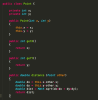 public class Point f private int x; private int y; public Point(int x, int y) this.x X; this.y y; public int getX() return x; public int getY() return Y: public double distance (Point other) double dx this.x-other.x; double dy this.y-other.y double dist Math.sqrt(dx dx + dy dy); return dist;
The method m() of class B overrides the m() method of class A, true or false?...
 The method m() of class B overrides the m() method of class A, true or false? class A int i; public void maint i) { this.is } } class B extends A{ public void m(Strings) { 1 Select one: True False For the following code, which statement is correct? public class Test { public static void main(String[] args) { Object al = new AC: Object a2 = new Object(); System.out.println(al); System.out.println(a): } } class A intx @Override public String toString()...
In Java Create a testing class that does the following to the given codes below: To...
In Java Create a testing class that does the following to the given codes below: To demonstrate polymorphism do the following: Create an arraylist to hold 4 base class objects Populate the arraylist with one object of each data type Code a loop that will process each element of the arraylist Call the first ‘common functionality’ method Call the second ‘common functionality’ method Call the third ‘common functionality’ method Verify that each of these method calls produces unique results Call...
What is wrong with this Code? Fix the code errors to run correctly without error. There...
What is wrong with this Code? Fix the code errors to run correctly without error. There are seven parts for one code, all are small code segments for one question. All the 'pets' need to 'speak', every sheet of code is connected. Four do need need any Debugging, three do have problems that need to be fixed. Does not need Debugging: public class Bird extends Pet { public Bird(String name) { super(name); } public void saySomething(){} } public class Cat...
CONVERT THIS JAVA CODE WITH THE JAVA DOC GUIDELINES WHERE APPROPRIATE. DO NOT CHANGE THE CODE....
CONVERT THIS JAVA CODE WITH THE JAVA DOC GUIDELINES WHERE APPROPRIATE. DO NOT CHANGE THE CODE. SAME CODE SHOULD BE USED FOR THE DOCUMENTATION PURPOSES. ONLY INSERT THE JAVA DOC. //Vehicle.java public class Vehicle { private String manufacturer; private int seat; private String drivetrain; private float enginesize; private float weight; //create getters for the attributes public String getmanufacturer() { return manufacturer; } public String getdrivetrain() { return drivetrain;...
Java help: 1.1) Create a class TA that extends class Student. 1.2) Add a variable to the...
Java help: 1.1) Create a class TA that extends class Student. 1.2) Add a variable to the TA class to represent the course the student is TA'ing. 1.3) Provide a constructor for the class so the code in the PeopleFactory will work as provided. 1.4) Provide a toString() method for the TA class so that TA's will output as shown in the sample code. Provide a class Staff so that you can un-comment the lines of code in the PeopleFactory class that...
java Use the classes given in the previous question and write the output tha t is...
 java
Use the classes given in the previous question and write the output tha t is generated when this program is run. You may write your answer as "Elaine 2 Jerry 1" or "Compiler Error" or "Runtime Error" If there is an error then explain why. public class Main{ public static void main(String args[]){ Object o = new Kramer(); ((George)(o)).method1(); ((Jerry)(o)). method1(); 0.method2(); public class George extends Elaine {! public void method1() { System.out.print("George 1 "); public class Jerry {...
java
Use the classes given in the previous question and write the output tha t is generated when this program is run. You may write your answer as "Elaine 2 Jerry 1" or "Compiler Error" or "Runtime Error" If there is an error then explain why. public class Main{ public static void main(String args[]){ Object o = new Kramer(); ((George)(o)).method1(); ((Jerry)(o)). method1(); 0.method2(); public class George extends Elaine {! public void method1() { System.out.print("George 1 "); public class Jerry {...
 public class Point f private int x; private int y; public Point(int x, int y) this.x X; this.y y; public int getX() return x; public int getY() return Y: public double distance (Point other) double dx this.x-other.x; double dy this.y-other.y double dist Math.sqrt(dx dx + dy dy); return dist;
 The method m() of class B overrides the m() method of class A, true or false? class A int i; public void maint i) { this.is } } class B extends A{ public void m(Strings) { 1 Select one: True False For the following code, which statement is correct? public class Test { public static void main(String[] args) { Object al = new AC: Object a2 = new Object(); System.out.println(al); System.out.println(a): } } class A intx @Override public String toString()...
 java
Use the classes given in the previous question and write the output tha t is generated when this program is run. You may write your answer as "Elaine 2 Jerry 1" or "Compiler Error" or "Runtime Error" If there is an error then explain why. public class Main{ public static void main(String args[]){ Object o = new Kramer(); ((George)(o)).method1(); ((Jerry)(o)). method1(); 0.method2(); public class George extends Elaine {! public void method1() { System.out.print("George 1 "); public class Jerry {...
java
Use the classes given in the previous question and write the output tha t is generated when this program is run. You may write your answer as "Elaine 2 Jerry 1" or "Compiler Error" or "Runtime Error" If there is an error then explain why. public class Main{ public static void main(String args[]){ Object o = new Kramer(); ((George)(o)).method1(); ((Jerry)(o)). method1(); 0.method2(); public class George extends Elaine {! public void method1() { System.out.print("George 1 "); public class Jerry {...
Most questions answered within 3 hours.
-
Where is the error in this code sequence?
String s1 = "Hello";
String s2 = "ello";...
asked 10 months ago -
Financial data for Joel de Paris, Inc., for last year
follow:
Joel de Paris, Inc.
Balance...
asked 10 months ago -
Consider this reaction:
Al2(SO4)3 (aq)+ BaCl3
(aq) Al2Cl6 (aq)- +
3BaSO4(s) . What is the...
asked 10 months ago -
Suppose that Savneet is considering increasing her
recent random sample from 20 car rentals to 40...
asked 10 months ago -
Trucks arrive at an unloading terminal at an average rate of 120
per hour.
Trucks arrive...
asked 10 months ago -
Why are methanol and ethanol completely soluble in water while
octanol is not very little soluble....
asked 10 months ago -
A facilities manager at a university reads in a research report
that the mean amount of...
asked 10 months ago -
When the CuSO4 is rehydrated by adding water to the anhydrous
compound, is this an endothermic...
asked 10 months ago -
A ray of sunlight is passing from diamond into crown glass; the
angle of incidence is...
asked 10 months ago -
A block of mass 0.249 kg is placed on top of a light, vertical
spring of...
asked 10 months ago -
how do the kidneys compensate in the presences of acidosis
a) trigger hyperventilate
b) reserve acid...
asked 10 months ago -
Question 501 pts
The rental rate of capital to the firm increases. Which of the
following...
asked 10 months ago