Give an example of an SN2 concerted mechanism with curved arrows. Show the solvent and substrate...
Give an example of an SN2 concerted mechanism with curved arrows. Show the solvent and substrate effect on the reaction, and the stereochemical and regiochemical outcome for the reaction.
Homework Answers
- SN2 reaction is a type of nucleophilic substitution reaction.
In this mechanism, one bond is formed and one bond is broken
simultaneously in a concerted manner in the transition state. The
mechanism is shown below-
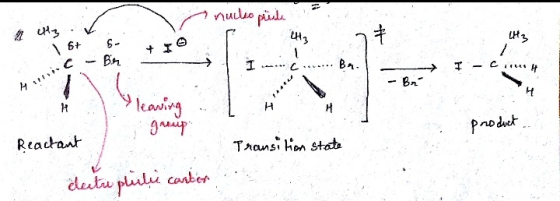
- SN2 reactions are regioselective. The nucleophile attacks from the backside. Front side attack is less favorable as the negative charge on nucleophile is repelled by the negative charge generated in the leaving group.
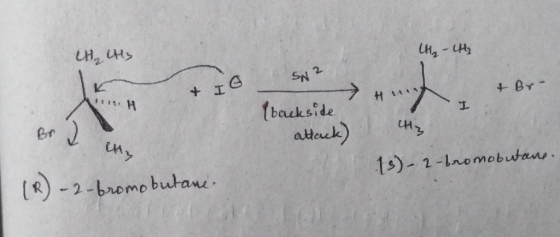
- Due to this backside attack, in SN2 reactions the inversion in
configuration takes place. The stereochemistry is always inversion
in configuration. (R) isomer will become (S) isomer. This is shown
below-
- Substrate plays an important role in SN2 reactions. As backside attack takes place in SN2 reactions, the rate will increase if the backside of the molecule is less hindered. The rate will be fastest if the backside group is methyl or primary carbon followed by secondary carbon. The rate is slowest if the group is tertiary carbon. In case of tertiary carbons or hindered molecules SN1 reaction takes place.
- Usually in SN2 reaction polar aprotic solvents are used. Usually the nucleophile is surrounded by solvent molecules. If we take polar protic solvents the solvent molecules will involve in hydrogen bonding with the nucleophile and thus it will reduce its reactivity towards attack to substrate molecule. In other words, polar protic solvents will stabilise the nucleophile. This polar aprotic solvents are used.
Add Answer to:
Give an example of an SN2 concerted mechanism with curved
arrows. Show the solvent and substrate...
SN2 stepwise mechanism with arrows, the substrate and solvent effect on the reaction, and the stereochemical...
SN2 stepwise mechanism with arrows, the substrate and solvent effect on the reaction, and the stereochemical and regiochemical outcome for the reaction
Complete the mechanism of the following Diels-Alder reaction by drawing the curved arrows for the concerted...
Complete the mechanism of the following Diels-Alder reaction by drawing the curved arrows for the concerted reaction and the final product formed. (Note that the COOH group is a carboxylic acid group, which is electron withdrawing.) Interactive 3D display mode Draw all missing reactants and/or products in the appropriate boxes by placing atoms on the grid and connecting them with bonds, including charges where needed. Indicate the mechanism by drawing the electron-flow arrows on the molecules. Arrows should start on...
Draw curved arrows to show the movement of electrons in this step of the mechanism.
 Electrophilic addition of hypohalous acids to alkenes yields a 1,2-haloalcohol called a halohydrin. Halohydrin formation, however, does not result from the addition of HO-Br, for example. Instead the addition is done indirectly by reaction of the alkene with Br2 in the presence of water. The reaction also works with Cl2 to give chlorohydrins instead of bromohydrins. The reaction proceeds through a cyclic intermediate known as a bromonium ion. In the second step of the reaction, water is the nucleophile and reacts with the...
also show the mechanism and curved arrows for each mechanism 2. Predict the products for the...
 also show the mechanism and curved arrows for each
mechanism
2. Predict the products for the reaction between le products for the reaction between Br, as well as Br/H, and the Alkenes listed below. rredict whether each reaction is syn- or anti-, Label the substrate, nucleophile and electrophile in each reaction. Substrate Structure Overall Reaction with Brz (with products) syn- or Overall Reaction with Bry/H20 (with products) anti- 3,3-dimethyl-1-1 butene 1-hexene styrene (phenylethene)
also show the mechanism and curved arrows for each
mechanism
2. Predict the products for the reaction between le products for the reaction between Br, as well as Br/H, and the Alkenes listed below. rredict whether each reaction is syn- or anti-, Label the substrate, nucleophile and electrophile in each reaction. Substrate Structure Overall Reaction with Brz (with products) syn- or Overall Reaction with Bry/H20 (with products) anti- 3,3-dimethyl-1-1 butene 1-hexene styrene (phenylethene)
Give a detailed mechanism for the reaction below. using the curved arrows to show electron flow....
 Give a detailed mechanism for the reaction below. using the
curved arrows to show electron flow. you must include all the
intermediates and all charges.
access HB
Give a detailed mechanism for the reaction below. using the
curved arrows to show electron flow. you must include all the
intermediates and all charges.
access HB
Add curved arrows to the reactant side of the following SN2 reaction. Add curved arrows to...
 Add curved arrows to the reactant side of the following SN2
reaction.
Add curved arrows to the reactant side of the following SN2 reaction.
Add curved arrows to the reactant side of the following SN2
reaction.
Add curved arrows to the reactant side of the following SN2 reaction.
draw curved arrows to show the movement of electrons in this step of the reaction mechanism...
 draw curved arrows to show the movement of electrons in this step
of the reaction mechanism
HCI H2O NH,CI -CEN ОН Acid catalyzed hydrolysis of a nitrile to give a carboxylic acid occurs by initial protonation of the nitrogen atom, fo Draw curved arrows to show the movement of electrons in this step of the reaction mechanism Arrow-pushing Instructions O: x H -CI: -NH₂ SLIDE ty Another Mansion 1 terrattuttomat
draw curved arrows to show the movement of electrons in this step
of the reaction mechanism
HCI H2O NH,CI -CEN ОН Acid catalyzed hydrolysis of a nitrile to give a carboxylic acid occurs by initial protonation of the nitrogen atom, fo Draw curved arrows to show the movement of electrons in this step of the reaction mechanism Arrow-pushing Instructions O: x H -CI: -NH₂ SLIDE ty Another Mansion 1 terrattuttomat
Draw curved arrows to show the movement of electrons in this step of the mechanism.
 Electrophilic addition of bromine, Br-, to alkenes yields a 1,2-dibromoalkane. The reaction proceeds through a cyclic intermediate known as a bromonium ion. The reaction occurs in an anhydrous solvent such as CH2Cl2 In the second step of the reaction, bromide is the nucleophile and attacks at one of the carbons of the bromonium ion to yield the product. Due to steric clashes, the bromide ion always attacks the carbon from the opposite face of the bromonium ion so that a product...
Draw curved arrows to show the movement of electrons in this step of the mechanism.
 Electrophilic addition of bromine, Br2, to alkenes yields a 1,2-dibromoalkane. The reaction proceeds through a cyclic intermediate known as a bromonium ion. The reaction occurs in an anhydrous solvent such as CH2Cl2 In the second step of the reaction, bromide is the nucleophile and attacks at one of the carbons of the bromonium ion to yield the product. Due to steric clashes, the bromide ion always attacks the carbon from the opposite face of the bromonium ion so that a product...
Give TWO examples of an E2 reaction. Use curved arrows to show electron flow involved in...
 Give TWO examples of an E2 reaction. Use curved arrows to show electron flow involved in the mechanism of reaction. Name ALL molecules involved in each reaction. Outline the mechanism for the E2 elimination of 3-bromopentane with sodium ethoxide. Show the Lewis structure for all molecules and use curved arrows to show electron flow.
 also show the mechanism and curved arrows for each
mechanism
2. Predict the products for the reaction between le products for the reaction between Br, as well as Br/H, and the Alkenes listed below. rredict whether each reaction is syn- or anti-, Label the substrate, nucleophile and electrophile in each reaction. Substrate Structure Overall Reaction with Brz (with products) syn- or Overall Reaction with Bry/H20 (with products) anti- 3,3-dimethyl-1-1 butene 1-hexene styrene (phenylethene)
also show the mechanism and curved arrows for each
mechanism
2. Predict the products for the reaction between le products for the reaction between Br, as well as Br/H, and the Alkenes listed below. rredict whether each reaction is syn- or anti-, Label the substrate, nucleophile and electrophile in each reaction. Substrate Structure Overall Reaction with Brz (with products) syn- or Overall Reaction with Bry/H20 (with products) anti- 3,3-dimethyl-1-1 butene 1-hexene styrene (phenylethene)
 Give a detailed mechanism for the reaction below. using the
curved arrows to show electron flow. you must include all the
intermediates and all charges.
access HB
Give a detailed mechanism for the reaction below. using the
curved arrows to show electron flow. you must include all the
intermediates and all charges.
access HB
 Add curved arrows to the reactant side of the following SN2
reaction.
Add curved arrows to the reactant side of the following SN2 reaction.
Add curved arrows to the reactant side of the following SN2
reaction.
Add curved arrows to the reactant side of the following SN2 reaction.
 draw curved arrows to show the movement of electrons in this step
of the reaction mechanism
HCI H2O NH,CI -CEN ОН Acid catalyzed hydrolysis of a nitrile to give a carboxylic acid occurs by initial protonation of the nitrogen atom, fo Draw curved arrows to show the movement of electrons in this step of the reaction mechanism Arrow-pushing Instructions O: x H -CI: -NH₂ SLIDE ty Another Mansion 1 terrattuttomat
draw curved arrows to show the movement of electrons in this step
of the reaction mechanism
HCI H2O NH,CI -CEN ОН Acid catalyzed hydrolysis of a nitrile to give a carboxylic acid occurs by initial protonation of the nitrogen atom, fo Draw curved arrows to show the movement of electrons in this step of the reaction mechanism Arrow-pushing Instructions O: x H -CI: -NH₂ SLIDE ty Another Mansion 1 terrattuttomat
 Give TWO examples of an E2 reaction. Use curved arrows to show electron flow involved in the mechanism of reaction. Name ALL molecules involved in each reaction. Outline the mechanism for the E2 elimination of 3-bromopentane with sodium ethoxide. Show the Lewis structure for all molecules and use curved arrows to show electron flow.
Most questions answered within 3 hours.
-
Where is the error in this code sequence?
String s1 = "Hello";
String s2 = "ello";...
asked 11 months ago -
Financial data for Joel de Paris, Inc., for last year
follow:
Joel de Paris, Inc.
Balance...
asked 11 months ago -
Consider this reaction:
Al2(SO4)3 (aq)+ BaCl3
(aq) Al2Cl6 (aq)- +
3BaSO4(s) . What is the...
asked 11 months ago -
Suppose that Savneet is considering increasing her
recent random sample from 20 car rentals to 40...
asked 11 months ago -
Trucks arrive at an unloading terminal at an average rate of 120
per hour.
Trucks arrive...
asked 11 months ago -
Why are methanol and ethanol completely soluble in water while
octanol is not very little soluble....
asked 11 months ago -
A facilities manager at a university reads in a research report
that the mean amount of...
asked 11 months ago -
When the CuSO4 is rehydrated by adding water to the anhydrous
compound, is this an endothermic...
asked 11 months ago -
A ray of sunlight is passing from diamond into crown glass; the
angle of incidence is...
asked 11 months ago -
A block of mass 0.249 kg is placed on top of a light, vertical
spring of...
asked 11 months ago -
how do the kidneys compensate in the presences of acidosis
a) trigger hyperventilate
b) reserve acid...
asked 11 months ago -
Question 501 pts
The rental rate of capital to the firm increases. Which of the
following...
asked 11 months ago