Graph the following data and find the spring constants for both springs. Mass (g) Position (cm)...
Graph the following data and find the spring constants for both springs.
|
Mass (g) |
Position (cm) Spring 1 |
Position (cm) Spring 2 |
|
50 |
8.5 |
7.0 |
|
100 |
16.5 |
13.0 |
|
250 |
41.0 |
31.0 |
|
Unknown |
25.0 |
19.0 |
Homework Answers

Add Answer to:
Graph the following data and find the spring constants for both
springs.
Mass (g)
Position (cm)...
Hang the 100 g mass on spring 1 and enter the additional displacement of the spring...
 Hang the 100 g mass on spring 1 and enter the additional
displacement of the spring
_____10______cm. Calculate the spring constant of this
spring___________ N/m.
3. Place the 250 g mass on spring 3 and change the “Softness”
setting to 1 notch to the right of the middle.
Calculate the spring constant of spring 3
:_________________N/m.
Note that the displacement of the springs with the masses attached
is the NEW equilibrium length of the spring. The restoring force of
the...
Hang the 100 g mass on spring 1 and enter the additional
displacement of the spring
_____10______cm. Calculate the spring constant of this
spring___________ N/m.
3. Place the 250 g mass on spring 3 and change the “Softness”
setting to 1 notch to the right of the middle.
Calculate the spring constant of spring 3
:_________________N/m.
Note that the displacement of the springs with the masses attached
is the NEW equilibrium length of the spring. The restoring force of
the...
1. Two sticky spheres of a mass 100 g each collide in vertical plane with velocities...
1. Two sticky spheres of a mass 100 g each collide in vertical plane with velocities (3i - 1k) m/s and (2i + 5k) m/s respectively. After the collision the spheres continue to move together in the field of gravity and hit the ground in 5 seconds after the collision. Find altitude, at which the collision occurred and horizontal distance traveled by the spheres after the collision. 2. A 60 kg swimmer is floating in a pool holding grip of...
6) A mass-spring system consists of a 250-g mass hanging from a spring with a spring...
 6) A mass-spring system consists of a 250-g mass hanging from a spring with a spring constant of k 0.18 J/m2. The mass is pulled down 7.1 cm from its equilibrium position and released from re a) How much work did the person do when she pulled the spring down from its equilibrium position? Assume that the mass was at rest before she pulled it down, and before it was released. (Use the energy-interaction model, not the expression W FavgAx,...
a) A hanging spring stretches by 35.0 cm when an object of mass 450 g is...
a) A hanging spring stretches by 35.0 cm when an object of mass 450 g is hung on it at rest. In this situation, we define its position as x =0. The object is pulled down an additional 18.0 cm and released from rest to oscillate without friction. What is its position x at a moment 84.4 s later? (b) Find the distance traveled by the vibrating object in part (a). (c) What If? Another hanging spring stretches by 35.5...
mass weighing W pounds stretches a spring 7 foot and stretches a different spring foot. The two springs are attached in series and the mass is then attached to the double spring as shown in th...
 mass weighing W pounds stretches a spring 7 foot and stretches a different spring foot. The two springs are attached in series and the mass is then attached to the double spring as shown in the figure below. (a) A rigid suppont that the motion is free and that there is no damping force present. Determine the equation of motion if the mass is initially released at a point 1 foot below the equlbrium postion with a downward velocity of...
6.3 Finding mass, damping, and spring constants to meet design specifications. One task an engineer performs...
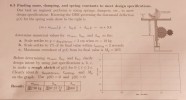 6.3 Finding mass, damping, and spring constants to meet design specifications. One task an engineer performs is sizing springs, dampers, ete., to meet design specifications. Knowing the ODE governing the downward deflection vlt) for the spring scale show to the right is determine numerical values for mrum, 401, and keq so the: = gequilibrium-2 cm when tn = 10 kg a. Scale settles to b. Scale settles to 1% of its final value within tsettling-2 seconds c. Maxínurn overshoot of...
please solve both. thank you! A mass of 1.25 kg stretches a spring 0.06 m. The...
 please solve both. thank
you!
A mass of 1.25 kg stretches a spring 0.06 m. The mass is in a medium that exerts a viscous resistance of 56 N when the mass has a velocity of 2 . The viscous resistance is proportional to the speed of the object. Suppose the object is displaced an additional 0.03 m and released. Find an function to express the object's displacement from the spring's equilibrium position, in m after t seconds. Let positive...
please solve both. thank
you!
A mass of 1.25 kg stretches a spring 0.06 m. The mass is in a medium that exerts a viscous resistance of 56 N when the mass has a velocity of 2 . The viscous resistance is proportional to the speed of the object. Suppose the object is displaced an additional 0.03 m and released. Find an function to express the object's displacement from the spring's equilibrium position, in m after t seconds. Let positive...
wooden block with mass M 3 kg is lying on a horizontal table and is attached to a spring in its equilibrium position. It is hit by a bullet with mass m 5 g which moves horizontally. The bullet re...
 wooden block with mass M 3 kg is lying on a horizontal table and is attached to a spring in its equilibrium position. It is hit by a bullet with mass m 5 g which moves horizontally. The bullet remains in the block after colliding with it. The block moves on the table compressing the spring, with spring constant k 50 Nm, a distance 10 cm. The coefficient of kinetic friction uk 0.2. a) Find the elastic energy stored in...
Procedure 1, 2, 3 Mass of a clamp: 21.5 True mass of meter stick: _133.6 g...
 Procedure 1, 2, 3 Mass of a clamp: 21.5 True mass of meter stick: _133.6 g Center of mass of meter stick: _50 cm True weight of unknown mass: _212.99_ Procedure 4 Position of the 100-g mass: 10.0 cm Position of equilibrium: _30.9 cm Mass of the stick from method of torques: Procedure 5 Position of the 100-g mass: 10.0 cm Position of the 200-g mass: _90.0 cm Position of equilibrium of meter stick: Procedure 6 Position of unknown mass...
Spring Constants & Periods By varying the mass placed on a spring, the period of oscillation...
 Spring Constants & Periods By varying the mass placed on a spring, the period of oscillation can be changed. When multiple data sets are collected and plotted, the spring constant can be determined. Before data was collected, the minimum and maximum masses were determined by visually watching the harmonic motion. For the minimum, a mass was chosen such that the resulting simple harmonic motion had an appreciable amplitude without significant dampening over ten periods. For the maximum, the mass was...
 Hang the 100 g mass on spring 1 and enter the additional
displacement of the spring
_____10______cm. Calculate the spring constant of this
spring___________ N/m.
3. Place the 250 g mass on spring 3 and change the “Softness”
setting to 1 notch to the right of the middle.
Calculate the spring constant of spring 3
:_________________N/m.
Note that the displacement of the springs with the masses attached
is the NEW equilibrium length of the spring. The restoring force of
the...
Hang the 100 g mass on spring 1 and enter the additional
displacement of the spring
_____10______cm. Calculate the spring constant of this
spring___________ N/m.
3. Place the 250 g mass on spring 3 and change the “Softness”
setting to 1 notch to the right of the middle.
Calculate the spring constant of spring 3
:_________________N/m.
Note that the displacement of the springs with the masses attached
is the NEW equilibrium length of the spring. The restoring force of
the...
 6) A mass-spring system consists of a 250-g mass hanging from a spring with a spring constant of k 0.18 J/m2. The mass is pulled down 7.1 cm from its equilibrium position and released from re a) How much work did the person do when she pulled the spring down from its equilibrium position? Assume that the mass was at rest before she pulled it down, and before it was released. (Use the energy-interaction model, not the expression W FavgAx,...
 mass weighing W pounds stretches a spring 7 foot and stretches a different spring foot. The two springs are attached in series and the mass is then attached to the double spring as shown in the figure below. (a) A rigid suppont that the motion is free and that there is no damping force present. Determine the equation of motion if the mass is initially released at a point 1 foot below the equlbrium postion with a downward velocity of...
 6.3 Finding mass, damping, and spring constants to meet design specifications. One task an engineer performs is sizing springs, dampers, ete., to meet design specifications. Knowing the ODE governing the downward deflection vlt) for the spring scale show to the right is determine numerical values for mrum, 401, and keq so the: = gequilibrium-2 cm when tn = 10 kg a. Scale settles to b. Scale settles to 1% of its final value within tsettling-2 seconds c. Maxínurn overshoot of...
 please solve both. thank
you!
A mass of 1.25 kg stretches a spring 0.06 m. The mass is in a medium that exerts a viscous resistance of 56 N when the mass has a velocity of 2 . The viscous resistance is proportional to the speed of the object. Suppose the object is displaced an additional 0.03 m and released. Find an function to express the object's displacement from the spring's equilibrium position, in m after t seconds. Let positive...
please solve both. thank
you!
A mass of 1.25 kg stretches a spring 0.06 m. The mass is in a medium that exerts a viscous resistance of 56 N when the mass has a velocity of 2 . The viscous resistance is proportional to the speed of the object. Suppose the object is displaced an additional 0.03 m and released. Find an function to express the object's displacement from the spring's equilibrium position, in m after t seconds. Let positive...
 wooden block with mass M 3 kg is lying on a horizontal table and is attached to a spring in its equilibrium position. It is hit by a bullet with mass m 5 g which moves horizontally. The bullet remains in the block after colliding with it. The block moves on the table compressing the spring, with spring constant k 50 Nm, a distance 10 cm. The coefficient of kinetic friction uk 0.2. a) Find the elastic energy stored in...
 Procedure 1, 2, 3 Mass of a clamp: 21.5 True mass of meter stick: _133.6 g Center of mass of meter stick: _50 cm True weight of unknown mass: _212.99_ Procedure 4 Position of the 100-g mass: 10.0 cm Position of equilibrium: _30.9 cm Mass of the stick from method of torques: Procedure 5 Position of the 100-g mass: 10.0 cm Position of the 200-g mass: _90.0 cm Position of equilibrium of meter stick: Procedure 6 Position of unknown mass...
 Spring Constants & Periods By varying the mass placed on a spring, the period of oscillation can be changed. When multiple data sets are collected and plotted, the spring constant can be determined. Before data was collected, the minimum and maximum masses were determined by visually watching the harmonic motion. For the minimum, a mass was chosen such that the resulting simple harmonic motion had an appreciable amplitude without significant dampening over ten periods. For the maximum, the mass was...
Most questions answered within 3 hours.
-
Where is the error in this code sequence?
String s1 = "Hello";
String s2 = "ello";...
asked 10 months ago -
Financial data for Joel de Paris, Inc., for last year
follow:
Joel de Paris, Inc.
Balance...
asked 10 months ago -
Consider this reaction:
Al2(SO4)3 (aq)+ BaCl3
(aq) Al2Cl6 (aq)- +
3BaSO4(s) . What is the...
asked 10 months ago -
Suppose that Savneet is considering increasing her
recent random sample from 20 car rentals to 40...
asked 10 months ago -
Trucks arrive at an unloading terminal at an average rate of 120
per hour.
Trucks arrive...
asked 10 months ago -
Why are methanol and ethanol completely soluble in water while
octanol is not very little soluble....
asked 10 months ago -
A facilities manager at a university reads in a research report
that the mean amount of...
asked 10 months ago -
When the CuSO4 is rehydrated by adding water to the anhydrous
compound, is this an endothermic...
asked 10 months ago -
A ray of sunlight is passing from diamond into crown glass; the
angle of incidence is...
asked 10 months ago -
A block of mass 0.249 kg is placed on top of a light, vertical
spring of...
asked 10 months ago -
how do the kidneys compensate in the presences of acidosis
a) trigger hyperventilate
b) reserve acid...
asked 10 months ago -
Question 501 pts
The rental rate of capital to the firm increases. Which of the
following...
asked 10 months ago