write out and show each reaction (no mechansim needed) for the Ceric Nitrate reagent with 1-butanol,...
Homework Answers


Add Answer to:
write out and show each reaction (no mechansim needed) for the
Ceric Nitrate reagent with 1-butanol,...
(a) Write out each of the three reactions below: 1-butanol, 2-butanol and tert-butanol with a mixture...
(a) Write out each of the three reactions below: 1-butanol, 2-butanol and tert-butanol with a mixture of NaBr and NaCl. Show the major product you expected for each one (bromo- or chloro?). (b) Which reactions do you predict SN1? SN2? Label them below. (c) For each, briefly explain the basis for your prediction of whether bromo or chloro substitution is the major product.
write the chemical reaction for: A) phenol with iron (III) chloride B) 2-methyl-2-propanol with Lucas reagent...
write the chemical reaction for: A) phenol with iron (III) chloride B) 2-methyl-2-propanol with Lucas reagent C) 2-butanol with chronic acid D) 2-butanol with iodoform reagent
Write chemical equations to illustrate the oxidation reaction of dichromate reagent with 1-butanol and 2-butanol. Bond...
Write chemical equations to illustrate the oxidation reaction of dichromate reagent with 1-butanol and 2-butanol. Bond configuration or organic structures must be shown.
1. Write the OVERALL reaction for this lab. 2. Show the mechanism's steps for this reaction....
 1. Write the OVERALL reaction for this lab. 2. Show the mechanism's steps for this reaction. Be sure to include the arrows showing where the electrons are being transferred. 3. What is(are) the intermediates in this mechanism? 4. Which step is the rate determining step? 13 SN1: Synthesis of tert-Butyl Chloride Alkyl halides can be prepared from their corresponding alcohols via an acid catalyzed substitution reaction. The mechanism of these acid catalyzed substitution reactions are labeled as Syl (substitution, nucleophilic,...
D. Questions 1. 3-methyl-2-butanol reacts with Lucas Reagent to produce only a single alkyl chloride of...
 D. Questions 1. 3-methyl-2-butanol reacts with Lucas Reagent to produce only a single alkyl chloride of formula CsH11Cl that gave the following carbon NMR spectrum CH CH2 CH3 C 180 200 160 140 120 80 60 40 20 100 ppm cos-06-322 a. What is the structure of this alkyl chloride? b. Write equations to show how it is formed from 3-methyl-2-butanol. Он +HCI Сн,
1. Use a molecular drawing program to construct a balanced equation for the specific reaction of...
 1. Use a molecular drawing program to construct a balanced equation for the specific reaction of 2-propanol with the Lucas reagent including structural/skeletal formulas. Do not just copy the general reaction (no R's in your answer). 2. Use a molecular drawing program to construct an equation for the reaction of each of the specific alcohols in Part A (listed in Table 1) with chromic acid including structural/skeletal formulas. Write "No Reaction" for the products if no reaction occurs. Assume the...
show the mechansim pf each step in each question Give the product for the following reaction....
 show the mechansim pf each step in each question
Give the product for the following reaction. CH:CH -CH:CHCH: 1. NaBH, > 2. H.O . Give the product for the following reaction. CH, CH H 1 CHỊ H. H 2. HO 3. NaBH(O,CCH) Give the product for the following reaction. 1. (CH, H, H CH: 2. H0 3. NaHCO.CCHE, Give the product for the following reaction. 1. H.NOH, H CH:CH- СН: 2.-H.0 3. HPC
show the mechansim pf each step in each question
Give the product for the following reaction. CH:CH -CH:CHCH: 1. NaBH, > 2. H.O . Give the product for the following reaction. CH, CH H 1 CHỊ H. H 2. HO 3. NaBH(O,CCH) Give the product for the following reaction. 1. (CH, H, H CH: 2. H0 3. NaHCO.CCHE, Give the product for the following reaction. 1. H.NOH, H CH:CH- СН: 2.-H.0 3. HPC
2. (20 pts) Write the reagent(s) needed for each of these reactions. If more than one step is required, number the s...
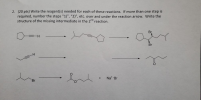 2. (20 pts) Write the reagent(s) needed for each of these reactions. If more than one step is required, number the steps "1)", "2)", etc. over and under the reaction arrow. Write the structure of the missing intermediate in the 2nd reaction. to Londo + NaBr
calculate the stoichiometry, limiting reagent, and theoretical yield of a reaction between 100uL of 2-butanol and...
calculate the stoichiometry, limiting reagent, and theoretical yield of a reaction between 100uL of 2-butanol and 50uL of concentrated sulfuric acid when heat is added. the products of the reaction are 1-butene, cis-2-butene, and trans-2-butene. All three of these products can be treated as one for these calculations, it is not necessary to find out how much of each one specifically there is, just the total amount of the three combined. please express answer of theoretical yield in mmol. Please...
QUESTIONS 1. Select a reagent that will distinguish between each pair of compound Write equations for any reaction...
 QUESTIONS 1. Select a reagent that will distinguish between each pair of compound Write equations for any reactions that occur. The reagent should react ONLY with one compound of the pair under reaction conditions. Reagent (1) l-propanol zincill 2-propanol OH Equation(s) (2) 2-butanol 2-roethyl-2-propanol (3) 1-propanol 1-chloropropane Popu (4) 1-propanol propene - (5) 2-pentanol 3-pentanol 2. Number the alcohols below according to increasing boiling points. Recall that addition of -CH - usually increases the boiling point by anout thirty degrees...
 1. Write the OVERALL reaction for this lab. 2. Show the mechanism's steps for this reaction. Be sure to include the arrows showing where the electrons are being transferred. 3. What is(are) the intermediates in this mechanism? 4. Which step is the rate determining step? 13 SN1: Synthesis of tert-Butyl Chloride Alkyl halides can be prepared from their corresponding alcohols via an acid catalyzed substitution reaction. The mechanism of these acid catalyzed substitution reactions are labeled as Syl (substitution, nucleophilic,...
 D. Questions 1. 3-methyl-2-butanol reacts with Lucas Reagent to produce only a single alkyl chloride of formula CsH11Cl that gave the following carbon NMR spectrum CH CH2 CH3 C 180 200 160 140 120 80 60 40 20 100 ppm cos-06-322 a. What is the structure of this alkyl chloride? b. Write equations to show how it is formed from 3-methyl-2-butanol. Он +HCI Сн,
 1. Use a molecular drawing program to construct a balanced equation for the specific reaction of 2-propanol with the Lucas reagent including structural/skeletal formulas. Do not just copy the general reaction (no R's in your answer). 2. Use a molecular drawing program to construct an equation for the reaction of each of the specific alcohols in Part A (listed in Table 1) with chromic acid including structural/skeletal formulas. Write "No Reaction" for the products if no reaction occurs. Assume the...
 show the mechansim pf each step in each question
Give the product for the following reaction. CH:CH -CH:CHCH: 1. NaBH, > 2. H.O . Give the product for the following reaction. CH, CH H 1 CHỊ H. H 2. HO 3. NaBH(O,CCH) Give the product for the following reaction. 1. (CH, H, H CH: 2. H0 3. NaHCO.CCHE, Give the product for the following reaction. 1. H.NOH, H CH:CH- СН: 2.-H.0 3. HPC
show the mechansim pf each step in each question
Give the product for the following reaction. CH:CH -CH:CHCH: 1. NaBH, > 2. H.O . Give the product for the following reaction. CH, CH H 1 CHỊ H. H 2. HO 3. NaBH(O,CCH) Give the product for the following reaction. 1. (CH, H, H CH: 2. H0 3. NaHCO.CCHE, Give the product for the following reaction. 1. H.NOH, H CH:CH- СН: 2.-H.0 3. HPC
 2. (20 pts) Write the reagent(s) needed for each of these reactions. If more than one step is required, number the steps "1)", "2)", etc. over and under the reaction arrow. Write the structure of the missing intermediate in the 2nd reaction. to Londo + NaBr
 QUESTIONS 1. Select a reagent that will distinguish between each pair of compound Write equations for any reactions that occur. The reagent should react ONLY with one compound of the pair under reaction conditions. Reagent (1) l-propanol zincill 2-propanol OH Equation(s) (2) 2-butanol 2-roethyl-2-propanol (3) 1-propanol 1-chloropropane Popu (4) 1-propanol propene - (5) 2-pentanol 3-pentanol 2. Number the alcohols below according to increasing boiling points. Recall that addition of -CH - usually increases the boiling point by anout thirty degrees...
Most questions answered within 3 hours.
-
Where is the error in this code sequence?
String s1 = "Hello";
String s2 = "ello";...
asked 10 months ago -
Financial data for Joel de Paris, Inc., for last year
follow:
Joel de Paris, Inc.
Balance...
asked 10 months ago -
Consider this reaction:
Al2(SO4)3 (aq)+ BaCl3
(aq) Al2Cl6 (aq)- +
3BaSO4(s) . What is the...
asked 10 months ago -
Suppose that Savneet is considering increasing her
recent random sample from 20 car rentals to 40...
asked 10 months ago -
Trucks arrive at an unloading terminal at an average rate of 120
per hour.
Trucks arrive...
asked 10 months ago -
Why are methanol and ethanol completely soluble in water while
octanol is not very little soluble....
asked 10 months ago -
A facilities manager at a university reads in a research report
that the mean amount of...
asked 10 months ago -
When the CuSO4 is rehydrated by adding water to the anhydrous
compound, is this an endothermic...
asked 10 months ago -
A ray of sunlight is passing from diamond into crown glass; the
angle of incidence is...
asked 10 months ago -
A block of mass 0.249 kg is placed on top of a light, vertical
spring of...
asked 10 months ago -
how do the kidneys compensate in the presences of acidosis
a) trigger hyperventilate
b) reserve acid...
asked 10 months ago -
Question 501 pts
The rental rate of capital to the firm increases. Which of the
following...
asked 10 months ago