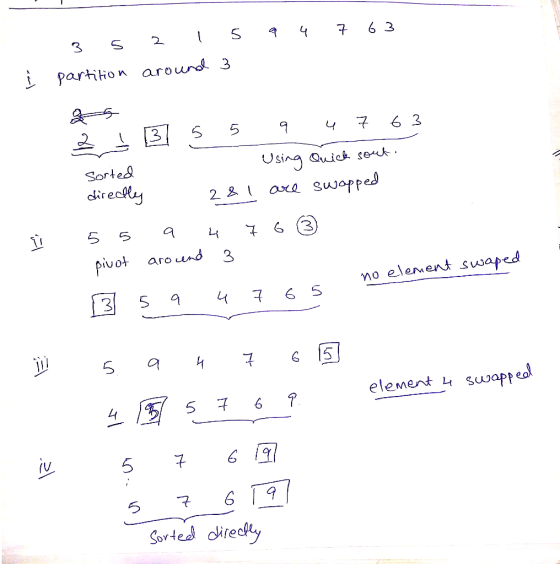
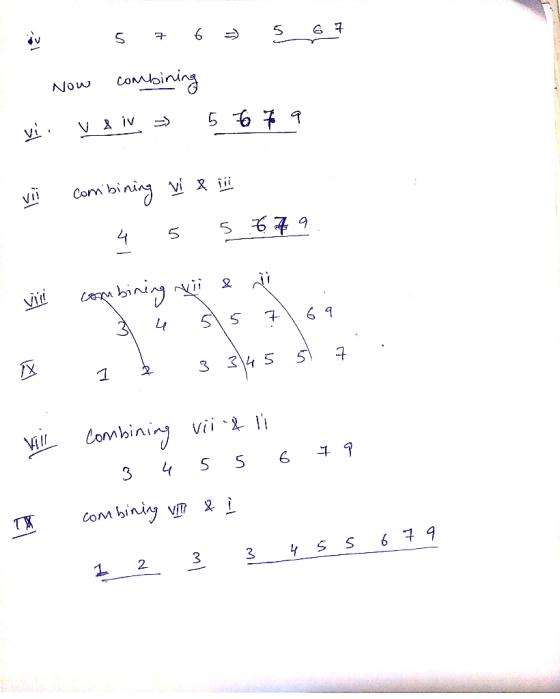
Sort 3, 5, 2, 1, 5, 9, 4, 7, 6, 3 using Quicksort with median-of-three partitioning....
Sort 3, 5, 2, 1, 5, 9, 4, 7, 6, 3 using Quicksort with median-of-three partitioning. Assume a cutoff of 3, i.e. once a partition size reaches 3, the elements are sorted by explicit comparison. You do not have to show each step of the i and j pointers, but clearly indicate which elements are swapped in each step. Assume that the three candidate elements are not pre-sorted when selecting the pivot, but that the pivot is moved to the end in each step.
Please write out the answer and don't give code.
Homework Answers
Friend, That was
a nice question to answer
If you have any doubts in understanding do let me know in the
comment section. I will be happy to help you further.
Please like it if you think effort deserves like.
Thanks
Add Answer to:
Sort 3, 5, 2, 1, 5, 9, 4, 7, 6, 3 using Quicksort with
median-of-three partitioning....
Show the first partition of quicksort using median of three numbers technique for the pivot element....
Show the first partition of quicksort using median of three numbers technique for the pivot element. Circle the pivot. Show step by step of your work. 23 5 27 25 9 7 11 19 17 1 29 3 21 13
data structure draw: 3) Sort 3, 4, 5, 6,1, 9, 2, 5, 6, 5 ,3 using...
 data structure
draw:
3) Sort 3, 4, 5, 6,1, 9, 2, 5, 6, 5 ,3 using quick sort with median of three pivot, with insertion sort cutoff at 4.
data structure
draw:
3) Sort 3, 4, 5, 6,1, 9, 2, 5, 6, 5 ,3 using quick sort with median of three pivot, with insertion sort cutoff at 4.
1. Show the steps in order to sort {11,5,6,3,8,1,9,2} using Mergesort algorithm. 2. Show the element...
1. Show the steps in order to sort {11,5,6,3,8,1,9,2} using Mergesort algorithm. 2. Show the element sequences of running Shellsort on the input {15,2,8,1,10,7,4,3,9,11,12,6} at the increments {7, 3, 1}, respectively. 3. Show the steps in details of sorting {15, 2, 8, 1, 10, 7, 4, 3, 9, 11, 12, 6} using quicksort with median-of-three partitioning and a cutoff 3 (if the elements are less than 3, using insertion sort).
Sorting Sort the following array using the quick sort algorithm: (4 Marks) a. 12 26 8...
 Sorting Sort the following array using the quick sort algorithm: (4 Marks) a. 12 26 8 9 7 0 4 Pivot selection is defined to be the first element of each sub-list. Show the array before and after each quicksort round (when the array is partitioned after placing the pivot at its correct position). Also, clearly highlight the pivot in each partition b. Consider an unsorted array of integers of size n. Write a Java program to arrange the array...
1. Given a set of numbers: A = {1, 3, 5, 2, 8, 7, 9, 4...
1. Given a set of numbers: A = {1, 3, 5, 2, 8, 7, 9, 4 }. Add each digit of your N-Number (e.g. N0 0 3 2 2 0 1 8) to each element of A separately to get your own final array B. ( e.g. B={1,3,8,4,10,7,10,12} = {B1,B2,B3,B4,B5,B6,B7,B8}. ) a) Your set B = ? b) Use merge-sort to sort the array B. Show each step. c) How many “comparisons” for each algorithm above? 2. Use binary-search for...
Introduction BUBBLE SORT: Step-by-step example Let us take the array of numbers "5 1 4 2...
 Introduction BUBBLE SORT: Step-by-step example Let us take the array of numbers "5 1 4 2 8", and sort the array from lowest number to greatest number using bubble sort. In each step, elements written in bold are being compared. Three passes will be required First Pass: ( 5 1 4 2 8 ) → ( 1 5 4 2 8 ). Here, algorithm compares the first two elements, swaps since 5 (15428)→(14528). Swap since 5 > 4 (14528)→(14258). Swap...
Use the selection sort to sort 6, 2, 3, 1, 5, 4, showing the lists obtained...
Use the selection sort to sort 6, 2, 3, 1, 5, 4, showing the lists obtained at each step.
DATA STRUCTURE 1) Sort 3, 4, 5, 6,1, 9, 2, 5, 6 using insertion sort.
 DATA STRUCTURE
1) Sort 3, 4, 5, 6,1, 9, 2, 5, 6 using insertion sort.
DATA STRUCTURE
1) Sort 3, 4, 5, 6,1, 9, 2, 5, 6 using insertion sort.
2.1 Searching and Sorting- 5 points each 1. Run Heapsort on the following array: A (7,3, 9, 4, 2,5, 6, 1,8) 2. Run merge sort on the same array. 3. What is the worst case for quick sort? What is...
 2.1 Searching and Sorting- 5 points each 1. Run Heapsort on the following array: A (7,3, 9, 4, 2,5, 6, 1,8) 2. Run merge sort on the same array. 3. What is the worst case for quick sort? What is the worst case time com- plexity for quick sort and why? Explain what modifications we can make to quick sort to make it run faster, and why this helps. 4. Gi pseudocode for an algorithm that will solve the following...
Hello I need help with this program. Should programmed in C! Program 2: Sorting with Pointers...
 Hello I need help with this program. Should programmed in C!
Program 2: Sorting with Pointers Sometimes we're given an array of data that we need to be able to view in sorted order while leaving the original order unchanged. In such cases we could sort the data set, but then we would lose the information contained in the original order. We need a better solution. One solution might be to create a duplicate of the data set, perhaps make...
Hello I need help with this program. Should programmed in C!
Program 2: Sorting with Pointers Sometimes we're given an array of data that we need to be able to view in sorted order while leaving the original order unchanged. In such cases we could sort the data set, but then we would lose the information contained in the original order. We need a better solution. One solution might be to create a duplicate of the data set, perhaps make...
 data structure
draw:
3) Sort 3, 4, 5, 6,1, 9, 2, 5, 6, 5 ,3 using quick sort with median of three pivot, with insertion sort cutoff at 4.
data structure
draw:
3) Sort 3, 4, 5, 6,1, 9, 2, 5, 6, 5 ,3 using quick sort with median of three pivot, with insertion sort cutoff at 4.
 Sorting Sort the following array using the quick sort algorithm: (4 Marks) a. 12 26 8 9 7 0 4 Pivot selection is defined to be the first element of each sub-list. Show the array before and after each quicksort round (when the array is partitioned after placing the pivot at its correct position). Also, clearly highlight the pivot in each partition b. Consider an unsorted array of integers of size n. Write a Java program to arrange the array...
 Introduction BUBBLE SORT: Step-by-step example Let us take the array of numbers "5 1 4 2 8", and sort the array from lowest number to greatest number using bubble sort. In each step, elements written in bold are being compared. Three passes will be required First Pass: ( 5 1 4 2 8 ) → ( 1 5 4 2 8 ). Here, algorithm compares the first two elements, swaps since 5 (15428)→(14528). Swap since 5 > 4 (14528)→(14258). Swap...
 DATA STRUCTURE
1) Sort 3, 4, 5, 6,1, 9, 2, 5, 6 using insertion sort.
DATA STRUCTURE
1) Sort 3, 4, 5, 6,1, 9, 2, 5, 6 using insertion sort.
 2.1 Searching and Sorting- 5 points each 1. Run Heapsort on the following array: A (7,3, 9, 4, 2,5, 6, 1,8) 2. Run merge sort on the same array. 3. What is the worst case for quick sort? What is the worst case time com- plexity for quick sort and why? Explain what modifications we can make to quick sort to make it run faster, and why this helps. 4. Gi pseudocode for an algorithm that will solve the following...
 Hello I need help with this program. Should programmed in C!
Program 2: Sorting with Pointers Sometimes we're given an array of data that we need to be able to view in sorted order while leaving the original order unchanged. In such cases we could sort the data set, but then we would lose the information contained in the original order. We need a better solution. One solution might be to create a duplicate of the data set, perhaps make...
Hello I need help with this program. Should programmed in C!
Program 2: Sorting with Pointers Sometimes we're given an array of data that we need to be able to view in sorted order while leaving the original order unchanged. In such cases we could sort the data set, but then we would lose the information contained in the original order. We need a better solution. One solution might be to create a duplicate of the data set, perhaps make...
Most questions answered within 3 hours.
-
Where is the error in this code sequence?
String s1 = "Hello";
String s2 = "ello";...
asked 10 months ago -
Financial data for Joel de Paris, Inc., for last year
follow:
Joel de Paris, Inc.
Balance...
asked 10 months ago -
Consider this reaction:
Al2(SO4)3 (aq)+ BaCl3
(aq) Al2Cl6 (aq)- +
3BaSO4(s) . What is the...
asked 10 months ago -
Suppose that Savneet is considering increasing her
recent random sample from 20 car rentals to 40...
asked 10 months ago -
Trucks arrive at an unloading terminal at an average rate of 120
per hour.
Trucks arrive...
asked 10 months ago -
Why are methanol and ethanol completely soluble in water while
octanol is not very little soluble....
asked 10 months ago -
A facilities manager at a university reads in a research report
that the mean amount of...
asked 10 months ago -
When the CuSO4 is rehydrated by adding water to the anhydrous
compound, is this an endothermic...
asked 10 months ago -
A ray of sunlight is passing from diamond into crown glass; the
angle of incidence is...
asked 10 months ago -
A block of mass 0.249 kg is placed on top of a light, vertical
spring of...
asked 10 months ago -
how do the kidneys compensate in the presences of acidosis
a) trigger hyperventilate
b) reserve acid...
asked 10 months ago -
Question 501 pts
The rental rate of capital to the firm increases. Which of the
following...
asked 10 months ago