Tina and David can produce any three combinations of goods X and Y as shown below:...
Tina and David can produce any three combinations of goods X and Y as shown below:
|
TINA |
DAVID |
|
l60X and 0Y |
80X and 0Y |
|
80X and 60Y |
40X and 50Y |
|
0X and 120Y |
0X and 100Y |
- Draw a production possibility frontier (curve) for Tina, and one for David.
- If Tina is producing 80X and 60Y, what is her opportunity cost for producing one more of X? If David is producing 40X and 50Y, what is his opportunity cost for producing one more unit of X?
- Who has a comparative advantage in producing good X? Of good Y? Explain your answer.
d. BONUS. What is a possible trade agreement that will make both Tina and David better off through specialization and trade (there are several possibilities). Assume that they originally are producing both goods separately. That is, start with Tina producing 80X and 60Y and David producing 40X and 50Y. Then show how much more each can gain by producing only one product and trading for the other, so that both have more of each product.
Homework Answers
a.
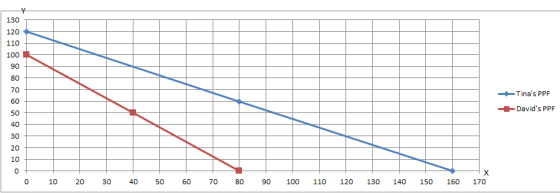
b.
|
TINA |
DAVID |
|
160X and 0Y |
80X and 0Y |
|
80X and 60Y |
40X and 50Y |
|
0X and 120Y |
0X and 100Y |
For Tina:
Tina can produce 80X and 60Y or 160X and 0Y
i.e., In order to increase the production by 160X-80X = 80X, Tina must forego 60Y
Therefore, the opportunity cost of producing 1 more unit of X = (60/80)Y = 0.75Y
For David:
David can produce 40X and 50Y or 80X and 0Y
i.e., In order to increase the production by 80X-40X = 40X, David must forego 50Y
Therefore, the opportunity cost of producing 1 more unit of X = (50/40)Y = 1.20Y
c. Comparative advantage occurs when the opportunity cost of producing a good for one entity is less than the opportunity cost for other entity.
As observed in part (b), the opportunity cost of producing 1 additional unit of X is more for David compared to Tina. Therefore, Tina has a comparative advantage in the production of X
The opportunity cost of producing 1 additional unit of Y for Tina = (80/60)X = 1.33X
The opportunity cost of producing 1 additional unit of Y for David = (40/50)X = 0.80X
The opportunity cost of producing 1 additional unit of Y is more for Tina compared to David. Therefore, David has a comparative advantage in the production of good Y.
d. Trade would be favourable for both Tina and David when the terms of trade are exactly in between their respective opportunity costs
Let us assume that the terms of trade are 1 unit of good X is exchanged for 1 unit of good Y
According to their respective comparative advantages, Tina specializes in the production of X and David specializes in the production of Y
Tina produces 160X and David produces 120Y
Let the exchange be 65 units of X for 65 units of Y
Then, TIna's final consumption = 95X and 65Y (against the initial consumption of 80X and 60Y)
David's final consumption = 65X and 55Y (against the initial consumption of 40X and 50Y)
Therefore, Tina can gain 15X and 5Y while David can gain 25X and 5Y
Add Answer to:
Tina and David can produce any three combinations of
goods X and Y as shown below:...
The following table summarizes the combinations of goods X and Y that two individuals, Tina and...
 The following table summarizes the combinations of goods X and Y that two individuals, Tina and David, can each produce individually. Tina X Y 1000 50 5 0 10 David XY 1500 75 37.5 0 75 fesch person specializes in the production of the good for which they have the comparative advantage, then would specialize in the production of good Y, and would specialize in the production of good X. (Hint: Calculate the opportunity cost of producing X and Y...
7. Working with Numbers and Graphs Q9 The following table summarizes the combinations of goods X...
 7. Working with Numbers and Graphs Q9 The following table summarizes the combinations of goods X and Y that two individuals, Tina and David, can each produce individually. Tina David X Y X Y 150 0 200 0 75 37.5 100 10 0 75 0 20 would specialize in the If each person specializes in the production of the good for which they have the comparative advantage, then would specialize in the production of good X. (Hint: Calculate the opportunity...
a) True b) False Note: This whole problem is just one question but consists of many...
 a) True
b) False
Note: This whole problem is just one question but consists of
many parts. I would highly, extremely appreciate it if someone
could solve this whole thing for me, this is tricky.
9. Working with Numbers and Graphs Q9 The following table summarizes the combinations of goods X and Y that two individuals, Tina and David, can each produce individually. Tina David 250 02000 125 62.5 100 10 0 125 0 20 If each person specializes in...
a) True
b) False
Note: This whole problem is just one question but consists of
many parts. I would highly, extremely appreciate it if someone
could solve this whole thing for me, this is tricky.
9. Working with Numbers and Graphs Q9 The following table summarizes the combinations of goods X and Y that two individuals, Tina and David, can each produce individually. Tina David 250 02000 125 62.5 100 10 0 125 0 20 If each person specializes in...
1. Countries A and B both can produce two goods, X and Y. If country A produces only good X, it can produce 30 unit...
 1. Countries A and B both can produce two goods, X and Y. If country A produces only good X, it can produce 30 units of X; if country A produces only good Y, it can produce 10 units of Y. If country B produces only good X, it can produce 40 units of X; if country B produces only good Y, it can produce 40 units of Y. Assume that both countries have homogenous resources so that the opportunity...
please answer all the following Lesson 1.4-Specialization and Trade Tony can produce any of the following...
 please answer all the following
Lesson 1.4-Specialization and Trade Tony can produce any of the following combinations of goods X and Y (a) 100 X and O Y, (b) 50 X and 25 Y, and (c) OX and 50 Y. Darlene can produce any of the following combinations of goods X and Y (a) 50 X and O Y, (b) 25 X and 40 Y, and (c) O X and 80 Y. Who has the comparative advantage in the production...
please answer all the following
Lesson 1.4-Specialization and Trade Tony can produce any of the following combinations of goods X and Y (a) 100 X and O Y, (b) 50 X and 25 Y, and (c) OX and 50 Y. Darlene can produce any of the following combinations of goods X and Y (a) 50 X and O Y, (b) 25 X and 40 Y, and (c) O X and 80 Y. Who has the comparative advantage in the production...
A country produces goods X and Y and has the following equation for its production possibilities...
A country produces goods X and Y and has the following equation for its production possibilities frontier: X3 + 2Y2 = 96 or Y = (48 - 0.5X3)1/2 = (48 – X3/2)1/2 Again you are told that the economy is producing efficiently and that this time it has chosen to produce and consume 3 units of X. At this point on the production possibilities frontier, you would use calculus to obtain the opportunity cost of one more unit of Y...
46) A shift outwards of the nation's production possibilities frontier can occur due to: 46) A)...
 46) A shift outwards of the nation's production possibilities frontier can occur due to: 46) A) a change in the amounts of one good desired. B) an increase in the labor force C) a natural disaster like a hurricane or bad earthquake D) a reduction in unemployment. 48) If a nation's production possibilities frontier moves outward, this represents: A) economic growth. B) an impossible situation. C) rising prices of the two goods on the production possibilities frontier model. D) a...
From the list on your right select the letter that contains the word, phrase, name, etc...
 From the list on your right select the letter that contains the word, phrase, name, etc that best matches the word, phrase, name, etc listed on the eft C Y Utility A a measure of the value of the forgone alternative when a choice made opportunity cost increase in available resources B. productive efficiency C. a subjective measure of satisfaction or value one obtains from consuming goods and services D specialization E has the ability to produce the good at...
Consider a two countries, Portugal and England, that produce two goods, wine and cheese, with only...
Consider a two countries, Portugal and England, that produce two goods, wine and cheese, with only one factor of production, Labor. In England, one unit of labor can produce 2 units of wine or 1 unit of cheese. In Portugal, one unit of labor can produce 3 units of wine or 1/2 of cheese. There are 100 units of labor in Portugal, and 100 in England. Countries share the same tastes, and there is perfect competition. 1) Fill in the...
Question 1 (6 points) Which of the following is true? A) David Ricardo proposed the theory...
 Question 1 (6 points) Which of the following is true? A) David Ricardo proposed the theory of absolute advantage as the basis for trade. B) Absolute advantage is based on comparing the opportunity costs of trading partners. C) The Ricardian model assumes labor is perfectly mobile. D) Adam Smith proposed the theory of comparative advantage as the basis for trade in The Wealth of Nations Question 2 (6 points) Answer the question(s) below based on the information in the following...
 The following table summarizes the combinations of goods X and Y that two individuals, Tina and David, can each produce individually. Tina X Y 1000 50 5 0 10 David XY 1500 75 37.5 0 75 fesch person specializes in the production of the good for which they have the comparative advantage, then would specialize in the production of good Y, and would specialize in the production of good X. (Hint: Calculate the opportunity cost of producing X and Y...
 7. Working with Numbers and Graphs Q9 The following table summarizes the combinations of goods X and Y that two individuals, Tina and David, can each produce individually. Tina David X Y X Y 150 0 200 0 75 37.5 100 10 0 75 0 20 would specialize in the If each person specializes in the production of the good for which they have the comparative advantage, then would specialize in the production of good X. (Hint: Calculate the opportunity...
 a) True
b) False
Note: This whole problem is just one question but consists of
many parts. I would highly, extremely appreciate it if someone
could solve this whole thing for me, this is tricky.
9. Working with Numbers and Graphs Q9 The following table summarizes the combinations of goods X and Y that two individuals, Tina and David, can each produce individually. Tina David 250 02000 125 62.5 100 10 0 125 0 20 If each person specializes in...
a) True
b) False
Note: This whole problem is just one question but consists of
many parts. I would highly, extremely appreciate it if someone
could solve this whole thing for me, this is tricky.
9. Working with Numbers and Graphs Q9 The following table summarizes the combinations of goods X and Y that two individuals, Tina and David, can each produce individually. Tina David 250 02000 125 62.5 100 10 0 125 0 20 If each person specializes in...
 1. Countries A and B both can produce two goods, X and Y. If country A produces only good X, it can produce 30 units of X; if country A produces only good Y, it can produce 10 units of Y. If country B produces only good X, it can produce 40 units of X; if country B produces only good Y, it can produce 40 units of Y. Assume that both countries have homogenous resources so that the opportunity...
 please answer all the following
Lesson 1.4-Specialization and Trade Tony can produce any of the following combinations of goods X and Y (a) 100 X and O Y, (b) 50 X and 25 Y, and (c) OX and 50 Y. Darlene can produce any of the following combinations of goods X and Y (a) 50 X and O Y, (b) 25 X and 40 Y, and (c) O X and 80 Y. Who has the comparative advantage in the production...
please answer all the following
Lesson 1.4-Specialization and Trade Tony can produce any of the following combinations of goods X and Y (a) 100 X and O Y, (b) 50 X and 25 Y, and (c) OX and 50 Y. Darlene can produce any of the following combinations of goods X and Y (a) 50 X and O Y, (b) 25 X and 40 Y, and (c) O X and 80 Y. Who has the comparative advantage in the production...
 46) A shift outwards of the nation's production possibilities frontier can occur due to: 46) A) a change in the amounts of one good desired. B) an increase in the labor force C) a natural disaster like a hurricane or bad earthquake D) a reduction in unemployment. 48) If a nation's production possibilities frontier moves outward, this represents: A) economic growth. B) an impossible situation. C) rising prices of the two goods on the production possibilities frontier model. D) a...
 From the list on your right select the letter that contains the word, phrase, name, etc that best matches the word, phrase, name, etc listed on the eft C Y Utility A a measure of the value of the forgone alternative when a choice made opportunity cost increase in available resources B. productive efficiency C. a subjective measure of satisfaction or value one obtains from consuming goods and services D specialization E has the ability to produce the good at...
 Question 1 (6 points) Which of the following is true? A) David Ricardo proposed the theory of absolute advantage as the basis for trade. B) Absolute advantage is based on comparing the opportunity costs of trading partners. C) The Ricardian model assumes labor is perfectly mobile. D) Adam Smith proposed the theory of comparative advantage as the basis for trade in The Wealth of Nations Question 2 (6 points) Answer the question(s) below based on the information in the following...
Most questions answered within 3 hours.
-
Where is the error in this code sequence?
String s1 = "Hello";
String s2 = "ello";...
asked 10 months ago -
Financial data for Joel de Paris, Inc., for last year
follow:
Joel de Paris, Inc.
Balance...
asked 10 months ago -
Consider this reaction:
Al2(SO4)3 (aq)+ BaCl3
(aq) Al2Cl6 (aq)- +
3BaSO4(s) . What is the...
asked 10 months ago -
Suppose that Savneet is considering increasing her
recent random sample from 20 car rentals to 40...
asked 10 months ago -
Trucks arrive at an unloading terminal at an average rate of 120
per hour.
Trucks arrive...
asked 10 months ago -
Why are methanol and ethanol completely soluble in water while
octanol is not very little soluble....
asked 10 months ago -
A facilities manager at a university reads in a research report
that the mean amount of...
asked 10 months ago -
When the CuSO4 is rehydrated by adding water to the anhydrous
compound, is this an endothermic...
asked 10 months ago -
A ray of sunlight is passing from diamond into crown glass; the
angle of incidence is...
asked 10 months ago -
A block of mass 0.249 kg is placed on top of a light, vertical
spring of...
asked 10 months ago -
how do the kidneys compensate in the presences of acidosis
a) trigger hyperventilate
b) reserve acid...
asked 10 months ago -
Question 501 pts
The rental rate of capital to the firm increases. Which of the
following...
asked 10 months ago