For a solid in which the occupation of the energy states is given by the Fermi-Dirac...
For a solid in which the occupation of the energy states is given by the Fermi-Dirac distribution, the probability that a certain state is occupied at a temperature T0 is 0.70. If the temperature is doubled to 2T0, what is the probability that the same state is occupied? Assume that the Fermi energy does not change with temperature.
Homework Answers

Add Answer to:
For a solid in which the occupation of the energy states is
given by the Fermi-Dirac...
2. Fermi-Dirac Statistics. Verify for both the Fermi-Dirac and Bose-Einstein grand partition functions Ż (Equations 7.21 and 7.24 respectively) that the occupancies D (Equation 7.23) and B...
 2. Fermi-Dirac Statistics. Verify for both the Fermi-Dirac and Bose-Einstein grand partition functions Ż (Equations 7.21 and 7.24 respectively) that the occupancies D (Equation 7.23) and BE (Equation 7.28) can be computed by -1 až where h kT 7.2 Bosons and Fermions called the Fermi-Dirac distribution; I'll call it TFD (7.23) FDT ibution goes to zero when u, and goes to 1 when energy much less than u tend to be occupied, while states r than u tend to be...
B3 (a) Assume that the T = 0 version of the Fermi-Dirac distribution, namely 1 f...
 B3 (a) Assume that the T = 0 version of the Fermi-Dirac distribution, namely 1 f (E) exp [E E)/(kBT) +1 in the usual notation, with Ep the Fermi energy, applies for T> 0. Sketch, on the same axes, the distribution for T = 0 and for T> 0, marking the Fermi energy and indicating the thermal energy kBT 5 Marks (b) In the Sommerfeld model (free electron quantum gas), each electron occupies (n/L)3 of k-space volume. Remembering that we...
What is the value of the Fermi-Dirac distribution for energies less than the Fermi energy, if...
What is the value of the Fermi-Dirac distribution for energies less than the Fermi energy, if the temperature is T=0K?
For a solid metal having a Fermi energy of 8.490 eV , what is the probability,...
For a solid metal having a Fermi energy of 8.490 eV , what is the probability, at room temperature, that a state having an energy of 8.540 eV is occupied by an electron?
(a) In calclum at room temperature, what is the electron energy at which the Fermi-Dlrac distributlon...
 (a) In calclum at room temperature, what is the electron energy at which the Fermi-Dlrac distributlon function has the value 0.13? (Glve thls energy to at least three declmal places. Take the temperature to be room temperature, 293 K.) (b) Over what energy range ?? does the Fermi-Dirac distribution function for calcium drop from 0.95 to 0.13? ?? ev
9(E) = 8VZtem3/2 1. (20 points) The Fermi energy in copper is 7.04 eV. a) What...
 9(E) = 8VZtem3/2 1. (20 points) The Fermi energy in copper is 7.04 eV. a) What percentage of free electrons in copper are in the excited state at room temperature, 25°C? b) What percentage of free electrons in copper are in the excited state at the melting point of copper, 1083°C? The density of energy states per unit volume per unit energy interval in copper is given by 8V2m3/2 ZVĒ. h3VE, Note the m is the mass of an electron...
HHHTTTHTTH? N! 20 2) Consider two single-particle states, A anu o, in a system of termions,...
 HHHTTTHTTH? N! 20 2) Consider two single-particle states, A anu o, in a system of termions, where A-ux and Ep-+x; that is,level A lies below u by the same amount that level B lies above μ. Prove that the probability of level B being occupied is the same as the probability of level A being unoccupied. In other words, the Fermi-Dirac distribution is "symmetrical" about the point where E=μ 3) The efficiency for a heat engine is given by es-....
i. l e blank(s). A gap suggest two-word in your answer Drift current in semiconductors is...
 i. l e blank(s). A gap suggest two-word in your answer Drift current in semiconductors is due to electric [20] tield. Carriers in the band are referred to as statistics is applied to electrons in The semiconductors. The position and principle states that we cannot simultaneously determine the of electrons. Vy is a . while w is a number and Current in the conduction is due to the flow of Extrinsic semiconductors are vii. viii. The wave function in Schrodinger's...
Density of states in 2 dimensions. Consider graphene, a 2 dimensional material which has a very...
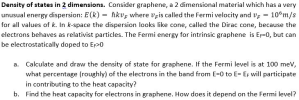 Density of states in 2 dimensions. Consider graphene, a 2 dimensional material which has a very unusual energy dispersion: E(k) -hkvF where VFis called the Fermi velocity and vF 10 m/s for all values of k. In k-space the dispersion looks like cone, called the Dirac cone, because the electrons behaves as relativist particles. The Fermi energy for intrinsic graphene is Ef-0, but can be electrostatically doped to Ef O - hkv; where Vris called the Fermi velocity and V...
Try to avoid handwriting please, thank you. 1. Consider the gas of electrons in gold, as...
 Try to avoid handwriting please, thank you.
1. Consider the gas of electrons in gold, as in problem 3 above. (a) Begin by assuming the gas obeys classical statistics. Using the Som- merfeld model for the density of states, an analysis shows that the partition function in the MB distribution is given by (where V is the volume) m3/2v Plug this into the MB distribution and plot N(E) as a function of E. Assume a temperature T 300 K and...
Try to avoid handwriting please, thank you.
1. Consider the gas of electrons in gold, as in problem 3 above. (a) Begin by assuming the gas obeys classical statistics. Using the Som- merfeld model for the density of states, an analysis shows that the partition function in the MB distribution is given by (where V is the volume) m3/2v Plug this into the MB distribution and plot N(E) as a function of E. Assume a temperature T 300 K and...
 2. Fermi-Dirac Statistics. Verify for both the Fermi-Dirac and Bose-Einstein grand partition functions Ż (Equations 7.21 and 7.24 respectively) that the occupancies D (Equation 7.23) and BE (Equation 7.28) can be computed by -1 až where h kT 7.2 Bosons and Fermions called the Fermi-Dirac distribution; I'll call it TFD (7.23) FDT ibution goes to zero when u, and goes to 1 when energy much less than u tend to be occupied, while states r than u tend to be...
 B3 (a) Assume that the T = 0 version of the Fermi-Dirac distribution, namely 1 f (E) exp [E E)/(kBT) +1 in the usual notation, with Ep the Fermi energy, applies for T> 0. Sketch, on the same axes, the distribution for T = 0 and for T> 0, marking the Fermi energy and indicating the thermal energy kBT 5 Marks (b) In the Sommerfeld model (free electron quantum gas), each electron occupies (n/L)3 of k-space volume. Remembering that we...
 (a) In calclum at room temperature, what is the electron energy at which the Fermi-Dlrac distributlon function has the value 0.13? (Glve thls energy to at least three declmal places. Take the temperature to be room temperature, 293 K.) (b) Over what energy range ?? does the Fermi-Dirac distribution function for calcium drop from 0.95 to 0.13? ?? ev
 9(E) = 8VZtem3/2 1. (20 points) The Fermi energy in copper is 7.04 eV. a) What percentage of free electrons in copper are in the excited state at room temperature, 25°C? b) What percentage of free electrons in copper are in the excited state at the melting point of copper, 1083°C? The density of energy states per unit volume per unit energy interval in copper is given by 8V2m3/2 ZVĒ. h3VE, Note the m is the mass of an electron...
 HHHTTTHTTH? N! 20 2) Consider two single-particle states, A anu o, in a system of termions, where A-ux and Ep-+x; that is,level A lies below u by the same amount that level B lies above μ. Prove that the probability of level B being occupied is the same as the probability of level A being unoccupied. In other words, the Fermi-Dirac distribution is "symmetrical" about the point where E=μ 3) The efficiency for a heat engine is given by es-....
 i. l e blank(s). A gap suggest two-word in your answer Drift current in semiconductors is due to electric [20] tield. Carriers in the band are referred to as statistics is applied to electrons in The semiconductors. The position and principle states that we cannot simultaneously determine the of electrons. Vy is a . while w is a number and Current in the conduction is due to the flow of Extrinsic semiconductors are vii. viii. The wave function in Schrodinger's...
 Density of states in 2 dimensions. Consider graphene, a 2 dimensional material which has a very unusual energy dispersion: E(k) -hkvF where VFis called the Fermi velocity and vF 10 m/s for all values of k. In k-space the dispersion looks like cone, called the Dirac cone, because the electrons behaves as relativist particles. The Fermi energy for intrinsic graphene is Ef-0, but can be electrostatically doped to Ef O - hkv; where Vris called the Fermi velocity and V...
 Try to avoid handwriting please, thank you.
1. Consider the gas of electrons in gold, as in problem 3 above. (a) Begin by assuming the gas obeys classical statistics. Using the Som- merfeld model for the density of states, an analysis shows that the partition function in the MB distribution is given by (where V is the volume) m3/2v Plug this into the MB distribution and plot N(E) as a function of E. Assume a temperature T 300 K and...
Try to avoid handwriting please, thank you.
1. Consider the gas of electrons in gold, as in problem 3 above. (a) Begin by assuming the gas obeys classical statistics. Using the Som- merfeld model for the density of states, an analysis shows that the partition function in the MB distribution is given by (where V is the volume) m3/2v Plug this into the MB distribution and plot N(E) as a function of E. Assume a temperature T 300 K and...
Most questions answered within 3 hours.
-
Where is the error in this code sequence?
String s1 = "Hello";
String s2 = "ello";...
asked 10 months ago -
Financial data for Joel de Paris, Inc., for last year
follow:
Joel de Paris, Inc.
Balance...
asked 10 months ago -
Consider this reaction:
Al2(SO4)3 (aq)+ BaCl3
(aq) Al2Cl6 (aq)- +
3BaSO4(s) . What is the...
asked 10 months ago -
Suppose that Savneet is considering increasing her
recent random sample from 20 car rentals to 40...
asked 10 months ago -
Trucks arrive at an unloading terminal at an average rate of 120
per hour.
Trucks arrive...
asked 10 months ago -
Why are methanol and ethanol completely soluble in water while
octanol is not very little soluble....
asked 10 months ago -
A facilities manager at a university reads in a research report
that the mean amount of...
asked 10 months ago -
When the CuSO4 is rehydrated by adding water to the anhydrous
compound, is this an endothermic...
asked 10 months ago -
A ray of sunlight is passing from diamond into crown glass; the
angle of incidence is...
asked 10 months ago -
A block of mass 0.249 kg is placed on top of a light, vertical
spring of...
asked 10 months ago -
how do the kidneys compensate in the presences of acidosis
a) trigger hyperventilate
b) reserve acid...
asked 10 months ago -
Question 501 pts
The rental rate of capital to the firm increases. Which of the
following...
asked 10 months ago