In performing the reaction of bromination of trans-stillbene, creating 1,2-dibromo-2-phenylethyl)benzene as a profuct, why is it...
Homework Answers

Add Answer to:
In
performing the reaction of bromination of trans-stillbene, creating
1,2-dibromo-2-phenylethyl)benzene as a profuct, why is it...
bromination of cyclohexene gives only trans-dibromo cyclohexane. why?
bromination of cyclohexene gives only trans-dibromo cyclohexane. why?
1) Write a stepwise mechanisms for the bromination of: a) trans-stilbene and b) cis-stilbene (substitute benzene...
 1) Write a stepwise mechanisms for the bromination of: a) trans-stilbene and b) cis-stilbene (substitute benzene rings by Ph-notation for convenience; e.g., stilbene could be written as Ph- CH=CH-Ph). I 2) Use (S) and (R) nomenclature to label all stereogenic centers in the above products (each has two stereogenic centers) in problem 1. Identify any enantiomers and meso-products. 3) Complete the following table including formula weights and grams and moles of reagents used in order to calculate a theoretical yield...
Part B: cis and trans 1,2-dibromo cyclopentane 1. Draw cis-1,2-dibromocyclopentane and its mirror image below: 2....
 Part B: cis and trans 1,2-dibromo cyclopentane 1. Draw cis-1,2-dibromocyclopentane and its mirror image below: 2. How many carbons in this compound are chiral, (bonded to 4 different groups? 3. Are the molecules superimposable? 1. Can this compound exist as a pair of enantiomers? 5. Which atom (according to IUPAC nomenclature) in the ring does the plane of symmetry cut in half? 6. Draw trans-1,2-dibromocyclopentane and its mirror image below:
(2s,3s)-1,2-dibromo-1,2-diphenylethane were formed in the photobromination reaction, why would it always be accompanied by an equal...
 (2s,3s)-1,2-dibromo-1,2-diphenylethane were formed in the photobromination reaction, why would it always be accompanied by an equal amount of the (2R,3R)-enantiomer, giving a racemic mixture?
Bromination of Alkenes 1: Write the reaction for the transformation of trans-stilbene to products, and why...
Bromination of Alkenes 1: Write the reaction for the transformation of trans-stilbene to products, and why do we not see carbocation in this reaction? Pyridinium Tribromide was used instead Elemental Bromine and Ethanol was used as a solvent Also, what would be the limiting reagent in this reaction and why?
Why is it important for all of your glassware to be clean and dry before performing...
 Why is it important for all of your glassware to be clean and dry before performing a titration? Why are air bubbles in the burette tip a possible source of error in a titration experiment? How do you remove air bubbles from the burette tip?
Synthesis Based Experiment 1: Free Radical Bromination of 1,2-Diphenylethane 1. If the R,R and S,S enantiomers...
 Synthesis Based Experiment 1: Free Radical Bromination of 1,2-Diphenylethane 1. If the R,R and S,S enantiomers of 1,2-dibromo-1,2-diphenylethane have an observed melting point range of 113 -114'C and the meso 1,2-dibromo-1,2-diphenylethane has an observed melting point range of 236-237 C, which stereoisomer did you isolate? TLC 2. All three of these dibromo stereoisomers were produced in this reaction but you only isolated one of them. Explain this result taking into account the large differences in the three stereoisomers melting point...
1. Why is there an ease of nitration and bromination of phenol relative to benzene? 2....
1. Why is there an ease of nitration and bromination of phenol relative to benzene? 2. What are some reactions of alcohols: - oxidation, dehydration, esterification, acylation.
Bromination of trans-Stilbene Introduction can drastically valla very viss The alkene halogenation reaction is a class...
 Bromination of trans-Stilbene Introduction can drastically valla very viss The alkene halogenation reaction is a class of reacties in which ha s as clectrophiles 10 attack double bond. Reactivity of halogens can drastically in the fileness of a halogenation react For example, the high reactivity of fluorine e of jodine results in very slow orine pas causes a very vigorous reaction while the low reactivity reactions. Chlorine and bromine showmoderate reactivity and a commonly used in this type of reaction:...
The treatment of i) trans-2-chlorocyclohexanol with NaOH yields 1,2-epoxycyclohexane, yet the reaction of the ii) cis-2-chlorocyclohexanol...
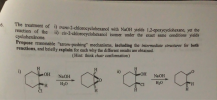 The treatment of i) trans-2-chlorocyclohexanol with NaOH yields 1,2-epoxycyclohexane, yet the reaction of the ii) cis-2-chlorocyclohexanol isomer under the exact same conditions yields cyclohexanone. Propose reasonable "arrow-pushing" mechanisms, including the intermediate structures for both reactions, and briefly explain for each why the different results are obtained. (Hint: think chair conformation) i) ii) NaOH OH NAOH கயாக H20 H2O my
 1) Write a stepwise mechanisms for the bromination of: a) trans-stilbene and b) cis-stilbene (substitute benzene rings by Ph-notation for convenience; e.g., stilbene could be written as Ph- CH=CH-Ph). I 2) Use (S) and (R) nomenclature to label all stereogenic centers in the above products (each has two stereogenic centers) in problem 1. Identify any enantiomers and meso-products. 3) Complete the following table including formula weights and grams and moles of reagents used in order to calculate a theoretical yield...
 Part B: cis and trans 1,2-dibromo cyclopentane 1. Draw cis-1,2-dibromocyclopentane and its mirror image below: 2. How many carbons in this compound are chiral, (bonded to 4 different groups? 3. Are the molecules superimposable? 1. Can this compound exist as a pair of enantiomers? 5. Which atom (according to IUPAC nomenclature) in the ring does the plane of symmetry cut in half? 6. Draw trans-1,2-dibromocyclopentane and its mirror image below:
 (2s,3s)-1,2-dibromo-1,2-diphenylethane were formed in the photobromination reaction, why would it always be accompanied by an equal amount of the (2R,3R)-enantiomer, giving a racemic mixture?
 Why is it important for all of your glassware to be clean and dry before performing a titration? Why are air bubbles in the burette tip a possible source of error in a titration experiment? How do you remove air bubbles from the burette tip?
 Synthesis Based Experiment 1: Free Radical Bromination of 1,2-Diphenylethane 1. If the R,R and S,S enantiomers of 1,2-dibromo-1,2-diphenylethane have an observed melting point range of 113 -114'C and the meso 1,2-dibromo-1,2-diphenylethane has an observed melting point range of 236-237 C, which stereoisomer did you isolate? TLC 2. All three of these dibromo stereoisomers were produced in this reaction but you only isolated one of them. Explain this result taking into account the large differences in the three stereoisomers melting point...
 Bromination of trans-Stilbene Introduction can drastically valla very viss The alkene halogenation reaction is a class of reacties in which ha s as clectrophiles 10 attack double bond. Reactivity of halogens can drastically in the fileness of a halogenation react For example, the high reactivity of fluorine e of jodine results in very slow orine pas causes a very vigorous reaction while the low reactivity reactions. Chlorine and bromine showmoderate reactivity and a commonly used in this type of reaction:...
 The treatment of i) trans-2-chlorocyclohexanol with NaOH yields 1,2-epoxycyclohexane, yet the reaction of the ii) cis-2-chlorocyclohexanol isomer under the exact same conditions yields cyclohexanone. Propose reasonable "arrow-pushing" mechanisms, including the intermediate structures for both reactions, and briefly explain for each why the different results are obtained. (Hint: think chair conformation) i) ii) NaOH OH NAOH கயாக H20 H2O my
Most questions answered within 3 hours.
-
Where is the error in this code sequence?
String s1 = "Hello";
String s2 = "ello";...
asked 10 months ago -
Financial data for Joel de Paris, Inc., for last year
follow:
Joel de Paris, Inc.
Balance...
asked 10 months ago -
Consider this reaction:
Al2(SO4)3 (aq)+ BaCl3
(aq) Al2Cl6 (aq)- +
3BaSO4(s) . What is the...
asked 10 months ago -
Suppose that Savneet is considering increasing her
recent random sample from 20 car rentals to 40...
asked 10 months ago -
Trucks arrive at an unloading terminal at an average rate of 120
per hour.
Trucks arrive...
asked 10 months ago -
Why are methanol and ethanol completely soluble in water while
octanol is not very little soluble....
asked 10 months ago -
A facilities manager at a university reads in a research report
that the mean amount of...
asked 10 months ago -
When the CuSO4 is rehydrated by adding water to the anhydrous
compound, is this an endothermic...
asked 10 months ago -
A ray of sunlight is passing from diamond into crown glass; the
angle of incidence is...
asked 10 months ago -
A block of mass 0.249 kg is placed on top of a light, vertical
spring of...
asked 10 months ago -
how do the kidneys compensate in the presences of acidosis
a) trigger hyperventilate
b) reserve acid...
asked 10 months ago -
Question 501 pts
The rental rate of capital to the firm increases. Which of the
following...
asked 10 months ago