Two bumper cars in an amusement park ride collide elastically as one approaches the other directly...
Two bumper cars in an amusement park ride collide elastically as one approaches the other directly from the rear. Car A has a mass of 455 kg and car B 505 kg . Car A approaches at 4.50 m/s and car B is moving at 3.70 m/s Determine the velocity of car A after the collision Determine the velocity of car B after the collision Calculate the change in momentum of car A after the collision. Calculate the change in momentum of car B after the collision
Homework Answers

Add Answer to:
Two bumper cars in an amusement park ride collide elastically as
one approaches the other directly...
Two bumper cars in an amusement park ride collide elastically as one approaches the other directly...
Two bumper cars in an amusement park ride collide elastically as one approaches the other directly from the rear. Car A has a mass of 450 kg and car B 495 kg . Car A approaches at 4.50 m/s and car B is moving at 3.70 m/s. Calculate the change in momentum of car B after the collision.
A pair of bumper cars in an amusement park ride collide elastically as one approaches the...
A pair of bumper cars in an amusement park ride collide elastically as one approaches the other directly from the rear, as seen in part (a) of the figure below. ((a) before collision, (b) after collision) One has a mass of m1 = 441 kg and the other m2 = 562 kg, owing to differences in passenger mass. If the lighter one approaches at v1 = 4.30 m/s and the other is moving at v2 = 3.70 m/s, calculate the...
The bumper cars at an amusement park collide as one approaches the other directly from the...
The bumper cars at an amusement park collide as one approaches the other directly from the rear. Car A has a mass of 401 kg and a velocity of 5.0 m/s. Car B has a mass of 481 kg and a velocity of 3.3 m/s. The coefficient of restitution is 0.63. A. Determine the velocity of car A immediately after the collision. B. Determine the velocity of car B immediately after the collision. C. Determine the change in momentum of...
The bumper cars at an amusement park collide as one approaches the other directly from the...
The bumper cars at an amusement park collide as one approaches the other directly from the rear. Car A has a mass of 426 kg and a velocity of 5.0 m/s. Car B has a mass of 470 kg and a velocity of 3.2 m/s. The coefficient of restitution is 0.72. A) Determine the velocity of car A immediately after the collision. (include units with answer) B) Determine the velocity of car B immediately after the collision. (include units with...
Two bumper cars
Two bumper cars in an amusement park ride collide elastically as one approaches the other directly from the rear. Car A has a mass of 450 kg and car B 550 kg, owing todifferences in passenger mass. If car A approaches at 4.5 m/s and car B is moving at 3.7 m/s calculate (a) their velocities after the collision, and (b) the change inmomentum of each.
Two bumper cars collide head on. Bumper car 1 has a weight of 150 lb and...
Two bumper cars collide head on. Bumper car 1 has a weight of 150 lb and is moving with a speed of 6 ft/s. Bumper car 2 has a weight of 170 lb and is moving with a speed of 4 ft/s. If no energy is lost during the collision, A) what are the velocities of the two cars after the collision? B) What is the magnitude of the average force between the two cars during the collision if it...
At a county fair, two children ram each other head-on while riding on the bumper cars....
At a county fair, two children ram each other head-on while riding on the bumper cars. Jill and her car, traveling left at 3.30 m/s , have a total mass of 350 kg . Jack and his car, traveling to the right at 1.60 m/s , have a total mass of 270 kg . Part A: Assuming the collision to be elastic, determine the speed of Jill and her car after the collision. Part B: Determine the direction of the...
2 cars collide, coming from the bottom, as seen in the diagram. The momentum of the...
 2
cars collide, coming from the bottom, as seen in the diagram. The
momentum of the blue car was found to be 24kg*m/s (52ENE) before
the collision and 16.4kg/m/s (64NWN) after the collision. The red
car was found to have a momentum of 13.3 kg*m/s (50WNW) and 20.8
kg*m/s (52ENE)
a)What was the Total Momentum Before the Collision and
After?
b) What was the Change in Momentum of Car 1 and 2
c) What was the total kinetic energy before...
2
cars collide, coming from the bottom, as seen in the diagram. The
momentum of the blue car was found to be 24kg*m/s (52ENE) before
the collision and 16.4kg/m/s (64NWN) after the collision. The red
car was found to have a momentum of 13.3 kg*m/s (50WNW) and 20.8
kg*m/s (52ENE)
a)What was the Total Momentum Before the Collision and
After?
b) What was the Change in Momentum of Car 1 and 2
c) What was the total kinetic energy before...
Physics Momentum: Car Crash Two cars collide and stick together. The total momentum of a system...
Physics Momentum: Car Crash Two cars collide and stick together. The total momentum of a system before a collision is 30,000 kgm/s. If each car has a mass of 1500 kg, what is the magnitude of the velocity of the stuck cars after the collision? a) 20m/s b) 2.2m/s c) 0.05m/s d) 10m/s
Chapter D2, Problem D2/146 In the design of an amusement park ride, the cars are attached...
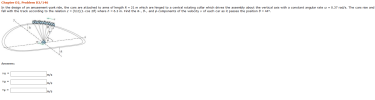 Chapter D2, Problem D2/146 In the design of an amusement park ride, the cars are attached to arms of length R = 21 m which are hinged to a central rotating collar which drives the assembly about the vertical axis with a constant angular rate w = 0.37 rad/s. The cars rise and fall with the track according to the relation z = (h/2)(1-сos 20) where h = 6.3 m. Find the R-, -, and 0-components of the velocity v...
 2
cars collide, coming from the bottom, as seen in the diagram. The
momentum of the blue car was found to be 24kg*m/s (52ENE) before
the collision and 16.4kg/m/s (64NWN) after the collision. The red
car was found to have a momentum of 13.3 kg*m/s (50WNW) and 20.8
kg*m/s (52ENE)
a)What was the Total Momentum Before the Collision and
After?
b) What was the Change in Momentum of Car 1 and 2
c) What was the total kinetic energy before...
2
cars collide, coming from the bottom, as seen in the diagram. The
momentum of the blue car was found to be 24kg*m/s (52ENE) before
the collision and 16.4kg/m/s (64NWN) after the collision. The red
car was found to have a momentum of 13.3 kg*m/s (50WNW) and 20.8
kg*m/s (52ENE)
a)What was the Total Momentum Before the Collision and
After?
b) What was the Change in Momentum of Car 1 and 2
c) What was the total kinetic energy before...
 Chapter D2, Problem D2/146 In the design of an amusement park ride, the cars are attached to arms of length R = 21 m which are hinged to a central rotating collar which drives the assembly about the vertical axis with a constant angular rate w = 0.37 rad/s. The cars rise and fall with the track according to the relation z = (h/2)(1-сos 20) where h = 6.3 m. Find the R-, -, and 0-components of the velocity v...
Most questions answered within 3 hours.
-
Where is the error in this code sequence?
String s1 = "Hello";
String s2 = "ello";...
asked 11 months ago -
Financial data for Joel de Paris, Inc., for last year
follow:
Joel de Paris, Inc.
Balance...
asked 11 months ago -
Consider this reaction:
Al2(SO4)3 (aq)+ BaCl3
(aq) Al2Cl6 (aq)- +
3BaSO4(s) . What is the...
asked 11 months ago -
Suppose that Savneet is considering increasing her
recent random sample from 20 car rentals to 40...
asked 11 months ago -
Trucks arrive at an unloading terminal at an average rate of 120
per hour.
Trucks arrive...
asked 11 months ago -
Why are methanol and ethanol completely soluble in water while
octanol is not very little soluble....
asked 11 months ago -
A facilities manager at a university reads in a research report
that the mean amount of...
asked 11 months ago -
When the CuSO4 is rehydrated by adding water to the anhydrous
compound, is this an endothermic...
asked 11 months ago -
A ray of sunlight is passing from diamond into crown glass; the
angle of incidence is...
asked 11 months ago -
A block of mass 0.249 kg is placed on top of a light, vertical
spring of...
asked 11 months ago -
how do the kidneys compensate in the presences of acidosis
a) trigger hyperventilate
b) reserve acid...
asked 11 months ago -
Question 501 pts
The rental rate of capital to the firm increases. Which of the
following...
asked 11 months ago