Please draw a separation scheme for the bromination of acetanilide. Bromine and hydrobromic acid were added.
Homework Answers

Add Answer to:
Please draw a separation scheme for the bromination of acetanilide.
Bromine and hydrobromic acid were added.
1) Write a mechanism for the bromination of acetanilide with bromine in acetic acid. Be as...
1) Write a mechanism for the bromination of acetanilide with bromine in acetic acid. Be as complete as possible and include all relevant resonance structures. Show electron flow for all steps.
Aniline and acetanilide undergo electrophilic aromatic bromination readily. Aniline is so reactive that it needs no...
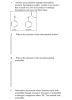 Aniline and acetanilide undergo electrophilic aromatic bromination readily. Aniline is so reactive that it needs no Lewis acid catalyst to undergo bromination, not once, but three times. NH2 HN aniline acetanilide A What is the structure of the tribrominated aniline? B What is the structure of the monobrominated nacetanilide C Rationalize the position where bromine reacts with acetanilide through resonance structures of acetanilide or through s-complexes where "Br" has reacted with acetanilide.
Draw the mechanism of the bromination reaction between trans cinnamic acid and bromine. Be sure to...
Draw the mechanism of the bromination reaction between trans cinnamic acid and bromine. Be sure to include stereochemistry( wedge and dashed structures). The product obtained was the racemic mixture of (2R,3S) and (2S,3R) of 2,3-dibromo-3-phenylpropanoic acid.
Draw out the detailed mechanisms for each step of bromination of acetanilide, aniline, and anisol...
 Draw out the detailed mechanisms for each step of bromination of
acetanilide, aniline, and anisole while including the most stable
resonance contributor for each intermediate. Then rank the three in
order of activating ability and clearly explain why.
C-CH3 NH2 OCH3 Acetanilide Aniline Anisole
C-CH3 NH2 OCH3 Acetanilide Aniline Anisole
Draw out the detailed mechanisms for each step of bromination of
acetanilide, aniline, and anisole while including the most stable
resonance contributor for each intermediate. Then rank the three in
order of activating ability and clearly explain why.
C-CH3 NH2 OCH3 Acetanilide Aniline Anisole
C-CH3 NH2 OCH3 Acetanilide Aniline Anisole
The Bromination of acetone is acid catalyzed; The rate of disappearance of bromine as measured for...
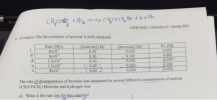 The Bromination of acetone is acid catalyzed; The rate of disappearance of bromine as measured for several different concentrations of acetone (CH3COCH3) Bromine and hydrogen ions a) What is the rate law for this reaction?
Bromination of Acetanilide In a 25-mL Erlenmeyer flask, dissolve 0.68 g of acetanilide in approximately 4...
Bromination of Acetanilide In a 25-mL Erlenmeyer flask, dissolve 0.68 g of acetanilide in approximately 4 mL glacial acetic acid. Record the exact amount of the limiting reactant that you used. Add a stir bar followed by 1.6 g pyridinium tribromide. Heat the mixture to ~60°C in a warm water bath for 10 minutes. After the 10 minutes, add 15 mL water and approximately 2 mL saturated sodium bisulfite solution to remove excess bromine, which shows by the disappearance of...
Reaction Scheme for the bromination of trans-stilbene added with chloroform and TLCed with a hexane:ethyl acetate...
Reaction Scheme for the bromination of trans-stilbene added with chloroform and TLCed with a hexane:ethyl acetate (4:1) solvent mixture
Please explain and correctly identify the correct separation scheme of 2bromo-5methylhept-5 enoic acid. Attached is the...
 Please explain and correctly identify the correct separation
scheme of 2bromo-5methylhept-5 enoic acid. Attached is the
INCORRECT separation scheme. Thank you!
Incorrect Separation Scheme ether, 5% NaHCO, aq ether 10% NaOH evap. ether 29 ether NaCl HO
Please explain and correctly identify the correct separation
scheme of 2bromo-5methylhept-5 enoic acid. Attached is the
INCORRECT separation scheme. Thank you!
Incorrect Separation Scheme ether, 5% NaHCO, aq ether 10% NaOH evap. ether 29 ether NaCl HO
draw a separation scheme to show how a pure product can be isolated. Br. H +...
 draw a separation scheme to show how a pure product can be
isolated.
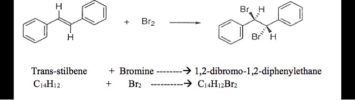
Br. H + Brz BH Trans-stilbene C14H12 + Bromine --------→ 1,2-dibromo-1,2-diphenylethane + Br2 ----------> C14H12Br2
draw a separation scheme to show how a pure product can be
isolated.
Br. H + Brz BH Trans-stilbene C14H12 + Bromine --------→ 1,2-dibromo-1,2-diphenylethane + Br2 ----------> C14H12Br2
can someone help please!!! REPORT FORM: REGIOSELECTIVE BROMINATION OF ACETANILIDE Balanced Equation(s) for Main Reaction(s): Brz...
 can someone help please!!!
REPORT FORM: REGIOSELECTIVE BROMINATION OF ACETANILIDE Balanced Equation(s) for Main Reaction(s): Brz Hjc Coche 4 И В Balanced Equation(s) for Important Side Reactions): compound MW mg or ml mmol acetanilide B5.17 95 mg 6. 25 ml bromine 159.22 p-bromoacetanilide 214.07 Indicate the limiting reagent with an asterisk (*). Product Observed melting point range: 160.0.4480 Literature melting point range:167.169 °C Molecular weight of product: 214.07 Theoretical yield: Experimental yield: g Percent yield: 95 %
can someone help please!!!
REPORT FORM: REGIOSELECTIVE BROMINATION OF ACETANILIDE Balanced Equation(s) for Main Reaction(s): Brz Hjc Coche 4 И В Balanced Equation(s) for Important Side Reactions): compound MW mg or ml mmol acetanilide B5.17 95 mg 6. 25 ml bromine 159.22 p-bromoacetanilide 214.07 Indicate the limiting reagent with an asterisk (*). Product Observed melting point range: 160.0.4480 Literature melting point range:167.169 °C Molecular weight of product: 214.07 Theoretical yield: Experimental yield: g Percent yield: 95 %
 Aniline and acetanilide undergo electrophilic aromatic bromination readily. Aniline is so reactive that it needs no Lewis acid catalyst to undergo bromination, not once, but three times. NH2 HN aniline acetanilide A What is the structure of the tribrominated aniline? B What is the structure of the monobrominated nacetanilide C Rationalize the position where bromine reacts with acetanilide through resonance structures of acetanilide or through s-complexes where "Br" has reacted with acetanilide.
 Draw out the detailed mechanisms for each step of bromination of
acetanilide, aniline, and anisole while including the most stable
resonance contributor for each intermediate. Then rank the three in
order of activating ability and clearly explain why.
C-CH3 NH2 OCH3 Acetanilide Aniline Anisole
C-CH3 NH2 OCH3 Acetanilide Aniline Anisole
Draw out the detailed mechanisms for each step of bromination of
acetanilide, aniline, and anisole while including the most stable
resonance contributor for each intermediate. Then rank the three in
order of activating ability and clearly explain why.
C-CH3 NH2 OCH3 Acetanilide Aniline Anisole
C-CH3 NH2 OCH3 Acetanilide Aniline Anisole
 The Bromination of acetone is acid catalyzed; The rate of disappearance of bromine as measured for several different concentrations of acetone (CH3COCH3) Bromine and hydrogen ions a) What is the rate law for this reaction?
 Please explain and correctly identify the correct separation
scheme of 2bromo-5methylhept-5 enoic acid. Attached is the
INCORRECT separation scheme. Thank you!
Incorrect Separation Scheme ether, 5% NaHCO, aq ether 10% NaOH evap. ether 29 ether NaCl HO
Please explain and correctly identify the correct separation
scheme of 2bromo-5methylhept-5 enoic acid. Attached is the
INCORRECT separation scheme. Thank you!
Incorrect Separation Scheme ether, 5% NaHCO, aq ether 10% NaOH evap. ether 29 ether NaCl HO
 draw a separation scheme to show how a pure product can be
isolated.
Br. H + Brz BH Trans-stilbene C14H12 + Bromine --------→ 1,2-dibromo-1,2-diphenylethane + Br2 ----------> C14H12Br2
draw a separation scheme to show how a pure product can be
isolated.
Br. H + Brz BH Trans-stilbene C14H12 + Bromine --------→ 1,2-dibromo-1,2-diphenylethane + Br2 ----------> C14H12Br2
 can someone help please!!!
REPORT FORM: REGIOSELECTIVE BROMINATION OF ACETANILIDE Balanced Equation(s) for Main Reaction(s): Brz Hjc Coche 4 И В Balanced Equation(s) for Important Side Reactions): compound MW mg or ml mmol acetanilide B5.17 95 mg 6. 25 ml bromine 159.22 p-bromoacetanilide 214.07 Indicate the limiting reagent with an asterisk (*). Product Observed melting point range: 160.0.4480 Literature melting point range:167.169 °C Molecular weight of product: 214.07 Theoretical yield: Experimental yield: g Percent yield: 95 %
can someone help please!!!
REPORT FORM: REGIOSELECTIVE BROMINATION OF ACETANILIDE Balanced Equation(s) for Main Reaction(s): Brz Hjc Coche 4 И В Balanced Equation(s) for Important Side Reactions): compound MW mg or ml mmol acetanilide B5.17 95 mg 6. 25 ml bromine 159.22 p-bromoacetanilide 214.07 Indicate the limiting reagent with an asterisk (*). Product Observed melting point range: 160.0.4480 Literature melting point range:167.169 °C Molecular weight of product: 214.07 Theoretical yield: Experimental yield: g Percent yield: 95 %
Most questions answered within 3 hours.
-
Where is the error in this code sequence?
String s1 = "Hello";
String s2 = "ello";...
asked 10 months ago -
Financial data for Joel de Paris, Inc., for last year
follow:
Joel de Paris, Inc.
Balance...
asked 10 months ago -
Consider this reaction:
Al2(SO4)3 (aq)+ BaCl3
(aq) Al2Cl6 (aq)- +
3BaSO4(s) . What is the...
asked 10 months ago -
Suppose that Savneet is considering increasing her
recent random sample from 20 car rentals to 40...
asked 10 months ago -
Trucks arrive at an unloading terminal at an average rate of 120
per hour.
Trucks arrive...
asked 10 months ago -
Why are methanol and ethanol completely soluble in water while
octanol is not very little soluble....
asked 10 months ago -
A facilities manager at a university reads in a research report
that the mean amount of...
asked 10 months ago -
When the CuSO4 is rehydrated by adding water to the anhydrous
compound, is this an endothermic...
asked 10 months ago -
A ray of sunlight is passing from diamond into crown glass; the
angle of incidence is...
asked 10 months ago -
A block of mass 0.249 kg is placed on top of a light, vertical
spring of...
asked 10 months ago -
how do the kidneys compensate in the presences of acidosis
a) trigger hyperventilate
b) reserve acid...
asked 10 months ago -
Question 501 pts
The rental rate of capital to the firm increases. Which of the
following...
asked 10 months ago