Can someone explain the reaction/mechanism of the Wittig Reaction to form (E) and (Z) -1-(4-bromophenyl)-2-phenylethene? and Aldol...
Can someone explain the reaction/mechanism of the Wittig Reaction to form (E) and (Z) -1-(4-bromophenyl)-2-phenylethene?
and Aldol Reaction to form dibenzylidenacetone?
Homework Answers
Request Answer!
We need at least 10 more requests to produce the answer.
0 / 10 have requested this problem solution
The more requests, the faster the answer.
Add Answer to:
Can someone explain the reaction/mechanism of the Wittig
Reaction to form (E) and (Z)
-1-(4-bromophenyl)-2-phenylethene?
and Aldol...
In this experiment, (E)- and (Z)-1-(4-bromophenyl)-2-phenylethene 6 and 7 are synthesized by a solvent-free, mechano-chemical Wittig...
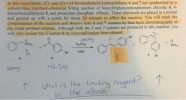 In this experiment, (E)- and (Z)-1-(4-bromophenyl)-2-phenylethene 6 and 7 are synthesized by a solvent-free, mechano-chemical Wittig reaction of benzyltriphenylphosphonium chloride 4, 4- bromobenzaldehyde 5, and potassium phosphate tribasic. These chemicals are placed in a mortar and ground up with a pestle for about 20 minutes to effect the reaction. You will track the completeness of the reaction and observe both 6 and 7 isomers by thin-layer chromatography of the crude product mixture. Although both the E and Z isomers are...
2- Show the how each alkene can be synthesized by a Wittig reaction including mechanism. (There are two routes to e...
 2- Show the how each alkene can be synthesized by a Wittig reaction including mechanism. (There are two routes to each). Plus show how to synthesize the corresponding ylides.
2-Phenylacetaldehyde undergoes an aldol reaction to form 3-hydroxy-2,4-diphenylbutanal. Complete the mechanism for the reaction by adding...
 2-Phenylacetaldehyde undergoes an aldol reaction to
form 3-hydroxy-2,4-diphenylbutanal. Complete the mechanism for the
reaction by adding missing atoms, bonds, nonbonding electrons, and
curved arrows
2-Phenylacetaldehyde undergoes an aldol reaction to
form 3-hydroxy-2,4-diphenylbutanal. Complete the mechanism for the
reaction by adding missing atoms, bonds, nonbonding electrons, and
curved arrows
This is the Wittig reaction (synthesis to make E and Z stilbenes) This is for the...
 This is the Wittig reaction (synthesis to make E and Z
stilbenes)
This is for the Wittig Lab of Organic Chemistry 2. Please answer
to all 3 questions with explanations as simple and specific and
possible to understand.
(CgHs)3РСH,CoH,Cr, NaOH H CH2CI2 What happens when NaOH is added to the reaction mixture? Draw the species formed and any reasonable resonance form(s). 10 pts 1. Once the reaction mixture is added to a test tube and dichloromethane (DCM) is added, why...
This is the Wittig reaction (synthesis to make E and Z
stilbenes)
This is for the Wittig Lab of Organic Chemistry 2. Please answer
to all 3 questions with explanations as simple and specific and
possible to understand.
(CgHs)3РСH,CoH,Cr, NaOH H CH2CI2 What happens when NaOH is added to the reaction mixture? Draw the species formed and any reasonable resonance form(s). 10 pts 1. Once the reaction mixture is added to a test tube and dichloromethane (DCM) is added, why...
This is the Wittig reaction (synthesis to make E and Z stilbenes) This is for the...
 This is the Wittig reaction (synthesis to make E and Z
stilbenes)
This is for the Wittig Lab of Organic Chemistry 2. Please answer
to all 3 questions with explanations as simple and specific and
possible to understand.
(CgHs)3РСH,CoH,Cr, NaOH H CH2CI2 What happens when NaOH is added to the reaction mixture? Draw the species formed and any reasonable resonance form(s). 10 pts 1. Once the reaction mixture is added to a test tube and dichloromethane (DCM) is added, why...
This is the Wittig reaction (synthesis to make E and Z
stilbenes)
This is for the Wittig Lab of Organic Chemistry 2. Please answer
to all 3 questions with explanations as simple and specific and
possible to understand.
(CgHs)3РСH,CoH,Cr, NaOH H CH2CI2 What happens when NaOH is added to the reaction mixture? Draw the species formed and any reasonable resonance form(s). 10 pts 1. Once the reaction mixture is added to a test tube and dichloromethane (DCM) is added, why...
Introduction: A description of the Wittig reaction, including the mechanism and driving force. See tex 1....
 Introduction: A description of the Wittig reaction, including the mechanism and driving force. See tex 1. 16.10, 10th Ed. Clearly draw the products showing stereochemistry (E vs Z) 2. RP=CH-CH3 + CH3-CH- R P=CH-CH3 Ph-CH-O R3P=CH-COOR CH3-CH=O
2-Phenylacetaldehyde undergoes an aldol reaction to form 3-hydroxy-2,4-diphenylbutanal shown below. 2-Phenylacetaldehyde undergoes an aldol reaction to...
 2-Phenylacetaldehyde undergoes an aldol reaction to form
3-hydroxy-2,4-diphenylbutanal shown below.
2-Phenylacetaldehyde undergoes an aldol reaction to form 3-hydroxy-2,4-diphenylbutanal shown below. o 10%NaOH 5°C HO Complete the mechanism for the reaction by adding missing atoms, bonds, charges, nonbonding electrons, and curved arrows.
2-Phenylacetaldehyde undergoes an aldol reaction to form
3-hydroxy-2,4-diphenylbutanal shown below.
2-Phenylacetaldehyde undergoes an aldol reaction to form 3-hydroxy-2,4-diphenylbutanal shown below. o 10%NaOH 5°C HO Complete the mechanism for the reaction by adding missing atoms, bonds, charges, nonbonding electrons, and curved arrows.
Can someone explain the mechanisms + products for these reactions? 1. (3p) Draw the mechanism and...
 Can someone explain the mechanisms + products for these
reactions?
1. (3p) Draw the mechanism and the expected reaction product for the following reaction: ? 2. (3p). Draw the mechanism and the expected Nucleophilic Substitution Reaction Product for the following reaction: ? OH
Can someone explain the mechanisms + products for these
reactions?
1. (3p) Draw the mechanism and the expected reaction product for the following reaction: ? 2. (3p). Draw the mechanism and the expected Nucleophilic Substitution Reaction Product for the following reaction: ? OH
In the box provided, draw the structures of the phosphorus ylid and carbonyl compound that can be reacted in a Wittig reaction to form the alkene shown below.
 In the box provided, draw the structures of the phosphorus ylid and carbonylcompound that can be reacted in a Wittig reaction to form the alkene shown below.I need the mechanism to get the answers.
la) Consider the mixed aldol condensation reaction of 1-methylcyclopentane-1-carbaldehyde (shown below) and 3,3-dimethyl-2-butanone (shown below) in...
 la) Consider the mixed aldol condensation reaction of 1-methylcyclopentane-1-carbaldehyde (shown below) and 3,3-dimethyl-2-butanone (shown below) in the presence of sodium hydroxide Provide the expected major MIXED aldol condensation product for this reaction (can exist as E or Z isomer so you can draw either) b) Would you have to heat the reaction mixture in order for the reaction to form the aldol condensation product? Why or wh y not? 2) Consider the mixed aldol condensation reaction of 3,3-dimethyl-2-butanone (shown in...
 In this experiment, (E)- and (Z)-1-(4-bromophenyl)-2-phenylethene 6 and 7 are synthesized by a solvent-free, mechano-chemical Wittig reaction of benzyltriphenylphosphonium chloride 4, 4- bromobenzaldehyde 5, and potassium phosphate tribasic. These chemicals are placed in a mortar and ground up with a pestle for about 20 minutes to effect the reaction. You will track the completeness of the reaction and observe both 6 and 7 isomers by thin-layer chromatography of the crude product mixture. Although both the E and Z isomers are...
 2- Show the how each alkene can be synthesized by a Wittig reaction including mechanism. (There are two routes to each). Plus show how to synthesize the corresponding ylides.
 2-Phenylacetaldehyde undergoes an aldol reaction to
form 3-hydroxy-2,4-diphenylbutanal. Complete the mechanism for the
reaction by adding missing atoms, bonds, nonbonding electrons, and
curved arrows
2-Phenylacetaldehyde undergoes an aldol reaction to
form 3-hydroxy-2,4-diphenylbutanal. Complete the mechanism for the
reaction by adding missing atoms, bonds, nonbonding electrons, and
curved arrows
 This is the Wittig reaction (synthesis to make E and Z
stilbenes)
This is for the Wittig Lab of Organic Chemistry 2. Please answer
to all 3 questions with explanations as simple and specific and
possible to understand.
(CgHs)3РСH,CoH,Cr, NaOH H CH2CI2 What happens when NaOH is added to the reaction mixture? Draw the species formed and any reasonable resonance form(s). 10 pts 1. Once the reaction mixture is added to a test tube and dichloromethane (DCM) is added, why...
This is the Wittig reaction (synthesis to make E and Z
stilbenes)
This is for the Wittig Lab of Organic Chemistry 2. Please answer
to all 3 questions with explanations as simple and specific and
possible to understand.
(CgHs)3РСH,CoH,Cr, NaOH H CH2CI2 What happens when NaOH is added to the reaction mixture? Draw the species formed and any reasonable resonance form(s). 10 pts 1. Once the reaction mixture is added to a test tube and dichloromethane (DCM) is added, why...
 This is the Wittig reaction (synthesis to make E and Z
stilbenes)
This is for the Wittig Lab of Organic Chemistry 2. Please answer
to all 3 questions with explanations as simple and specific and
possible to understand.
(CgHs)3РСH,CoH,Cr, NaOH H CH2CI2 What happens when NaOH is added to the reaction mixture? Draw the species formed and any reasonable resonance form(s). 10 pts 1. Once the reaction mixture is added to a test tube and dichloromethane (DCM) is added, why...
This is the Wittig reaction (synthesis to make E and Z
stilbenes)
This is for the Wittig Lab of Organic Chemistry 2. Please answer
to all 3 questions with explanations as simple and specific and
possible to understand.
(CgHs)3РСH,CoH,Cr, NaOH H CH2CI2 What happens when NaOH is added to the reaction mixture? Draw the species formed and any reasonable resonance form(s). 10 pts 1. Once the reaction mixture is added to a test tube and dichloromethane (DCM) is added, why...
 Introduction: A description of the Wittig reaction, including the mechanism and driving force. See tex 1. 16.10, 10th Ed. Clearly draw the products showing stereochemistry (E vs Z) 2. RP=CH-CH3 + CH3-CH- R P=CH-CH3 Ph-CH-O R3P=CH-COOR CH3-CH=O
 2-Phenylacetaldehyde undergoes an aldol reaction to form
3-hydroxy-2,4-diphenylbutanal shown below.
2-Phenylacetaldehyde undergoes an aldol reaction to form 3-hydroxy-2,4-diphenylbutanal shown below. o 10%NaOH 5°C HO Complete the mechanism for the reaction by adding missing atoms, bonds, charges, nonbonding electrons, and curved arrows.
2-Phenylacetaldehyde undergoes an aldol reaction to form
3-hydroxy-2,4-diphenylbutanal shown below.
2-Phenylacetaldehyde undergoes an aldol reaction to form 3-hydroxy-2,4-diphenylbutanal shown below. o 10%NaOH 5°C HO Complete the mechanism for the reaction by adding missing atoms, bonds, charges, nonbonding electrons, and curved arrows.
 Can someone explain the mechanisms + products for these
reactions?
1. (3p) Draw the mechanism and the expected reaction product for the following reaction: ? 2. (3p). Draw the mechanism and the expected Nucleophilic Substitution Reaction Product for the following reaction: ? OH
Can someone explain the mechanisms + products for these
reactions?
1. (3p) Draw the mechanism and the expected reaction product for the following reaction: ? 2. (3p). Draw the mechanism and the expected Nucleophilic Substitution Reaction Product for the following reaction: ? OH
 la) Consider the mixed aldol condensation reaction of 1-methylcyclopentane-1-carbaldehyde (shown below) and 3,3-dimethyl-2-butanone (shown below) in the presence of sodium hydroxide Provide the expected major MIXED aldol condensation product for this reaction (can exist as E or Z isomer so you can draw either) b) Would you have to heat the reaction mixture in order for the reaction to form the aldol condensation product? Why or wh y not? 2) Consider the mixed aldol condensation reaction of 3,3-dimethyl-2-butanone (shown in...
Most questions answered within 3 hours.
-
Where is the error in this code sequence?
String s1 = "Hello";
String s2 = "ello";...
asked 11 months ago -
Financial data for Joel de Paris, Inc., for last year
follow:
Joel de Paris, Inc.
Balance...
asked 11 months ago -
Consider this reaction:
Al2(SO4)3 (aq)+ BaCl3
(aq) Al2Cl6 (aq)- +
3BaSO4(s) . What is the...
asked 11 months ago -
Suppose that Savneet is considering increasing her
recent random sample from 20 car rentals to 40...
asked 11 months ago -
Trucks arrive at an unloading terminal at an average rate of 120
per hour.
Trucks arrive...
asked 11 months ago -
Why are methanol and ethanol completely soluble in water while
octanol is not very little soluble....
asked 11 months ago -
A facilities manager at a university reads in a research report
that the mean amount of...
asked 11 months ago -
When the CuSO4 is rehydrated by adding water to the anhydrous
compound, is this an endothermic...
asked 11 months ago -
A ray of sunlight is passing from diamond into crown glass; the
angle of incidence is...
asked 11 months ago -
A block of mass 0.249 kg is placed on top of a light, vertical
spring of...
asked 11 months ago -
how do the kidneys compensate in the presences of acidosis
a) trigger hyperventilate
b) reserve acid...
asked 11 months ago -
Question 501 pts
The rental rate of capital to the firm increases. Which of the
following...
asked 11 months ago