An insurance company supposes that the number of accidents that each of its policyholders will have...
An insurance company supposes that the number of accidents that each of its policyholders will have this year is Poisson distributed, with a mean depending on the policyholder: the Poisson mean Λ of a randomly chosen person has a Gamma distribution with the Γ(2, 1)-density function fΛ(λ) = λe^(−λ )(λ > 0). Find the expected value of Λ for a policyholder having x accidents this year (x = 0, 1, 2, . . .).
Homework Answers

Add Answer to:
An insurance company supposes that the number of accidents that
each of its policyholders will have...
2. An insurance company supposes that each person has a accident parameter and that the yearly...
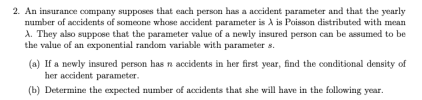 2. An insurance company supposes that each person has a accident parameter and that the yearly number of accidents of someone whose accident parameter is is Poisson distributed with mean 1. They also suppose that the parameter value of a newly insured person can be assumed to be the value of an exponential random variable with parameter s. (a) If a newly insured person has n accidents in her first year, find the conditional density of her accident parameter. (b)...
An insurance company offers its policyholders a number of different premium payment options. For a randomly...
 An insurance company offers its policyholders a number of different premium payment options. For a randomly selected policyholder, let X be the number of months between successive payments. The cumulative distribution function of X is F(x) = {0, if x < 1, 0.4, if 1 lessthanorequalto x < 3, 0.6, if 3 lessthanorequalto x < 5, 0.8, if 5 lessthanorequalto x < 7, 1.0, if x greaterthanorequalto 7. (a) What is the probability mass function of X? (b) Compute P(4...
An insurance company offers its policyholders a number of different premium payment options. For a randomly...
An insurance company offers its policyholders a number of different premium payment options. For a randomly selected policyholder, let X be the number of months between successive payments. The cumulative distribution function of X is ⎧ ⎪ ⎪ 0, if x < 1, ⎪ ⎪ ⎨ ⎪ 0.4, if 1 ≤ x < 3, F(x) = 0.6, if 3 ≤ x < 5, ⎪ ⎪ ⎪ ⎪ 0.8, if 5 ≤ x < 7, ⎩ ⎪ 1.0, if x ≥...
SELF ASSESSMENT 2 An insurance company offers policyholders a number of different Premium payment options. For...
 SELF ASSESSMENT 2 An insurance company offers policyholders a number of different Premium payment options. For a randomly selected policyholder, let X be the number of months between successive payments. The cumulative distribution function,cdf, of X is as follows: F(x) = 0x< 1 0.30 15x<3 0.40 35x< 4 10.45 4 < x < 6 0.60 6<x< 12 x 12 1 i. Determine the probability distribution function, f(x). ii. Find the expectation and standard deviation of X. iii. Compute,P(3 SXS 6).
(3) An insurance company offers its policyholders a number of different payment options For a randomly...
 (3) An insurance company offers its policyholders a number of different payment options For a randomly sclected policyholder, let X the number of months between successive payments. The edf of X is as follows: 40 3514 44s6 Fa a. What ts the prnfonr b Using just the cdf compue 20 a Using just the pmf compute Px
An insurance company offers its policyholders a number of different premium payment options. For a randomly...
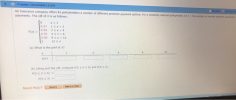 An insurance company offers its policyholders a number of different premium payment options. For a randomly selected payments. The cdf of X is as follows policyholder, let x a the number of months between successive 0.37 1Sx <3 Fx)0.49 3sx <4 0.85 6sx <12 12 s x (a) What is the pmf of x? 12 p(x) (b) Using just the cdf, compute P(3 S XS 6) and P4 x
Question 3-6 An insurance company each policy follows a Poisson distribution with a mean 3. has issued 75 policies. The number of claims filed under Assuming that the claims filed by each policyh...
 Question 3-6 An insurance company each policy follows a Poisson distribution with a mean 3. has issued 75 policies. The number of claims filed under Assuming that the claims filed by each policyholder are independent of each other, what is the approximate probability that more than 250 claims will be filed by the group of policyholders? A) 0.048 B 0.168 C) 0.424 D) 0.576 E) 0.952 Question 3-7 650X and let X have the following probability density function: Let Y...
In each of the summer months (June, July, August), the number of accidents per months at...
 In each of the summer months (June, July, August), the number of accidents per months at a busy intersection is Poisson distributed with mean 1.5 accidents/month. For all other months, the number of accidents is Poisson distributed with mean 0.5 accidents/month. 7. a) (3 pts) First, let Y an, YFeb, YMar,... be the number of accidents occurring in the months of January, February, March, etc. Define a variable A- the total number of accidents occurring in the second half of...
A policyholder has a two-year auto insurance for his new car. Let X be the number of accidents th...
A policyholder has a two-year auto insurance for his new car. Let X be the number of accidents that the policyholder experiences in one year. You are given: Pr[X = 0] = 0.9 Pr[X = 1] = 0.08 Pr[X = 2] = 0.02 The number of accidents that the policyholder experiences in each year is independent. Given that the policyholder experiences exactly 2 accidents in two years, find the probability that the policyholder experiences at least one accident in each...
An insurance company offers its policyholders a number of different premium payment options. For a randomly...
An insurance company offers its policyholders a number of different premium payment options. For a randomly selected policyholder, let X = the number of months between successive payments. The cdf of X is as follows: F(x) = 0 x < 1 0.33 1 < x < 3 0.44 3 < x < 4 0.48 4 < x < 6 0.86 6 < x < 12 1 12 < x (a) What is...
 2. An insurance company supposes that each person has a accident parameter and that the yearly number of accidents of someone whose accident parameter is is Poisson distributed with mean 1. They also suppose that the parameter value of a newly insured person can be assumed to be the value of an exponential random variable with parameter s. (a) If a newly insured person has n accidents in her first year, find the conditional density of her accident parameter. (b)...
 An insurance company offers its policyholders a number of different premium payment options. For a randomly selected policyholder, let X be the number of months between successive payments. The cumulative distribution function of X is F(x) = {0, if x < 1, 0.4, if 1 lessthanorequalto x < 3, 0.6, if 3 lessthanorequalto x < 5, 0.8, if 5 lessthanorequalto x < 7, 1.0, if x greaterthanorequalto 7. (a) What is the probability mass function of X? (b) Compute P(4...
 SELF ASSESSMENT 2 An insurance company offers policyholders a number of different Premium payment options. For a randomly selected policyholder, let X be the number of months between successive payments. The cumulative distribution function,cdf, of X is as follows: F(x) = 0x< 1 0.30 15x<3 0.40 35x< 4 10.45 4 < x < 6 0.60 6<x< 12 x 12 1 i. Determine the probability distribution function, f(x). ii. Find the expectation and standard deviation of X. iii. Compute,P(3 SXS 6).
 (3) An insurance company offers its policyholders a number of different payment options For a randomly sclected policyholder, let X the number of months between successive payments. The edf of X is as follows: 40 3514 44s6 Fa a. What ts the prnfonr b Using just the cdf compue 20 a Using just the pmf compute Px
 An insurance company offers its policyholders a number of different premium payment options. For a randomly selected payments. The cdf of X is as follows policyholder, let x a the number of months between successive 0.37 1Sx <3 Fx)0.49 3sx <4 0.85 6sx <12 12 s x (a) What is the pmf of x? 12 p(x) (b) Using just the cdf, compute P(3 S XS 6) and P4 x
 Question 3-6 An insurance company each policy follows a Poisson distribution with a mean 3. has issued 75 policies. The number of claims filed under Assuming that the claims filed by each policyholder are independent of each other, what is the approximate probability that more than 250 claims will be filed by the group of policyholders? A) 0.048 B 0.168 C) 0.424 D) 0.576 E) 0.952 Question 3-7 650X and let X have the following probability density function: Let Y...
 In each of the summer months (June, July, August), the number of accidents per months at a busy intersection is Poisson distributed with mean 1.5 accidents/month. For all other months, the number of accidents is Poisson distributed with mean 0.5 accidents/month. 7. a) (3 pts) First, let Y an, YFeb, YMar,... be the number of accidents occurring in the months of January, February, March, etc. Define a variable A- the total number of accidents occurring in the second half of...
Most questions answered within 3 hours.
-
Where is the error in this code sequence?
String s1 = "Hello";
String s2 = "ello";...
asked 11 months ago -
Financial data for Joel de Paris, Inc., for last year
follow:
Joel de Paris, Inc.
Balance...
asked 11 months ago -
Consider this reaction:
Al2(SO4)3 (aq)+ BaCl3
(aq) Al2Cl6 (aq)- +
3BaSO4(s) . What is the...
asked 11 months ago -
Suppose that Savneet is considering increasing her
recent random sample from 20 car rentals to 40...
asked 11 months ago -
Trucks arrive at an unloading terminal at an average rate of 120
per hour.
Trucks arrive...
asked 11 months ago -
Why are methanol and ethanol completely soluble in water while
octanol is not very little soluble....
asked 11 months ago -
A facilities manager at a university reads in a research report
that the mean amount of...
asked 11 months ago -
When the CuSO4 is rehydrated by adding water to the anhydrous
compound, is this an endothermic...
asked 11 months ago -
A ray of sunlight is passing from diamond into crown glass; the
angle of incidence is...
asked 11 months ago -
A block of mass 0.249 kg is placed on top of a light, vertical
spring of...
asked 11 months ago -
how do the kidneys compensate in the presences of acidosis
a) trigger hyperventilate
b) reserve acid...
asked 11 months ago -
Question 501 pts
The rental rate of capital to the firm increases. Which of the
following...
asked 11 months ago