A second order reaction has been running for 4.5 minutes and has a concentration of 0.31....
A second order reaction has been running for 4.5 minutes and has a concentration of 0.31. Determine the initial concentration of the system. k = 0.18 L/(mol·min)
Homework Answers

Add Answer to:
A second order reaction has been running for 4.5 minutes and has
a concentration of 0.31....
What is the concentration of A after 50.5 minutes for the second order reaction A →...
What is the concentration of A after 50.5 minutes for the second order reaction A → Products when the initial concentration of A is 0.250 M? (k = 0.117 M⁻¹min⁻¹)
The following chemical reaction: A → products shows second order kinetics with respect to A; rate...
The following chemical reaction: A → products shows second order kinetics with respect to A; rate = k[A]2. Assume k = 3.40 x 10⁻⁴ mol-1 L s-1 . If the initial concentration of A is 0.77 mol L-1, what is the concentration of A (in mol L-1) after 8.69 minutes?
A first order reaction (A—>B) has a half-life if 30 minutes. If the initial concentration of...
A first order reaction (A—>B) has a half-life if 30 minutes. If the initial concentration of A is 0.900 M, what is the concentration of B after 60 minutes?
The decay of ozone residual in an aqueous solution has sometimes been described as a first order ...
 The decay of ozone residual in an aqueous solution has sometimes been described as a first order reaction, as shown below: Given the following data please detemine the decay constant, k Residual Ozone Concentration (mg/L) 0.31 0.28 0.21 0.17 0.15 0.12 0.1 0.09 0.07 0.06 0.05 0.05 0.04 0.03 Decay time (min) 0 2 3 4 5 6 7 8 9 10 13 17 Do you think that this first order reaction is suitable for use? Please determine how long...
What is the concentration of A for a 1st order reaction after 3.00 minutes where the...
What is the concentration of A for a 1st order reaction after 3.00 minutes where the initial concentration of A is 0.614 M and k = 0.000165/s. A 0.982 M B 0.613 M C 0.596 M D 0.573 M
[time] [Z] 4. Suppose the data shown are for the second order reaction: → products. What...
 [time] [Z] 4. Suppose the data shown are for the second order reaction: → products. What is the value of the rate constant k? O min 50.000 atm 6.250 3.333 2.273. 5. For a first order reaction (G - products) with k = 0.173 min', suppose a chemist runs the reaction starting with an initial concentration [G]. = 12.0 M. a. How many minutes will it take for [G] to decrease to 4.70 M? b. What [G] will remain after...
Reaction A + 2B -> C is studied and it is discovered to be second order...
Reaction A + 2B -> C is studied and it is discovered to be second order with the rate law rate=k[A][B]. If the initial concentrations of A and B are 2.0M and the rate constant is 0.15L/(mol s), what is the concentration of B after 2 minutes if the concentration of A is found to be 0.35M?
7. Consider the following second-order reaction: 2X ? Y. The initial concentration of X is 0.50...
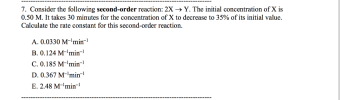 7. Consider the following second-order reaction: 2X ? Y. The initial concentration of X is 0.50 M. It takes 30 minutes for the concentration of X to decrease to 35% of its initial value. Calculate the rate constant for this second-order reaction. A. 0.0330 Mmin B. 0.124 M-min-1 C. 0.185 M-'min-1 D.0.367 Mmin-1 E. 2.48 M-min-1
If a zero order reaction has a rate constant k of 0.0416Mmin and an initial concentration...
If a zero order reaction has a rate constant k of 0.0416Mmin and an initial concentration of 2.29 M, what will be its concentration after 20.0 minutes? Your answer should have three significant figures.
5. The following reaction is a second order irreversible reaction: 2A + 3B2C i. Derive an...
 5. The following reaction is a second order irreversible reaction: 2A + 3B2C i. Derive an expression for the rate of change in the concentration of A as a function of reaction time, initial concentrations and a second order rate constant. Solve this differential equation to yield an equation for fractional conversion of A as a function of time The rate constant is 0.02 L mmol min, and the initial concentrations of A, B, and C are 10 mmol/L, 10...
 The decay of ozone residual in an aqueous solution has sometimes been described as a first order reaction, as shown below: Given the following data please detemine the decay constant, k Residual Ozone Concentration (mg/L) 0.31 0.28 0.21 0.17 0.15 0.12 0.1 0.09 0.07 0.06 0.05 0.05 0.04 0.03 Decay time (min) 0 2 3 4 5 6 7 8 9 10 13 17 Do you think that this first order reaction is suitable for use? Please determine how long...
 [time] [Z] 4. Suppose the data shown are for the second order reaction: → products. What is the value of the rate constant k? O min 50.000 atm 6.250 3.333 2.273. 5. For a first order reaction (G - products) with k = 0.173 min', suppose a chemist runs the reaction starting with an initial concentration [G]. = 12.0 M. a. How many minutes will it take for [G] to decrease to 4.70 M? b. What [G] will remain after...
 7. Consider the following second-order reaction: 2X ? Y. The initial concentration of X is 0.50 M. It takes 30 minutes for the concentration of X to decrease to 35% of its initial value. Calculate the rate constant for this second-order reaction. A. 0.0330 Mmin B. 0.124 M-min-1 C. 0.185 M-'min-1 D.0.367 Mmin-1 E. 2.48 M-min-1
 5. The following reaction is a second order irreversible reaction: 2A + 3B2C i. Derive an expression for the rate of change in the concentration of A as a function of reaction time, initial concentrations and a second order rate constant. Solve this differential equation to yield an equation for fractional conversion of A as a function of time The rate constant is 0.02 L mmol min, and the initial concentrations of A, B, and C are 10 mmol/L, 10...
Most questions answered within 3 hours.
-
Where is the error in this code sequence?
String s1 = "Hello";
String s2 = "ello";...
asked 10 months ago -
Financial data for Joel de Paris, Inc., for last year
follow:
Joel de Paris, Inc.
Balance...
asked 10 months ago -
Consider this reaction:
Al2(SO4)3 (aq)+ BaCl3
(aq) Al2Cl6 (aq)- +
3BaSO4(s) . What is the...
asked 10 months ago -
Suppose that Savneet is considering increasing her
recent random sample from 20 car rentals to 40...
asked 10 months ago -
Trucks arrive at an unloading terminal at an average rate of 120
per hour.
Trucks arrive...
asked 10 months ago -
Why are methanol and ethanol completely soluble in water while
octanol is not very little soluble....
asked 10 months ago -
A facilities manager at a university reads in a research report
that the mean amount of...
asked 10 months ago -
When the CuSO4 is rehydrated by adding water to the anhydrous
compound, is this an endothermic...
asked 10 months ago -
A ray of sunlight is passing from diamond into crown glass; the
angle of incidence is...
asked 10 months ago -
A block of mass 0.249 kg is placed on top of a light, vertical
spring of...
asked 10 months ago -
how do the kidneys compensate in the presences of acidosis
a) trigger hyperventilate
b) reserve acid...
asked 10 months ago -
Question 501 pts
The rental rate of capital to the firm increases. Which of the
following...
asked 10 months ago