what happens when a benzene ring reacts with NBS then with NaOH
what happens when a benzene ring reacts with NBS then with NaOH
Homework Answers

b) Predict the major product with mechanism when Ethylbenzene reacts with NBS& NBS 2 tl c)...
 b) Predict the major product with mechanism when Ethylbenzene reacts with NBS& NBS 2 tl c) Propose the mechanism of this reaction: (2) NBS Be
When there is an electron-withdrawing group on a benzene ring (eg. compounds such as nitrobenzenebenzoic acid,...
 When there is an electron-withdrawing group on a benzene ring (eg. compounds such as nitrobenzenebenzoic acid, acetophenone, etc, resonance structures can be drawn that indicate the positions on the benzene ring that are least nucleophilic (because they have a positive charge on the carbon at that position). Because these positions are much less nucleophilic, the substitution reaction will not occur here; instead, substitution will occur at the other position(s) on the ring. As a result, which position(s) are most nucleophilic...
When installing a substituent on a benzene ring that already has 2 substituents on it, my...
 When installing a substituent on a benzene ring that already has
2 substituents on it, my textbook says that the stronger activator
will determine where the new substituent is installed. What about
in the case of the a benzene ring that has 2 deactivators? What is
the rule in that case? Does the stronger deactivator determine
where the new substituent is installed? How does that work?
Here is an example of what im talking about:
React the following ring with...
When installing a substituent on a benzene ring that already has
2 substituents on it, my textbook says that the stronger activator
will determine where the new substituent is installed. What about
in the case of the a benzene ring that has 2 deactivators? What is
the rule in that case? Does the stronger deactivator determine
where the new substituent is installed? How does that work?
Here is an example of what im talking about:
React the following ring with...
9. What product is formed when benzene reacts with AlCl3 and each of the following reagents?...
 9. What product is formed when benzene reacts with AlCl3 and each of the following reagents? 10. Draw all the products of the following reaction: + OH
that product is formed when benzene reacts with each of the following reagents? 35. What product...
 that product is formed when benzene reacts with each of the following reagents? 35. What product a. CH CHCH3 + AICI: b. CH2=CHCH,CI + AICI: C. CH3CCI + AICI:
1. What is the product formed when propanoic acid reacts with NaOH(aq). 1. What is the...
 1. What is the product formed when propanoic acid reacts with
NaOH(aq).
1. What is the product formed when propanoic acid reacts with NaOH(aq) O- Na+ w do outro YOHO yo maio COH O A OB oc OD
1. What is the product formed when propanoic acid reacts with
NaOH(aq).
1. What is the product formed when propanoic acid reacts with NaOH(aq) O- Na+ w do outro YOHO yo maio COH O A OB oc OD
What happens when we add NaOH to a CH3COOH solution? (A) Nothing happens (B) Formation of...
What happens when we add NaOH to a CH3COOH solution? (A) Nothing happens (B) Formation of CH3COONa in solution I know the answer is B, but can you explain why and how?
Retrosynthesis, beneze ring to substituted benzene ring. What are the two steps? Help please. Br
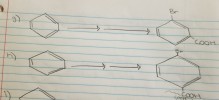 Retrosynthesis, beneze ring to substituted benzene
ring. What are the two steps? Help please.
Br
Retrosynthesis, beneze ring to substituted benzene
ring. What are the two steps? Help please.
Br
5) When benzene reacts with isopropyl chloride in the presence of AlCl3, a compound with a...
 5) When benzene reacts with isopropyl chloride in the presence of AlCl3, a compound with a molecular mass of 162 g/mol is isolated. In HNMR, this compound has the following spectrum. What is it and why is it formed? PPM
When benzene C6H6 reacts with bromine Br2, bromobenzene C6H5Br is obtained: C6H6 + Br2 --> C6H5Br...
When benzene C6H6 reacts with bromine Br2, bromobenzene C6H5Br is obtained: C6H6 + Br2 --> C6H5Br + HBr (balanced already) When 15.0 g of benzene reacts with excess Br2, 0.19 mole of bromobenzene C6H5Br was produced? IF the actual yield was 42.3 g of C6H5Br produced, Calculate the percent yield.
 b) Predict the major product with mechanism when Ethylbenzene reacts with NBS& NBS 2 tl c) Propose the mechanism of this reaction: (2) NBS Be
 When there is an electron-withdrawing group on a benzene ring (eg. compounds such as nitrobenzenebenzoic acid, acetophenone, etc, resonance structures can be drawn that indicate the positions on the benzene ring that are least nucleophilic (because they have a positive charge on the carbon at that position). Because these positions are much less nucleophilic, the substitution reaction will not occur here; instead, substitution will occur at the other position(s) on the ring. As a result, which position(s) are most nucleophilic...
 When installing a substituent on a benzene ring that already has
2 substituents on it, my textbook says that the stronger activator
will determine where the new substituent is installed. What about
in the case of the a benzene ring that has 2 deactivators? What is
the rule in that case? Does the stronger deactivator determine
where the new substituent is installed? How does that work?
Here is an example of what im talking about:
React the following ring with...
When installing a substituent on a benzene ring that already has
2 substituents on it, my textbook says that the stronger activator
will determine where the new substituent is installed. What about
in the case of the a benzene ring that has 2 deactivators? What is
the rule in that case? Does the stronger deactivator determine
where the new substituent is installed? How does that work?
Here is an example of what im talking about:
React the following ring with...
 9. What product is formed when benzene reacts with AlCl3 and each of the following reagents? 10. Draw all the products of the following reaction: + OH
 that product is formed when benzene reacts with each of the following reagents? 35. What product a. CH CHCH3 + AICI: b. CH2=CHCH,CI + AICI: C. CH3CCI + AICI:
 1. What is the product formed when propanoic acid reacts with
NaOH(aq).
1. What is the product formed when propanoic acid reacts with NaOH(aq) O- Na+ w do outro YOHO yo maio COH O A OB oc OD
1. What is the product formed when propanoic acid reacts with
NaOH(aq).
1. What is the product formed when propanoic acid reacts with NaOH(aq) O- Na+ w do outro YOHO yo maio COH O A OB oc OD
 Retrosynthesis, beneze ring to substituted benzene
ring. What are the two steps? Help please.
Br
Retrosynthesis, beneze ring to substituted benzene
ring. What are the two steps? Help please.
Br
 5) When benzene reacts with isopropyl chloride in the presence of AlCl3, a compound with a molecular mass of 162 g/mol is isolated. In HNMR, this compound has the following spectrum. What is it and why is it formed? PPM
Most questions answered within 3 hours.
-
Where is the error in this code sequence?
String s1 = "Hello";
String s2 = "ello";...
asked 10 months ago -
Financial data for Joel de Paris, Inc., for last year
follow:
Joel de Paris, Inc.
Balance...
asked 10 months ago -
Consider this reaction:
Al2(SO4)3 (aq)+ BaCl3
(aq) Al2Cl6 (aq)- +
3BaSO4(s) . What is the...
asked 10 months ago -
Suppose that Savneet is considering increasing her
recent random sample from 20 car rentals to 40...
asked 10 months ago -
Trucks arrive at an unloading terminal at an average rate of 120
per hour.
Trucks arrive...
asked 10 months ago -
Why are methanol and ethanol completely soluble in water while
octanol is not very little soluble....
asked 10 months ago -
A facilities manager at a university reads in a research report
that the mean amount of...
asked 10 months ago -
When the CuSO4 is rehydrated by adding water to the anhydrous
compound, is this an endothermic...
asked 10 months ago -
A ray of sunlight is passing from diamond into crown glass; the
angle of incidence is...
asked 10 months ago -
A block of mass 0.249 kg is placed on top of a light, vertical
spring of...
asked 10 months ago -
how do the kidneys compensate in the presences of acidosis
a) trigger hyperventilate
b) reserve acid...
asked 10 months ago -
Question 501 pts
The rental rate of capital to the firm increases. Which of the
following...
asked 10 months ago