Can a hydrogen atom absorb a photon of energy greater than 13.6 eV? Please explain.
Can a hydrogen atom absorb a photon of energy greater than 13.6 eV? Please explain.
Homework Answers
Energy required to remove electron from the shell of hydrogen is 13.6 eV therefore when energy greater than 13.6 eV is applied then all of the extra energy gets converted to kinetic energy of ejected electron. This is according to Einstein's photoelectric equation:

Where K is the kinetic energy of ejected electron
h is the Planck's constant
v is the frequency of incident photon
 is the work
function of the element
is the work
function of the element
Please give a up vote if you like the answer.
If you dislike the answer then put your queries, feedback, or suggestion in comments section.
If it doesn't get resolved then down vote the answer.
Add Answer to:
Can a hydrogen atom absorb a photon of energy greater than 13.6
eV? Please explain.
Can the electron in the ground state of hydrogen absorb a photon of energy less than...
Can the electron in the ground state of hydrogen absorb a photon of energy less than 13.6 eV? YesNo Can it absorb a photon of energy greater than 13.6 eV? YesNo Explain your answer.
The electron in hydrogen atom absorbs a photon with an energy of 13.6 eV. The electron...
The electron in hydrogen atom absorbs a photon with an energy of 13.6 eV. The electron decays to its energy level of 3.4 eV. What is the energy of the photon it emits? (Planck's constant is 4.14 x 10^-15 eVs. What is the frequency of that proton? What is the corresponding wave length of that proton? Thanks for the help ...I know it is a loaded question but I am lost!
An electron in the ground state of a hydrogen atom (-13.6 eV) absorbs a 10.2 eV...
An electron in the ground state of a hydrogen atom (-13.6 eV) absorbs a 10.2 eV photon and jumps to the first excited state. What is the energy in eV of the first excited state?
The ground state energy of hydrogen is -13.6 eV. What is the wavelength of the photon...
The ground state energy of hydrogen is -13.6 eV. What is the wavelength of the photon emitted in the transition between an n=5 and an n=2 state?
For the hydrogen atom, its energy at ground state is 13.6 eV, at first excited state...
 For the hydrogen atom, its energy at ground state is 13.6 eV, at first excited state is 3.4 eV at second excited state is 1.5 eV and at the third excited state is 0.85 eV. i) Give the energy value for the first two states in Joule (J). [1eV =1.6 x 10⁻¹⁹ J] (2 marks) ii) With the aid of schematic diagram, determine the energy of emitted photon when the atom jumps from the first and third excited states to...
A photon of wavelength 300 Å is incident upon a hydrogen atom at rest. The photon...
 A photon of wavelength 300 Å is incident upon a hydrogen atom at rest. The photon gives of its energy to the bound electron, thus releasing it from the atom (binding energy = 13.6 eV). Find the kinetic energy in eV and the velocity of the photoelectron.
The ionization potential of a hydrogen atom is 13.6 eV. How does this compare to the energy of a typical particle at the...
The ionization potential of a hydrogen atom is 13.6 eV. How does this compare to the energy of a typical particle at the recombination epoch, when the temperature of the universe was 3000 K. How does that compare to the energy of photons at the peak of the Planck function at that time? What can you conclude from these comparisons?
Absorption Q: What is the minimum energy of a photon in eV which can remove an...
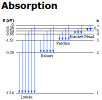 Absorption
Q: What is the minimum
energy of a photon in eV which can remove an electron completely
from the n = 12 level of the Bohr hydrogen atom?
Absorption E (eY) 0.38 54 rac kett Pfund 1.51 Paschen 3.39 Balmer -13.6 Lyman
Absorption
Q: What is the minimum
energy of a photon in eV which can remove an electron completely
from the n = 12 level of the Bohr hydrogen atom?
Absorption E (eY) 0.38 54 rac kett Pfund 1.51 Paschen 3.39 Balmer -13.6 Lyman
In chemistry you learned that a hydrogen atom has an ionization energy of 13.6 eV. Restate...
In chemistry you learned that a hydrogen atom has an ionization energy of 13.6 eV. Restate this using the physics concepts we’ve been studying in our course (for example, use the language of “electrostatic force,” “work,” “electric potential energy” etc. instead of “ionization energy,” which is a chemistry term).
A hydrogen atom initially in its ground state (n = 1) absorbs a photon and ends...
A hydrogen atom initially in its ground state (n = 1) absorbs a photon and ends up in the state for which n = 3. (a) What is the energy of the absorbed photon? eV (b) If the atom eventually returns to the ground state, what photon energies could the atom emit? 13.6 eV, 1.89 eV, 10.2 eV12.09 eV 12.09 eV, 1.89 eV1.89 eV, 10.2 eV12.09 eV, 1.89 eV, 10.2 eV
 For the hydrogen atom, its energy at ground state is 13.6 eV, at first excited state is 3.4 eV at second excited state is 1.5 eV and at the third excited state is 0.85 eV. i) Give the energy value for the first two states in Joule (J). [1eV =1.6 x 10⁻¹⁹ J] (2 marks) ii) With the aid of schematic diagram, determine the energy of emitted photon when the atom jumps from the first and third excited states to...
 A photon of wavelength 300 Å is incident upon a hydrogen atom at rest. The photon gives of its energy to the bound electron, thus releasing it from the atom (binding energy = 13.6 eV). Find the kinetic energy in eV and the velocity of the photoelectron.
 Absorption
Q: What is the minimum
energy of a photon in eV which can remove an electron completely
from the n = 12 level of the Bohr hydrogen atom?
Absorption E (eY) 0.38 54 rac kett Pfund 1.51 Paschen 3.39 Balmer -13.6 Lyman
Absorption
Q: What is the minimum
energy of a photon in eV which can remove an electron completely
from the n = 12 level of the Bohr hydrogen atom?
Absorption E (eY) 0.38 54 rac kett Pfund 1.51 Paschen 3.39 Balmer -13.6 Lyman
Most questions answered within 3 hours.
-
Where is the error in this code sequence?
String s1 = "Hello";
String s2 = "ello";...
asked 11 months ago -
Financial data for Joel de Paris, Inc., for last year
follow:
Joel de Paris, Inc.
Balance...
asked 11 months ago -
Consider this reaction:
Al2(SO4)3 (aq)+ BaCl3
(aq) Al2Cl6 (aq)- +
3BaSO4(s) . What is the...
asked 11 months ago -
Suppose that Savneet is considering increasing her
recent random sample from 20 car rentals to 40...
asked 11 months ago -
Trucks arrive at an unloading terminal at an average rate of 120
per hour.
Trucks arrive...
asked 11 months ago -
Why are methanol and ethanol completely soluble in water while
octanol is not very little soluble....
asked 11 months ago -
A facilities manager at a university reads in a research report
that the mean amount of...
asked 11 months ago -
When the CuSO4 is rehydrated by adding water to the anhydrous
compound, is this an endothermic...
asked 11 months ago -
A ray of sunlight is passing from diamond into crown glass; the
angle of incidence is...
asked 11 months ago -
A block of mass 0.249 kg is placed on top of a light, vertical
spring of...
asked 11 months ago -
how do the kidneys compensate in the presences of acidosis
a) trigger hyperventilate
b) reserve acid...
asked 11 months ago -
Question 501 pts
The rental rate of capital to the firm increases. Which of the
following...
asked 11 months ago