Suppose that you are testing the hypotheses Upper H0: p=0.33 vs. HA: p>0.33 A sample of...
Suppose that you are testing the hypotheses
Upper H0: p=0.33 vs. HA: p>0.33
A sample of size150 results in a sample proportion of 0.39
a) Construct a 99% confidence interval for p.
b) Based on the confidence interval, can you reject H0 at αequals=0.005?Explain.
c) What is the difference between the standard error and standard deviation of the sample proportion?
d) Which is used in computing the confidence interval?
Homework Answers
Sample size, n = 150
Sample proportion,  = 0.39
Null and alternative hypothesis:
H0: p=0.33 vs. HA: p>0.33
a) At  = 0.01, critical
value,
= 0.01, critical
value,  =
2.576
=
2.576
99% confidence interval for p
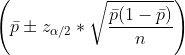
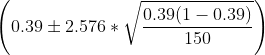

b) No, we cannot reject H0. As the value 0.33 is included in the confidence interval.
c) The standard error is based on the sample proportion
, while the
standard deviation is based on the hypothesized proportion p.
d) Standard error is used in computing the confidence interval
Add Answer to:
Suppose that you are testing the hypotheses
Upper H0: p=0.33 vs. HA: p>0.33
A sample of...
Suppose that you are testing the hypotheses Upper H 0: p=0.38 vs. Upper H Subscript Upper...
Suppose that you are testing the hypotheses Upper H 0: p=0.38 vs. Upper H Subscript Upper A: p>0.38. A sample of size 250 results in a sample proportion of 0.45. a) Construct a 99% confidence interval for p. (__,__) b) Determine the conclusion for the hypothesis test based on the confidence interval. Since the confidence interval ▼ does does not contain the null hypothesis value, ▼ reject fail to reject the null hypothesis at alphaαequals=0.005. c) What is the difference...
Suppose that you are testing the hypotheses H0: μ=70 vs. HA: μ≠70. A sample of size...
Suppose that you are testing the hypotheses H0: μ=70 vs. HA: μ≠70. A sample of size 41 results in a sample mean of 65 and a sample standard deviation of 1.7. a) What is the standard error of the mean? b) What is the critical value of t* for a 99% confidence interval? c) Construct a 99% confidence interval for μ. d) Based on the confidence interval, at α=0.010 can you reject H0? Explain.
Suppose that you are testing the hypotheses Ho: p= 0.20 vs. HA, p 0.20. A sample...
 Suppose that you are testing the hypotheses Ho: p= 0.20 vs. HA, p 0.20. A sample of size 250 results in a sample proportion of 0.27 a) Construct a 95% confidence interval for p. b) Based on the confidence interval, can you reject Ho at a 0.05? Explain c) What is the difference between the standard error and standard deviation of the sample proportion? d) Which is used in computing the confidence interval? a) The 95% confidence interval for p...
need help: Suppose that you are testing the hypotheses H0 με 16 vs. HA: μ< 16....
 need help:
Suppose that you are testing the hypotheses H0 με 16 vs. HA: μ< 16. A sample of size 16 results in a sample mean of 15.5 and a sample standard deviation of 20 a) What is the standard error of the mean? b) What is the critical value of t* for a 90% confidence interval? c) Construct a 90% confidence interval for μ. d) Based on the confidence interval, at α#0.05 can you reject Ho? Explain. a) The...
need help:
Suppose that you are testing the hypotheses H0 με 16 vs. HA: μ< 16. A sample of size 16 results in a sample mean of 15.5 and a sample standard deviation of 20 a) What is the standard error of the mean? b) What is the critical value of t* for a 90% confidence interval? c) Construct a 90% confidence interval for μ. d) Based on the confidence interval, at α#0.05 can you reject Ho? Explain. a) The...
14. Suppose that you are testing the hypotheses Ho:p 0.40 vs. HA:p > 0.40. A sample...
 14. Suppose that you are testing the hypotheses Ho:p 0.40 vs. HA:p > 0.40. A sample of size 200 results in a sample proportion of 0.55. a) Construct a 90% confidence interval for p b) Based on the confidence interval, at a .05 can you re- ject Ho? Explain
14. Suppose that you are testing the hypotheses Ho:p 0.40 vs. HA:p0.40. A sample of size...
 14. Suppose that you are testing the hypotheses Ho:p 0.40 vs. HA:p0.40. A sample of size 200 results in a sample proportion of 0.55. a) Construct a 90% confidence interval for p b) Based on the confidence interval, at a 05 can you re- ject Ho? Explain.
Suppose you are testing the hypotheses Ho : p=0.21 vs. p +0.21 with significance level a...
 Suppose you are testing the hypotheses Ho : p=0.21 vs. p +0.21 with significance level a = 0.05. A sample size of 209 results in a sample proportion of 0.26. As you know, one way to address two-sided tests is to create confidence intervals. Construct the appropriate confidence interval for p that could be used to address the test and report the upper limit of the confidence interval. Note: 1- Only round your final answer to 2 decimal places. Enter...
Suppose you want to test the following hypotheses: H0: p ≥ 0.4 vs. H1: p <...
Suppose you want to test the following hypotheses: H0: p ≥ 0.4 vs. H1: p < 0.4. A random sample of 1000 observations was taken from the population. Answer the following questions and show your Excel calculation for each question clearly: (a) Let p ̂ be the sample proportion. What is the standard error of sample proportion (i.e., σ_p ̂ ) if H0 is true? (b) If the sample proportion obtained were 0.38 (i.e., p ̂=0.38), what is its p-value?...
Question 19 (1 point) Suppose you are testing the hypotheses Ho : p=0.22 vs. p +0.22 with significance level a = 0.05....
 Question 19 (1 point) Suppose you are testing the hypotheses Ho : p=0.22 vs. p +0.22 with significance level a = 0.05. A sample size of 262 results in a sample proportion of 0.28. As you know, one way to address two-sided tests is to create confidence intervals. Construct the appropriate confidence interval for p that could be used to address the test and report the upper limit of the confidence interval. Note: 1- Only round your final answer to...
Suppose you are testing the hypotheses H0: μd = 0 and Ha: μd ≠ 0 in...
Suppose you are testing the hypotheses H0: μd = 0 and Ha: μd ≠ 0 in a paired-design and obtain a p-value of 0.21. Which one of the following could be a possible 95% confidence interval for μd? A) 4.50 to 6.90 B) 1.50 to 3.80 C) -1.20 to .90 D) -2.30 to -.70
 Suppose that you are testing the hypotheses Ho: p= 0.20 vs. HA, p 0.20. A sample of size 250 results in a sample proportion of 0.27 a) Construct a 95% confidence interval for p. b) Based on the confidence interval, can you reject Ho at a 0.05? Explain c) What is the difference between the standard error and standard deviation of the sample proportion? d) Which is used in computing the confidence interval? a) The 95% confidence interval for p...
 need help:
Suppose that you are testing the hypotheses H0 με 16 vs. HA: μ< 16. A sample of size 16 results in a sample mean of 15.5 and a sample standard deviation of 20 a) What is the standard error of the mean? b) What is the critical value of t* for a 90% confidence interval? c) Construct a 90% confidence interval for μ. d) Based on the confidence interval, at α#0.05 can you reject Ho? Explain. a) The...
need help:
Suppose that you are testing the hypotheses H0 με 16 vs. HA: μ< 16. A sample of size 16 results in a sample mean of 15.5 and a sample standard deviation of 20 a) What is the standard error of the mean? b) What is the critical value of t* for a 90% confidence interval? c) Construct a 90% confidence interval for μ. d) Based on the confidence interval, at α#0.05 can you reject Ho? Explain. a) The...
 14. Suppose that you are testing the hypotheses Ho:p 0.40 vs. HA:p > 0.40. A sample of size 200 results in a sample proportion of 0.55. a) Construct a 90% confidence interval for p b) Based on the confidence interval, at a .05 can you re- ject Ho? Explain
 14. Suppose that you are testing the hypotheses Ho:p 0.40 vs. HA:p0.40. A sample of size 200 results in a sample proportion of 0.55. a) Construct a 90% confidence interval for p b) Based on the confidence interval, at a 05 can you re- ject Ho? Explain.
 Suppose you are testing the hypotheses Ho : p=0.21 vs. p +0.21 with significance level a = 0.05. A sample size of 209 results in a sample proportion of 0.26. As you know, one way to address two-sided tests is to create confidence intervals. Construct the appropriate confidence interval for p that could be used to address the test and report the upper limit of the confidence interval. Note: 1- Only round your final answer to 2 decimal places. Enter...
 Question 19 (1 point) Suppose you are testing the hypotheses Ho : p=0.22 vs. p +0.22 with significance level a = 0.05. A sample size of 262 results in a sample proportion of 0.28. As you know, one way to address two-sided tests is to create confidence intervals. Construct the appropriate confidence interval for p that could be used to address the test and report the upper limit of the confidence interval. Note: 1- Only round your final answer to...
Most questions answered within 3 hours.
-
Where is the error in this code sequence?
String s1 = "Hello";
String s2 = "ello";...
asked 10 months ago -
Financial data for Joel de Paris, Inc., for last year
follow:
Joel de Paris, Inc.
Balance...
asked 10 months ago -
Consider this reaction:
Al2(SO4)3 (aq)+ BaCl3
(aq) Al2Cl6 (aq)- +
3BaSO4(s) . What is the...
asked 10 months ago -
Suppose that Savneet is considering increasing her
recent random sample from 20 car rentals to 40...
asked 10 months ago -
Trucks arrive at an unloading terminal at an average rate of 120
per hour.
Trucks arrive...
asked 10 months ago -
Why are methanol and ethanol completely soluble in water while
octanol is not very little soluble....
asked 10 months ago -
A facilities manager at a university reads in a research report
that the mean amount of...
asked 10 months ago -
When the CuSO4 is rehydrated by adding water to the anhydrous
compound, is this an endothermic...
asked 10 months ago -
A ray of sunlight is passing from diamond into crown glass; the
angle of incidence is...
asked 10 months ago -
A block of mass 0.249 kg is placed on top of a light, vertical
spring of...
asked 10 months ago -
how do the kidneys compensate in the presences of acidosis
a) trigger hyperventilate
b) reserve acid...
asked 10 months ago -
Question 501 pts
The rental rate of capital to the firm increases. Which of the
following...
asked 10 months ago