For a spring-mass system, the mass is 4kg and stiffness 2500 N/m. Write the equation of...
For a spring-mass system, the mass is 4kg and stiffness 2500 N/m. Write the equation of response in the form of displacement using the following initial conditions: a) The mass is initially displaced by 100 mm from equilibrium position and released. b) The mass is struck by an impulse of 10 Ns, which acts along the direction of the mass.
Homework Answers


Add Answer to:
For a spring-mass system, the mass is 4kg and stiffness 2500
N/m. Write the equation of...
Problem A spring-mass system has mass of 0.5 kg and stiffness coefficient of 32 N/m. The...
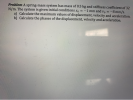 Problem A spring-mass system has mass of 0.5 kg and stiffness coefficient of 32 N/m. The system is given initial conditions xo = -1 mm and vo -8 mm/s. a) Calculate the maximum values of displacement, velocity and acceleration. b) Calculate the phases of the displacement, velocity and acceleration.
A 1-kg mass is attached to a spring with stiffness 45N/m. The damping constant for the system is 6 N-sec/m. The mass is pulled 1 m to the right of the equilibrium position and released. Find the...
 A 1-kg mass is attached to a spring with stiffness 45N/m. The damping constant for the system is 6 N-sec/m. The mass is pulled 1 m to the right of the equilibrium position and released. Find the equation of motion in phase-shift form. When will the mass first return to its equilibriom position, and at what velocity?
A 1-kg mass is attached to a spring with stiffness 45N/m. The damping constant for the system is 6 N-sec/m. The mass is...
A 1-kg mass is attached to a spring with stiffness 45N/m. The damping constant for the system is 6 N-sec/m. The mass is pulled 1 m to the right of the equilibrium position and released. Find the equation of motion in phase-shift form. When will the mass first return to its equilibriom position, and at what velocity?
A 1-kg mass is attached to a spring with stiffness 45N/m. The damping constant for the system is 6 N-sec/m. The mass is...
A mass of 0.3 kg is suspended from a spring of stiffness 200 Nm–1 . The mass is displaced by 10 mm from its equilibrium...
 A mass of 0.3 kg is suspended from a spring of stiffness 200
Nm–1 . The mass is displaced by 10 mm from its equilibrium position
and released, as shown in Figure 1. For the resulting vibration,
calculate:
(a) (i)
the frequency of vibration;
(ii) the maximum velocity of the mass during the vibration;
(iii) the maximum acceleration of the mass during the
vibration;
(iv) the mass required to produce double the maximum
velocity
calculated in (ii) using the same...
A mass of 0.3 kg is suspended from a spring of stiffness 200
Nm–1 . The mass is displaced by 10 mm from its equilibrium position
and released, as shown in Figure 1. For the resulting vibration,
calculate:
(a) (i)
the frequency of vibration;
(ii) the maximum velocity of the mass during the vibration;
(iii) the maximum acceleration of the mass during the
vibration;
(iv) the mass required to produce double the maximum
velocity
calculated in (ii) using the same...
2 with spring stiffness k 1000 N/m, Consider a mass-spring-damper system shown in Figure mass m...
 2 with spring stiffness k 1000 N/m, Consider a mass-spring-damper system shown in Figure mass m = 10 kg, and damping constant c-150 N-s/m. If the initial displacement is xo-o and the initial velocity is 10 m/s (1) Find the damping ratio. (2) Is the system underdamped or overdamped? Why? (3) Calculate the damped natural frequency (4) Determine the free vibration response of the system.
1. A 1 kg mass is attached to a spring of spring constant k = 4kg/82, The spring-mass system is a...
 Differntial Equations Forced Spring Motion
1. A 1 kg mass is attached to a spring of spring constant k = 4kg/82, The spring-mass system is attached to a machine that supplies an external driving force of f(t) = 4 cos(wt). The systern is started from equilibrium i.e. 2(0) = 0 and z'(0) = 0. There is no damping. (a) Find the position x(t) of the mass as a function of time (b) write your answer in the form r(t)-1 sin(6t)...
Differntial Equations Forced Spring Motion
1. A 1 kg mass is attached to a spring of spring constant k = 4kg/82, The spring-mass system is attached to a machine that supplies an external driving force of f(t) = 4 cos(wt). The systern is started from equilibrium i.e. 2(0) = 0 and z'(0) = 0. There is no damping. (a) Find the position x(t) of the mass as a function of time (b) write your answer in the form r(t)-1 sin(6t)...
QUESTION 6 130 MARKS For a vibrating system, the body mass is 10 kg, stiffness is 2.5 kN/m, and damping constant is 45...
 QUESTION 6 130 MARKS For a vibrating system, the body mass is 10 kg, stiffness is 2.5 kN/m, and damping constant is 45 Ns/m. A harmonic force of amplitude 180 N and frequency 3.5 Hz acts on the mass. If the initial displacement and velocity of the mass are 15 mm and 5 m/s, compute the complete solution representing the motion of the mass. 45 (30 Marks)
QUESTION 6 130 MARKS For a vibrating system, the body mass is 10...
QUESTION 6 130 MARKS For a vibrating system, the body mass is 10 kg, stiffness is 2.5 kN/m, and damping constant is 45 Ns/m. A harmonic force of amplitude 180 N and frequency 3.5 Hz acts on the mass. If the initial displacement and velocity of the mass are 15 mm and 5 m/s, compute the complete solution representing the motion of the mass. 45 (30 Marks)
QUESTION 6 130 MARKS For a vibrating system, the body mass is 10...
A mass weighing 8 pounds stretches a spring 1 foot. The system is then immersed in...
A mass weighing 8 pounds stretches a spring 1 foot. The system is then immersed in a medium that offers a damping force numerically equal to 3 times the instantaneous velocity. The mass is initially released from the equilibrium position with a downward velocity of 4 ft/s. Find the spring constant ?, mass ? and the damping constant ? Find ? and ?, and the roots of the characteristic equation: Write the initial conditions: Estimate the time when the mass...
A -kg mass is attached to a spring with stiffness 10 N/m. The damping constant for the system is ...
 A -kg mass is attached to a spring with stiffness 10 N/m. The damping constant for the system is 2 4 N-sec/m. If the mass is moved - m to the left of equilibrium and given an initial rightward velocity of - m/sec, determine the equation of motion of the mass and give its damping factor, quasiperiod, and quasifrequency. What is the equation of motion? 15 2 (Type an exact answer, using radicals as needed.)
A -kg mass is attached...
A -kg mass is attached to a spring with stiffness 10 N/m. The damping constant for the system is 2 4 N-sec/m. If the mass is moved - m to the left of equilibrium and given an initial rightward velocity of - m/sec, determine the equation of motion of the mass and give its damping factor, quasiperiod, and quasifrequency. What is the equation of motion? 15 2 (Type an exact answer, using radicals as needed.)
A -kg mass is attached...
A 1-kg mass is attached to a spring with stiffness 10 N/m. The damping constant for...
 A 1-kg mass is attached to a spring with stiffness 10 N/m. The damping constant for the system is 7 N-sec/m. If the mass is pulled^ m to the left of equilibrium and given an initial rightward velocity of 4 m/sec a) Find and solve the equation of motion governing the system b) State the type of motion for the system? c) When will the mass first return to its equilibrium position?
Problem 5: The spring-mass system shown has spring constants ky = 24 kN/m and kz =...
 Problem 5: The spring-mass system shown has spring constants ky = 24 kN/m and kz = 36 kN/m with a suspended mass of 35 kg at A. If the block is displaced 50 mm below its equilibrium position and released with no initial velocity, determine: a) The circular natural frequency, the natural frequency, and the period b) The position, velocity, and acceleration of the block after a time of 30 seconds k2 mm ki A
 Problem A spring-mass system has mass of 0.5 kg and stiffness coefficient of 32 N/m. The system is given initial conditions xo = -1 mm and vo -8 mm/s. a) Calculate the maximum values of displacement, velocity and acceleration. b) Calculate the phases of the displacement, velocity and acceleration.
 A 1-kg mass is attached to a spring with stiffness 45N/m. The damping constant for the system is 6 N-sec/m. The mass is pulled 1 m to the right of the equilibrium position and released. Find the equation of motion in phase-shift form. When will the mass first return to its equilibriom position, and at what velocity?
A 1-kg mass is attached to a spring with stiffness 45N/m. The damping constant for the system is 6 N-sec/m. The mass is...
A 1-kg mass is attached to a spring with stiffness 45N/m. The damping constant for the system is 6 N-sec/m. The mass is pulled 1 m to the right of the equilibrium position and released. Find the equation of motion in phase-shift form. When will the mass first return to its equilibriom position, and at what velocity?
A 1-kg mass is attached to a spring with stiffness 45N/m. The damping constant for the system is 6 N-sec/m. The mass is...
 A mass of 0.3 kg is suspended from a spring of stiffness 200
Nm–1 . The mass is displaced by 10 mm from its equilibrium position
and released, as shown in Figure 1. For the resulting vibration,
calculate:
(a) (i)
the frequency of vibration;
(ii) the maximum velocity of the mass during the vibration;
(iii) the maximum acceleration of the mass during the
vibration;
(iv) the mass required to produce double the maximum
velocity
calculated in (ii) using the same...
A mass of 0.3 kg is suspended from a spring of stiffness 200
Nm–1 . The mass is displaced by 10 mm from its equilibrium position
and released, as shown in Figure 1. For the resulting vibration,
calculate:
(a) (i)
the frequency of vibration;
(ii) the maximum velocity of the mass during the vibration;
(iii) the maximum acceleration of the mass during the
vibration;
(iv) the mass required to produce double the maximum
velocity
calculated in (ii) using the same...
 2 with spring stiffness k 1000 N/m, Consider a mass-spring-damper system shown in Figure mass m = 10 kg, and damping constant c-150 N-s/m. If the initial displacement is xo-o and the initial velocity is 10 m/s (1) Find the damping ratio. (2) Is the system underdamped or overdamped? Why? (3) Calculate the damped natural frequency (4) Determine the free vibration response of the system.
 Differntial Equations Forced Spring Motion
1. A 1 kg mass is attached to a spring of spring constant k = 4kg/82, The spring-mass system is attached to a machine that supplies an external driving force of f(t) = 4 cos(wt). The systern is started from equilibrium i.e. 2(0) = 0 and z'(0) = 0. There is no damping. (a) Find the position x(t) of the mass as a function of time (b) write your answer in the form r(t)-1 sin(6t)...
Differntial Equations Forced Spring Motion
1. A 1 kg mass is attached to a spring of spring constant k = 4kg/82, The spring-mass system is attached to a machine that supplies an external driving force of f(t) = 4 cos(wt). The systern is started from equilibrium i.e. 2(0) = 0 and z'(0) = 0. There is no damping. (a) Find the position x(t) of the mass as a function of time (b) write your answer in the form r(t)-1 sin(6t)...
 QUESTION 6 130 MARKS For a vibrating system, the body mass is 10 kg, stiffness is 2.5 kN/m, and damping constant is 45 Ns/m. A harmonic force of amplitude 180 N and frequency 3.5 Hz acts on the mass. If the initial displacement and velocity of the mass are 15 mm and 5 m/s, compute the complete solution representing the motion of the mass. 45 (30 Marks)
QUESTION 6 130 MARKS For a vibrating system, the body mass is 10...
QUESTION 6 130 MARKS For a vibrating system, the body mass is 10 kg, stiffness is 2.5 kN/m, and damping constant is 45 Ns/m. A harmonic force of amplitude 180 N and frequency 3.5 Hz acts on the mass. If the initial displacement and velocity of the mass are 15 mm and 5 m/s, compute the complete solution representing the motion of the mass. 45 (30 Marks)
QUESTION 6 130 MARKS For a vibrating system, the body mass is 10...
 A -kg mass is attached to a spring with stiffness 10 N/m. The damping constant for the system is 2 4 N-sec/m. If the mass is moved - m to the left of equilibrium and given an initial rightward velocity of - m/sec, determine the equation of motion of the mass and give its damping factor, quasiperiod, and quasifrequency. What is the equation of motion? 15 2 (Type an exact answer, using radicals as needed.)
A -kg mass is attached...
A -kg mass is attached to a spring with stiffness 10 N/m. The damping constant for the system is 2 4 N-sec/m. If the mass is moved - m to the left of equilibrium and given an initial rightward velocity of - m/sec, determine the equation of motion of the mass and give its damping factor, quasiperiod, and quasifrequency. What is the equation of motion? 15 2 (Type an exact answer, using radicals as needed.)
A -kg mass is attached...
 A 1-kg mass is attached to a spring with stiffness 10 N/m. The damping constant for the system is 7 N-sec/m. If the mass is pulled^ m to the left of equilibrium and given an initial rightward velocity of 4 m/sec a) Find and solve the equation of motion governing the system b) State the type of motion for the system? c) When will the mass first return to its equilibrium position?
 Problem 5: The spring-mass system shown has spring constants ky = 24 kN/m and kz = 36 kN/m with a suspended mass of 35 kg at A. If the block is displaced 50 mm below its equilibrium position and released with no initial velocity, determine: a) The circular natural frequency, the natural frequency, and the period b) The position, velocity, and acceleration of the block after a time of 30 seconds k2 mm ki A
Most questions answered within 3 hours.
-
Where is the error in this code sequence?
String s1 = "Hello";
String s2 = "ello";...
asked 11 months ago -
Financial data for Joel de Paris, Inc., for last year
follow:
Joel de Paris, Inc.
Balance...
asked 11 months ago -
Consider this reaction:
Al2(SO4)3 (aq)+ BaCl3
(aq) Al2Cl6 (aq)- +
3BaSO4(s) . What is the...
asked 11 months ago -
Suppose that Savneet is considering increasing her
recent random sample from 20 car rentals to 40...
asked 11 months ago -
Trucks arrive at an unloading terminal at an average rate of 120
per hour.
Trucks arrive...
asked 11 months ago -
Why are methanol and ethanol completely soluble in water while
octanol is not very little soluble....
asked 11 months ago -
A facilities manager at a university reads in a research report
that the mean amount of...
asked 11 months ago -
When the CuSO4 is rehydrated by adding water to the anhydrous
compound, is this an endothermic...
asked 11 months ago -
A ray of sunlight is passing from diamond into crown glass; the
angle of incidence is...
asked 11 months ago -
A block of mass 0.249 kg is placed on top of a light, vertical
spring of...
asked 11 months ago -
how do the kidneys compensate in the presences of acidosis
a) trigger hyperventilate
b) reserve acid...
asked 11 months ago -
Question 501 pts
The rental rate of capital to the firm increases. Which of the
following...
asked 11 months ago