Code in C #### Array of pointers 1. Define a structure. 2. Allocate a *dynamic* array...
Code in C

#### Array of pointers
1. Define a structure.
2. Allocate a *dynamic* array of **pointers** to structures. What is the type of the array variable?
3. Sketch the array on the worksheet.
3. Assign values in a loop.
4. Free all dynamic memory. Mind the order to avoid leaving dangling pointers!
Homework Answers
#include <stdio.h>
#include <stdlib.h>
struct my_struct{
int key;
};
int main(void) {
struct my_struct **arr = (struct my_struct **)malloc(5*sizeof(struct my_struct *));
for(int i=0;i<5;++i){
arr[i] = (struct my_struct *)malloc(sizeof(struct my_struct));
arr[i]->key = i;
}
printf("Values are: \n");
for(int i=0;i<5;++i){
printf("Key is: %d\n",arr[i]->key);
}
printf("Freeing Memory\n");
for(int i=0;i<5;++i){
free(arr[i]);
}
free(arr);
printf("Freed Memory\n");
return 0;
}
==============================================
1) Structure is defined with name my_struct
2) Using malloc we created array of pointers and its type is struct
my_struct *
3) Using loop we added value and memory was freed
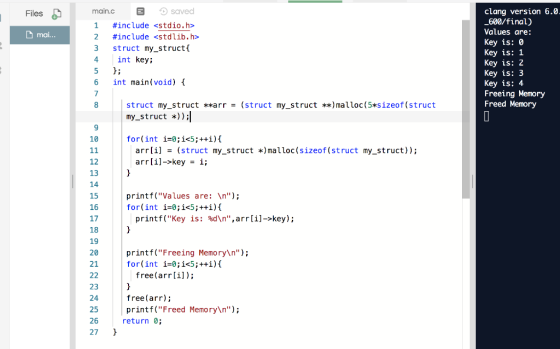
Thanks, PLEASE COMMENT if there is any
concern.
Add Answer to:
Code in C
#### Array of pointers
1. Define a structure.
2. Allocate a *dynamic* array...
Following the instruction This is c++ programming Lab Tasks: 1. Define a dynamic array class in...
 Following the instruction
This is c++ programming
Lab Tasks: 1. Define a dynamic array class in DynamicArray .h and DynamicArray.cpp files, according to the following UML class diagram: DynamicArray - int arrySize; - int currentSize; int* arrayPtr; + DynamicArray(int size) // Explicit constructor, which you define- allocate space in dynamic memory for an integer array of the given size. + DynamicArray) // Explicit destructor, which you define-de allocate dynamic memory. + additem(int item): bool // Set the value of the...
Following the instruction
This is c++ programming
Lab Tasks: 1. Define a dynamic array class in DynamicArray .h and DynamicArray.cpp files, according to the following UML class diagram: DynamicArray - int arrySize; - int currentSize; int* arrayPtr; + DynamicArray(int size) // Explicit constructor, which you define- allocate space in dynamic memory for an integer array of the given size. + DynamicArray) // Explicit destructor, which you define-de allocate dynamic memory. + additem(int item): bool // Set the value of the...
Introduction: One of the most important uses of pointers is for dynamic allocation of memory. In...
Introduction: One of the most important uses of pointers is for dynamic allocation of memory. In C++ there are commands that let the user request a chunk of memory from the operating system, and use this memory to store data. There are also commands to return memory back to the O/S when the program is finished using the data. In this lab, we will explore some of the things that can go wrong when using dynamic memory and discuss how...
Write the code to dynamically allocate ONE integer variable using calloc (contiguous allocation) or malloc (memory...
Write the code to dynamically allocate ONE integer variable using calloc (contiguous allocation) or malloc (memory allocation) and have it pointed to by a pointer (of type int * ) named ptr_1. Use ptr_1 to assign the number 7 to that dynamically allocated integer, and in another line use printf to output the contents of that dynamically allocated integer variable. Write the code to dynamically allocate an integer array of length 5 using calloc or malloc and have it pointed...
Review structures, pointers and dynamic memory allocation from CSIT 839. Also, review pointers and dynamic memory...
Review structures, pointers and dynamic memory allocation from CSIT 839. Also, review pointers and dynamic memory allocation posted here under Pages. For sorting, you can refer to the textbook for Co Sci 839 or google "C++ sort functions". I've also included under files, a sample C++ source file named sort_binsearch.cpp which gives an example of both sorting and binary search. The Bubble sort is the simplest. For binary search too, you can refer to Co Sci 839 or google: "binary...
Quick C Programming Questions: I) Which of the following is false? A) To pass a structure...
Quick C Programming Questions: I) Which of the following is false? A) To pass a structure by reference, pass the address of the structure variable. B) A way to pass an array by value is to create a structure with the array as a member then pass the name of the structure. C) To pass a structure by reference, pass the name of the structure variable. D) Passing large structures by reference is more efficient than passing large structures by...
How to initialize a dynamic two-dimensional array with values? (C++) Here's my problem... # include using...
How to initialize a dynamic two-dimensional array with values? (C++) Here's my problem... # include using namespace std; int main() { // Q#5 - dynamic 2d arrays, indexing via subscript operator, pointer arithmetic // tic tac toe board is an array of int pointers // each int pointer in the board points to a row // declare a pointer to an array of int pointers (i.e. a pointer to a pointer of type int) const...
C programming. 1.Create a program that does the following - Creates three pointers, a character pointer...
C programming. 1.Create a program that does the following - Creates three pointers, a character pointer professor, and two integer pointers student_ids, grades - Using dynamic memory, use calloc to allocate 256 characters for the professor pointer - Prompts the professor for their name, and the number of students to mark. - Stores the professor’s name using the professor pointer and in an integer the number of students to mark. - Using dynamic memory, use malloc to allocate memory for...
Write in C code: Define an array f=[23,-12,34,-56,-10,12,19], using call-by-reference (use pointers), to pass the array...
Write in C code: Define an array f=[23,-12,34,-56,-10,12,19], using call-by-reference (use pointers), to pass the array to a function, named Summation. In main: Define array, pass array, print out the array and the result returned from Summation on screen. In function Summation: 1)take array and size from main 2) sum each element according to the following rules 3) if the value of f(i) is positive, add 2*f(i) to the sum 4)if the value of f(i) is negative, add -3*f(i) to...
Structures in C++ :- 1. Write a program that declares a structure to store the code...
Structures in C++ :- 1. Write a program that declares a structure to store the code number, salary and grade of an employee. The program defines two structure variables, inputs record of two employees and then displays the record of the employee with more salary. 2. Write a program that declares a structure to store the distance covered by player along with the time taken to cover the distance. The program should input the records of two players and then...
Write the following program in C++. Review structures, pointers and dynamic memory allocation from CSIT 839....
Write the following program in C++. Review structures, pointers and dynamic memory allocation from CSIT 839. Also, review pointers and dynamic memory allocation posted here under Pages. For sorting, you can refer to the textbook for Co Sci 839 or google "C++ sort functions". I've also included under files, a sample C++ source file named sort_binsearch.cpp which gives an example of both sorting and binary search. The Bubble sort is the simplest. For binary search too, you can refer to...
 Following the instruction
This is c++ programming
Lab Tasks: 1. Define a dynamic array class in DynamicArray .h and DynamicArray.cpp files, according to the following UML class diagram: DynamicArray - int arrySize; - int currentSize; int* arrayPtr; + DynamicArray(int size) // Explicit constructor, which you define- allocate space in dynamic memory for an integer array of the given size. + DynamicArray) // Explicit destructor, which you define-de allocate dynamic memory. + additem(int item): bool // Set the value of the...
Following the instruction
This is c++ programming
Lab Tasks: 1. Define a dynamic array class in DynamicArray .h and DynamicArray.cpp files, according to the following UML class diagram: DynamicArray - int arrySize; - int currentSize; int* arrayPtr; + DynamicArray(int size) // Explicit constructor, which you define- allocate space in dynamic memory for an integer array of the given size. + DynamicArray) // Explicit destructor, which you define-de allocate dynamic memory. + additem(int item): bool // Set the value of the...
Most questions answered within 3 hours.
-
Where is the error in this code sequence?
String s1 = "Hello";
String s2 = "ello";...
asked 10 months ago -
Financial data for Joel de Paris, Inc., for last year
follow:
Joel de Paris, Inc.
Balance...
asked 10 months ago -
Consider this reaction:
Al2(SO4)3 (aq)+ BaCl3
(aq) Al2Cl6 (aq)- +
3BaSO4(s) . What is the...
asked 10 months ago -
Suppose that Savneet is considering increasing her
recent random sample from 20 car rentals to 40...
asked 10 months ago -
Trucks arrive at an unloading terminal at an average rate of 120
per hour.
Trucks arrive...
asked 10 months ago -
Why are methanol and ethanol completely soluble in water while
octanol is not very little soluble....
asked 10 months ago -
A facilities manager at a university reads in a research report
that the mean amount of...
asked 10 months ago -
When the CuSO4 is rehydrated by adding water to the anhydrous
compound, is this an endothermic...
asked 10 months ago -
A ray of sunlight is passing from diamond into crown glass; the
angle of incidence is...
asked 10 months ago -
A block of mass 0.249 kg is placed on top of a light, vertical
spring of...
asked 10 months ago -
how do the kidneys compensate in the presences of acidosis
a) trigger hyperventilate
b) reserve acid...
asked 10 months ago -
Question 501 pts
The rental rate of capital to the firm increases. Which of the
following...
asked 10 months ago