We have a coin with an unknown probability of showing head. We denote this unknown probability...
We have a coin with an unknown probability of showing head. We denote this unknown probability by X X and we know that the pdf of X X is given by f X (p)= p α−1 (1−p) β−1 B(α,β) , fX(p)=pα-1(1-p)β-1B(α,β), where B(α,β)= Γ(α)Γ(β) Γ(α+β) B(α,β)=Γ(α)Γ(β)Γ(α+β) , and Γ(n)=(n−1)! Γ(n)=(n-1)! if n n is a positive integer. We toss the coin 5 5 times. Let α=2 α=2 and β=2 β=2 . What is the probability that we observe 4 4 heads?
Homework Answers

Add Answer to:
We have a coin with an unknown probability of showing head. We
denote this unknown probability...
4. Toss a fair coin 6 times and let X denote the number of heads that...
 4. Toss a fair coin 6 times and let X denote the number of heads
that appear. Compute P(X ≤ 4). If the coin has probability p of
landing heads, compute P(X ≤ 3)
4. Toss a fair coin 6 times and let X denote the number of heads that appear. Compute P(X 4). If the coin has probability p of landing heads, compute P(X < 3).
4. Toss a fair coin 6 times and let X denote the number of heads
that appear. Compute P(X ≤ 4). If the coin has probability p of
landing heads, compute P(X ≤ 3)
4. Toss a fair coin 6 times and let X denote the number of heads that appear. Compute P(X 4). If the coin has probability p of landing heads, compute P(X < 3).
Suppose we toss a weighted coin, for which the probability of getting a head (H) is...
 Suppose we toss a weighted coin, for which the probability of getting a head (H) is 60% i) If we toss this coin 3 times, then the probability of getting exactly two heads (to two decimal places) is Number ii) If we toss this coin 6 times, then the probability of getting exactly four heads (to two decimal places) is Number CI iii) if we toss this coin 8 times, then the probability of getting 6 or more heads (to...
A box contains five coins. For each coin there is a different probability that a head...
A box contains five coins. For each coin there is a different probability that a head will be obtained when the coin is tossed. (Some of the coins are not fair coins!) Let pi denote the probability of a head when the i th coin is tossed (i = 1, . . . , 5), and suppose that p1 = 0, p2 =1/4, p3 =1/2, p4 =3/4, p5 =1. The experiment we are interested in consists in selecting at random...
Example: A coin is tossed twice. Let X denote the number of head on the first...
Example: A coin is tossed twice. Let X denote the number of head on the first toss and Y denote the total number of heads on the 2tosses. Construct the join probability mass function of X and Y is given below and answer the following questions. f(x, y) x Row Total 0 1 y 0 1 2 Column Total (a) Find P(X = 0,Y <= 1) (b) Find P(X + Y = 2) (c) Find P(Y ≤ 1) (d)...
Suppose we toss a coin (with P(H) p and P(T) 1-p-q) infinitely many times. Let Yi be the waiting time for the first head so (i-n)- (the first head occurs on the n-th toss) and Xn be the number of hea...
 Suppose we toss a coin (with P(H) p and P(T) 1-p-q) infinitely many times. Let Yi be the waiting time for the first head so (i-n)- (the first head occurs on the n-th toss) and Xn be the number of heads after n-tosses so (X·= k)-(there are k heads after n tosses of the coin). (a) Compute the P(Y> n) (b) Prove using the formula P(AnB) P(B) (c) What is the physical meaning of the formula you just proved?
Suppose...
Suppose we toss a coin (with P(H) p and P(T) 1-p-q) infinitely many times. Let Yi be the waiting time for the first head so (i-n)- (the first head occurs on the n-th toss) and Xn be the number of heads after n-tosses so (X·= k)-(there are k heads after n tosses of the coin). (a) Compute the P(Y> n) (b) Prove using the formula P(AnB) P(B) (c) What is the physical meaning of the formula you just proved?
Suppose...
2. SUPPLEMENTAL QUESTION 1 (a) Toss a fair coin so that with probability pheads occurs and...
 2. SUPPLEMENTAL QUESTION 1 (a) Toss a fair coin so that with probability pheads occurs and with probability p tails occurs. Let X be the number of heads and Y be the number of tails. Prove X and Y are dependent (b) Now, toss the same coin n times, where n is a random integer with Poisson distribution: n~Poisson(A) Let X be the random variable counting the number of heads, Y the random variable counting the number of tails. Prove...
If the coin is unbalanced and a head has a 30% chance of occurring, find the joint probability distribution f(w, z)
A coin is tossed twice. Let Z denote the number of heads on the first toss and let W denote the total number of heads on the two tosses. If the coin is unbalanced and a head has a 30% chance of occurring, find the joint probability distribution f(w, z)
A fair coin is tossed 3 times. Let X denote a 0 if the first toss...
A fair coin is tossed 3 times. Let X denote a 0 if the first toss is a head or 1 if the first toss is a zero. Y denotes the number of heads. Find the distribution of X. Of Y. And find the joint distribution of X and Y.
Problem 4: Consider the problem of estimating the unknown parameter p of a Bernoulli random varia...
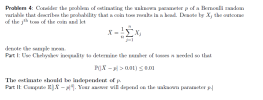 Problem 4: Consider the problem of estimating the unknown parameter p of a Bernoulli random variable that describes the probability that a coin toss results in a head. Denote by X the outcome of the jth toss of the coin and let j-1 denote the sample mean. Part I: Use Chebyshev inequality to determine the number of tosses n needed so that P( -pl> 0.01) 0.01 The estimate should be independent of p Part II: Compute ElIX -pl]. Your answer...
A coin with unknown probability, θ of heads is tossed four times and you are told...
 A coin with unknown probability, θ of heads is tossed four times and you are told that heads appeared fewer than 2 times. That's all you know. Compute the probability that a next toss will be heads assuming a uniform prior for θ.
 4. Toss a fair coin 6 times and let X denote the number of heads
that appear. Compute P(X ≤ 4). If the coin has probability p of
landing heads, compute P(X ≤ 3)
4. Toss a fair coin 6 times and let X denote the number of heads that appear. Compute P(X 4). If the coin has probability p of landing heads, compute P(X < 3).
4. Toss a fair coin 6 times and let X denote the number of heads
that appear. Compute P(X ≤ 4). If the coin has probability p of
landing heads, compute P(X ≤ 3)
4. Toss a fair coin 6 times and let X denote the number of heads that appear. Compute P(X 4). If the coin has probability p of landing heads, compute P(X < 3).
 Suppose we toss a weighted coin, for which the probability of getting a head (H) is 60% i) If we toss this coin 3 times, then the probability of getting exactly two heads (to two decimal places) is Number ii) If we toss this coin 6 times, then the probability of getting exactly four heads (to two decimal places) is Number CI iii) if we toss this coin 8 times, then the probability of getting 6 or more heads (to...
 Suppose we toss a coin (with P(H) p and P(T) 1-p-q) infinitely many times. Let Yi be the waiting time for the first head so (i-n)- (the first head occurs on the n-th toss) and Xn be the number of heads after n-tosses so (X·= k)-(there are k heads after n tosses of the coin). (a) Compute the P(Y> n) (b) Prove using the formula P(AnB) P(B) (c) What is the physical meaning of the formula you just proved?
Suppose...
Suppose we toss a coin (with P(H) p and P(T) 1-p-q) infinitely many times. Let Yi be the waiting time for the first head so (i-n)- (the first head occurs on the n-th toss) and Xn be the number of heads after n-tosses so (X·= k)-(there are k heads after n tosses of the coin). (a) Compute the P(Y> n) (b) Prove using the formula P(AnB) P(B) (c) What is the physical meaning of the formula you just proved?
Suppose...
 2. SUPPLEMENTAL QUESTION 1 (a) Toss a fair coin so that with probability pheads occurs and with probability p tails occurs. Let X be the number of heads and Y be the number of tails. Prove X and Y are dependent (b) Now, toss the same coin n times, where n is a random integer with Poisson distribution: n~Poisson(A) Let X be the random variable counting the number of heads, Y the random variable counting the number of tails. Prove...
 Problem 4: Consider the problem of estimating the unknown parameter p of a Bernoulli random variable that describes the probability that a coin toss results in a head. Denote by X the outcome of the jth toss of the coin and let j-1 denote the sample mean. Part I: Use Chebyshev inequality to determine the number of tosses n needed so that P( -pl> 0.01) 0.01 The estimate should be independent of p Part II: Compute ElIX -pl]. Your answer...
 A coin with unknown probability, θ of heads is tossed four times and you are told that heads appeared fewer than 2 times. That's all you know. Compute the probability that a next toss will be heads assuming a uniform prior for θ.
Most questions answered within 3 hours.
-
Where is the error in this code sequence?
String s1 = "Hello";
String s2 = "ello";...
asked 10 months ago -
Financial data for Joel de Paris, Inc., for last year
follow:
Joel de Paris, Inc.
Balance...
asked 10 months ago -
Consider this reaction:
Al2(SO4)3 (aq)+ BaCl3
(aq) Al2Cl6 (aq)- +
3BaSO4(s) . What is the...
asked 10 months ago -
Suppose that Savneet is considering increasing her
recent random sample from 20 car rentals to 40...
asked 10 months ago -
Trucks arrive at an unloading terminal at an average rate of 120
per hour.
Trucks arrive...
asked 10 months ago -
Why are methanol and ethanol completely soluble in water while
octanol is not very little soluble....
asked 10 months ago -
A facilities manager at a university reads in a research report
that the mean amount of...
asked 10 months ago -
When the CuSO4 is rehydrated by adding water to the anhydrous
compound, is this an endothermic...
asked 10 months ago -
A ray of sunlight is passing from diamond into crown glass; the
angle of incidence is...
asked 10 months ago -
A block of mass 0.249 kg is placed on top of a light, vertical
spring of...
asked 10 months ago -
how do the kidneys compensate in the presences of acidosis
a) trigger hyperventilate
b) reserve acid...
asked 10 months ago -
Question 501 pts
The rental rate of capital to the firm increases. Which of the
following...
asked 10 months ago