A force of 1.150×10³ N pushes a man on a bicycle forward. Air resistance pushes against...
A force of 1.150×10³ N pushes a man on a bicycle forward. Air resistance pushes against him with a force of 635 N. If he starts from rest and is on a level road, what speed ? will he be going after 30.0 m? The mass of the bicyclist and his bicycle is 90.0 kg. v=....... ms?
Homework Answers

Add Answer to:
A force of 1.150×10³ N pushes a man on a bicycle forward. Air
resistance pushes against...
A force of 1.150 x 10° N pushes a man on a bicycle forward. Air resistance...
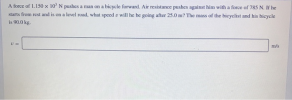 A force of 1.150 x 10° N pushes a man on a bicycle forward. Air resistance pushes against him with a force of 785 N. If he starts from rest and is on a level road, what speed u will he be going after 25.0 m? The mass of the bicyclist and his bicycle is 90.0 kg. m/s
A force of 5500 N gives Sally a little push forward as she rides her bicycle....
A force of 5500 N gives Sally a little push forward as she rides her bicycle. At the same time air resistance pushes against her with a force of 100 N. If she starts with a speed of 2.0 m/s and is on a level road, how fast will she be moving after 30 m? The mass of the bicyclist and her bicycle is 120 kg.
A man pushes on a 75.0 kg box such that his force of 225 N is...
A man pushes on a 75.0 kg box such that his force of 225 N is exerted at an angle of 27.0o to the horizontal as shown. (a) If the floor exerts a frictional force of 44.0 N on the box, what is the net force acting on the box? (b)If the box is initially at rest, how far will it have been pushed in 5.00 s assuming those forces continued?
The (non-conservative) force propelling a 2.00 x 10³-kg car up a mountain road does 6.80 x...
The (non-conservative) force propelling a 2.00 x 10³-kg car up a mountain road does 6.80 x 10⁶ J of work on the car. The car starts from rest at sea level and has a speed of 30.0 m/s at an altitude of 1.70 x 10² m above sea level. Obtain the work done on the car by the combined forces of friction and air resistance, both of which are non-conservative forces.
A man pushes a lawn mower on a level lawn with a force of 207 N....
A man pushes a lawn mower on a level lawn with a force of 207 N. If 35% of this force is directed forward, how much power does he expend in pushing the mower 6.6 m in 10 s?
A man pushes a lawn mower on a level lawn with a force of 194 N....
A man pushes a lawn mower on a level lawn with a force of 194 N. If 37% of this force is directed forward, how much power does he expend in pushing the mower 5.2 m in 13 s? W
An 90.0 kg spacewalking astronaut pushes off a 660 kg satellite, exerting a 85.0 N force...
An 90.0 kg spacewalking astronaut pushes off a 660 kg satellite, exerting a 85.0 N force for the 0.590 s it takes him to straighten his arms.
A mechanic pushes a 2.60 ✕ 103-kg car from rest to a speed of v, doing...
A mechanic pushes a 2.60 ✕ 103-kg car from rest to a speed of v, doing 4,770 J of work in the process. During this time, the car moves 20.0 m. Neglecting friction between car and road, find v and the horizontal force exerted on the car. (a) the speed v m/s (b) the horizontal force exerted on the car (Enter the magnitude.) N
A mechanic pushes a 3.30 ✕ 103-kg car from rest to a speed of v, doing...
A mechanic pushes a 3.30 ✕ 103-kg car from rest to a speed of v, doing 4,860 J of work in the process. During this time, the car moves 29.0 m. Neglecting friction between car and road, find v and the horizontal force exerted on the car. (a) the speed v m/s (b) the horizontal force exerted on the car (Enter the magnitude.) N
The driver of a 1.19 103 kg car traveling on the interstate at 35.0 m/s (nearly...
The driver of a 1.19 103 kg car traveling on the interstate at 35.0 m/s (nearly 80.0 mph) slams on his brakes to avoid hitting a second vehicle in front of him, which had come to rest because of congestion ahead. After the brakes are applied, a constant kinetic friction force of magnitude 7.96 103 N acts on the car. Ignore air resistance. (a) At what minimum distance should the brakes be applied to avoid a collision with the other...
 A force of 1.150 x 10° N pushes a man on a bicycle forward. Air resistance pushes against him with a force of 785 N. If he starts from rest and is on a level road, what speed u will he be going after 25.0 m? The mass of the bicyclist and his bicycle is 90.0 kg. m/s
Most questions answered within 3 hours.
-
Where is the error in this code sequence?
String s1 = "Hello";
String s2 = "ello";...
asked 11 months ago -
Financial data for Joel de Paris, Inc., for last year
follow:
Joel de Paris, Inc.
Balance...
asked 11 months ago -
Consider this reaction:
Al2(SO4)3 (aq)+ BaCl3
(aq) Al2Cl6 (aq)- +
3BaSO4(s) . What is the...
asked 11 months ago -
Suppose that Savneet is considering increasing her
recent random sample from 20 car rentals to 40...
asked 11 months ago -
Trucks arrive at an unloading terminal at an average rate of 120
per hour.
Trucks arrive...
asked 11 months ago -
Why are methanol and ethanol completely soluble in water while
octanol is not very little soluble....
asked 11 months ago -
A facilities manager at a university reads in a research report
that the mean amount of...
asked 11 months ago -
When the CuSO4 is rehydrated by adding water to the anhydrous
compound, is this an endothermic...
asked 11 months ago -
A ray of sunlight is passing from diamond into crown glass; the
angle of incidence is...
asked 11 months ago -
A block of mass 0.249 kg is placed on top of a light, vertical
spring of...
asked 11 months ago -
how do the kidneys compensate in the presences of acidosis
a) trigger hyperventilate
b) reserve acid...
asked 11 months ago -
Question 501 pts
The rental rate of capital to the firm increases. Which of the
following...
asked 11 months ago