in a single muscle twitch, the contraction period: A. is from start of contraction to the...
Homework Answers

Add Answer to:
in
a single muscle twitch, the contraction period:
A. is from start of contraction to the...
- Using the above diagram explain the difference between muscle twitch and tetanus from the near-muscular...
 - Using the above diagram explain the difference between muscle
twitch and tetanus from the near-muscular physiology view point
Action Potentials: 0 mv | A. 11 PULL 02. WOW! -90 mV Contraction: twitch summation rough tetanus smooth tetanus Basic Physiology.com Using the above diagram explain the difference between muscle twitch and tetanus from the neuro-muscular physiology view point.
- Using the above diagram explain the difference between muscle
twitch and tetanus from the near-muscular physiology view point
Action Potentials: 0 mv | A. 11 PULL 02. WOW! -90 mV Contraction: twitch summation rough tetanus smooth tetanus Basic Physiology.com Using the above diagram explain the difference between muscle twitch and tetanus from the neuro-muscular physiology view point.
Which portion of this myogram (graph below) shows a single twitch of the muscle? Explain your...
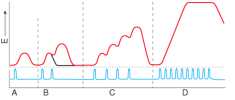 Which portion of this myogram (graph below) shows a single
twitch of the muscle? Explain your rationale.
الالالالالالال ر ان الا ال | C B A
Which portion of this myogram (graph below) shows a single
twitch of the muscle? Explain your rationale.
الالالالالالال ر ان الا ال | C B A
1. Explain the steps involved in muscle contraction starting from stimulation of the sciatic nerve (somatic...
 1. Explain the steps involved in muscle contraction starting from stimulation of the sciatic nerve (somatic motor neuron) to contraction of the muscle fibers within the gastrocnemius. Be sure to include any movements of ions, neurotransmitters, myofilaments and other relevant structures/particles in your answer. (3 pts) 2. Why do we see a graded response (tension increasing) in single muscle twitch when increasing the voltage (strength) of the stimulus that is applied? Was there a point at which maximal tension was...
homwork help The average skeletal muscle cell's latent period is ___ the contraction/relaxation phase. o A...
 homwork help
The average skeletal muscle cell's latent period is ___ the contraction/relaxation phase. o A much shorter than o B about as long as O C much longer than Unanswered Question 49 The latent period represents A the phase of crossbridge formation 0 B the phase of calcium re-uptake by the SR the delay between action potential stimulus arrival and calcium release from the SR D the phase of myosin head release from the actin filament
homwork help
The average skeletal muscle cell's latent period is ___ the contraction/relaxation phase. o A much shorter than o B about as long as O C much longer than Unanswered Question 49 The latent period represents A the phase of crossbridge formation 0 B the phase of calcium re-uptake by the SR the delay between action potential stimulus arrival and calcium release from the SR D the phase of myosin head release from the actin filament
Most muscle strains are caused by a. abnormal muscle contraction. b. muscle asymmetry. c. a tear...
Most muscle strains are caused by a. abnormal muscle contraction. b. muscle asymmetry. c. a tear in an adjoining tendon. d. bleeding into the muscle.
Generally, muscle force is greater when which of the following occur? A) More motor units are...
Generally, muscle force is greater when which of the following occur? A) More motor units are involved in a contraction B) More calcium is involved in a contraction C) There is a greater percentage of slow-twitch fibers in the muscle D) A person has hypermobile joints
Review & Practice She Exerci e in Motor wow m Muscle Physiology A Matching w ach...
 Review & Practice She Exerci e in Motor wow m Muscle Physiology A Matching w ach on the left with red description on the rich A Resto of wiches ension changes more than length polarization C hating more motor units D. shift in transmembrane potential toward om E. contraction with no relaxation cycles 6. e contraction onse to single stimulus 7. depolarization G. length changes more than tension H. contraction with rapid relaxation cycles I. neurotransmitter time prior to tension...
1) Muscle contraction is initiated at the NMJ by the release of _______________ from synaptic vesicles. a. Epinephrine b...
1) Muscle contraction is initiated at the NMJ by the release of _______________ from synaptic vesicles. a. Epinephrine b. Acetylcholine c. Calcium d. Sodium 2) Which of the following types of muscle contractions describes force development with no change in the muscle’s length? a. isokinetic b. isometric c. concentric d. eccentric 3) Which of the following describes the ability of a muscle to contract repeatedly against an opposing force? a. Muscular Endurance b. Aerobic Endurance c. Muscular Strength d. Muscular...
Flag question "All or none" applies to Select one: a. individual muscle fibers O b. muscle...
 Flag question "All or none" applies to Select one: a. individual muscle fibers O b. muscle bundles Clear my choice Which of the following fibers would you expect to find in higher concentration in the postural muscles? Select one: O a. fast twitch O b. slow twitch Which of the following describes skeletal muscle relaxation? Select one: O a. Ca+2 transported into SR O b. action potential causes release of neurotransmitter O C. ATP required O d. Ca+2 binds to...
please answer within 5 mins! 46) Which of the following is referred to as the period...
 please answer within 5 mins!
46) Which of the following is referred to as the period of lost excitability in skeletal muscle fibers? a) refractory period b) contraction period c) latent period d) relaxation period e) wave summation 47) Increasing the number of active motor units within a skeletal muscle is called a) wave summation. b) fused tetanus. c) motor unit recruitment. d) muscle tone. e) flaccidity. 48) Which of the following microscopic structures is only found in the cardiac...
please answer within 5 mins!
46) Which of the following is referred to as the period of lost excitability in skeletal muscle fibers? a) refractory period b) contraction period c) latent period d) relaxation period e) wave summation 47) Increasing the number of active motor units within a skeletal muscle is called a) wave summation. b) fused tetanus. c) motor unit recruitment. d) muscle tone. e) flaccidity. 48) Which of the following microscopic structures is only found in the cardiac...
 - Using the above diagram explain the difference between muscle
twitch and tetanus from the near-muscular physiology view point
Action Potentials: 0 mv | A. 11 PULL 02. WOW! -90 mV Contraction: twitch summation rough tetanus smooth tetanus Basic Physiology.com Using the above diagram explain the difference between muscle twitch and tetanus from the neuro-muscular physiology view point.
- Using the above diagram explain the difference between muscle
twitch and tetanus from the near-muscular physiology view point
Action Potentials: 0 mv | A. 11 PULL 02. WOW! -90 mV Contraction: twitch summation rough tetanus smooth tetanus Basic Physiology.com Using the above diagram explain the difference between muscle twitch and tetanus from the neuro-muscular physiology view point.
 Which portion of this myogram (graph below) shows a single
twitch of the muscle? Explain your rationale.
الالالالالالال ر ان الا ال | C B A
Which portion of this myogram (graph below) shows a single
twitch of the muscle? Explain your rationale.
الالالالالالال ر ان الا ال | C B A
 1. Explain the steps involved in muscle contraction starting from stimulation of the sciatic nerve (somatic motor neuron) to contraction of the muscle fibers within the gastrocnemius. Be sure to include any movements of ions, neurotransmitters, myofilaments and other relevant structures/particles in your answer. (3 pts) 2. Why do we see a graded response (tension increasing) in single muscle twitch when increasing the voltage (strength) of the stimulus that is applied? Was there a point at which maximal tension was...
 homwork help
The average skeletal muscle cell's latent period is ___ the contraction/relaxation phase. o A much shorter than o B about as long as O C much longer than Unanswered Question 49 The latent period represents A the phase of crossbridge formation 0 B the phase of calcium re-uptake by the SR the delay between action potential stimulus arrival and calcium release from the SR D the phase of myosin head release from the actin filament
homwork help
The average skeletal muscle cell's latent period is ___ the contraction/relaxation phase. o A much shorter than o B about as long as O C much longer than Unanswered Question 49 The latent period represents A the phase of crossbridge formation 0 B the phase of calcium re-uptake by the SR the delay between action potential stimulus arrival and calcium release from the SR D the phase of myosin head release from the actin filament
 Review & Practice She Exerci e in Motor wow m Muscle Physiology A Matching w ach on the left with red description on the rich A Resto of wiches ension changes more than length polarization C hating more motor units D. shift in transmembrane potential toward om E. contraction with no relaxation cycles 6. e contraction onse to single stimulus 7. depolarization G. length changes more than tension H. contraction with rapid relaxation cycles I. neurotransmitter time prior to tension...
 Flag question "All or none" applies to Select one: a. individual muscle fibers O b. muscle bundles Clear my choice Which of the following fibers would you expect to find in higher concentration in the postural muscles? Select one: O a. fast twitch O b. slow twitch Which of the following describes skeletal muscle relaxation? Select one: O a. Ca+2 transported into SR O b. action potential causes release of neurotransmitter O C. ATP required O d. Ca+2 binds to...
 please answer within 5 mins!
46) Which of the following is referred to as the period of lost excitability in skeletal muscle fibers? a) refractory period b) contraction period c) latent period d) relaxation period e) wave summation 47) Increasing the number of active motor units within a skeletal muscle is called a) wave summation. b) fused tetanus. c) motor unit recruitment. d) muscle tone. e) flaccidity. 48) Which of the following microscopic structures is only found in the cardiac...
please answer within 5 mins!
46) Which of the following is referred to as the period of lost excitability in skeletal muscle fibers? a) refractory period b) contraction period c) latent period d) relaxation period e) wave summation 47) Increasing the number of active motor units within a skeletal muscle is called a) wave summation. b) fused tetanus. c) motor unit recruitment. d) muscle tone. e) flaccidity. 48) Which of the following microscopic structures is only found in the cardiac...
Most questions answered within 3 hours.
-
Where is the error in this code sequence?
String s1 = "Hello";
String s2 = "ello";...
asked 10 months ago -
Financial data for Joel de Paris, Inc., for last year
follow:
Joel de Paris, Inc.
Balance...
asked 10 months ago -
Consider this reaction:
Al2(SO4)3 (aq)+ BaCl3
(aq) Al2Cl6 (aq)- +
3BaSO4(s) . What is the...
asked 10 months ago -
Suppose that Savneet is considering increasing her
recent random sample from 20 car rentals to 40...
asked 10 months ago -
Trucks arrive at an unloading terminal at an average rate of 120
per hour.
Trucks arrive...
asked 10 months ago -
Why are methanol and ethanol completely soluble in water while
octanol is not very little soluble....
asked 10 months ago -
A facilities manager at a university reads in a research report
that the mean amount of...
asked 10 months ago -
When the CuSO4 is rehydrated by adding water to the anhydrous
compound, is this an endothermic...
asked 10 months ago -
A ray of sunlight is passing from diamond into crown glass; the
angle of incidence is...
asked 10 months ago -
A block of mass 0.249 kg is placed on top of a light, vertical
spring of...
asked 10 months ago -
how do the kidneys compensate in the presences of acidosis
a) trigger hyperventilate
b) reserve acid...
asked 10 months ago -
Question 501 pts
The rental rate of capital to the firm increases. Which of the
following...
asked 10 months ago