Elastic collisions: one at rest one moving, two colliding, both initially moving the same direction. Inelastic...
Elastic collisions: one at rest one moving, two colliding, both initially moving the same direction.
Inelastic collisions: one at rest one moving, two colliding, both initially moving the same direction.
Perfectly elastic collisions: one at rest one moving, two colliding, both initially moving the same direction.
Questions1. Was momentum conserved for all types of collisions you examined in this experiment? If not, explain the cause of losing orgaining momentum.2. Was total velocity conserved for all types of collisions you examined in this experiment? If not, explain the cause of losing orgaining velocity.3. Was kinetic energy conserved for all types of collisions you examined in this experiment? If not, explain the cause of losing orgaining kinetic energy. In general, how does the momentum after a collision compare to the momentum before the collision?5. In which type of collision was the before-and-after difference in momentum the least? In which type of collision was thedifference the most?6. What factors might cause the total momentum immediately after a collision to not equal the total momentum immediatelybefore the collision? Explain how these factors affect the momentum.7. For a head-on collision between two carts of equal mass and equal speed, what is the total momentum before the collision?8. Compare the momentum of a firecracker at rest to the momentum of the firecracker after it explodes.9. Imagine two carts, one with twice the mass of the other, that are going to have a head-on collision. In order for the two cartsto be at rest after the collision, how fast must the less-massive cart move compared to the more-massive cart?
Homework Answers

Add Answer to:
Elastic collisions: one at rest one moving, two colliding, both
initially moving the same direction.
Inelastic...
Background Info: In this experiment you will observe and analyze elastic and inelastic collisions in one...
Background Info: In this experiment you will observe and analyze elastic and inelastic collisions in one dimension and in two dimensions. You will measure the final momentum of a system after it explodes. You will see how both kinds of collision affect the kinetic energy of a system that consists of two frictionless carts. You will determine the momentum of two carts after they collide when one cart is initially stationary. You will analyze the results qualitatively as well as...
Consider four types of collisions: inelastic, totally inelastic, elastic and explosive. (a) For which of these...
 Consider four types of collisions: inelastic, totally inelastic, elastic and explosive. (a) For which of these collision types is total linear momentum conserved? Do you need anything special for the momentum to stay constant? Explain! (b) For which of these types of collisions is kinetic energy the same before and after the collision? For each type, if the final kinetic energy is different than the initial, state whether kinetic energy has increased or decreased, and what other types of energy...
stion 5. Comment on momentum conservation for the inelastie collisions. » u can find patterns in momentum conservat...
 stion 5. Comment on momentum conservation for the inelastie collisions. » u can find patterns in momentum conservation according to whether one carton were moving before the collision, and whether the masses of the carts were ncany or very different. collisions. See if Fone cart or two were nearly equal Question 6. Explain what happens to the momentum in each of the cases. Loo the total momentum is divided un between the two carts after the collisions, compared to how...
1) Consider a head-on collision between two carts of equal mass. One is initially at rest...
1) Consider a head-on collision between two carts of equal mass. One is initially at rest and the other moves toward it with velocity v0. Use conservation of momentum and conservation of kinetic energy (assuming perfectly elastic) to determine the final velocity of each cart after the collision. 2) Draw a position vs time and velocity vs time graph for each ball covering the time span from just before the collision to just after the collision.
Imagine two carts with different masses colliding (m1 = 1.0 kg, m2 = 2.0 kg). If...
Imagine two carts with different masses colliding (m1 = 1.0 kg, m2 = 2.0 kg). If cart one is initially moving at 10 m/s and the other cart is stationary, calculate the final speed of each mass after they have a 100% elastic collision. Please show all work!
In procedure 1, cart 1 and cart 2 are initially at rest, and after the explosion the momentum of ...
 In procedure 1, cart 1 and cart 2 are initially at rest, and after the explosion the momentum of the two carts was the same. 2. a) If both carts were moving at some initial speed vi before the explosion: would the momentum of the two carts before the explosion still be equal to the sum of the momenta of the two carts after the explosion? A) yes B) no C) it depends on the initial conditions b) Explain your...
A cart on a table (cart A) collides with another cart that is initially at rest...
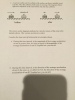 A cart on a table (cart A) collides with another cart that is initially at rest (cart B). After the collision, both carts are moving. The diagrams below represent snapshots of the carts before and after the collision. The arrows on the diagrams indicate the velocity vectors of the carts at the instants shown. (The vectors are drawn to scale.) Consider the time interval between the two instants shown. During this time interval, is the magnitude of the average acceleration...
1) Why is there a different equation for elastic vs inelastic collisions? Are they really different?...
 1) Why is there a different equation for elastic vs inelastic collisions? Are they really different? 5) If the first car does not go through either photogate after collision, what will its velocity essentially be? The conservation of momentum is a fundamental law in classical mechanics. It states that the total momentum of a system at the initial condition and ending conditions must be equivalent or p. - P. This can be modeled by studying the effect of objects in...
In Lab 8 you examined elastic collisions and one type of collision was the standing still...
In Lab 8 you examined elastic collisions and one type of collision was the standing still (one cart at rest prior to collision) collision. What outcome do you expect from a standing still collisions if: Cart 1 with mass M is moving to the right with a velocity of V and Cart 2 with mass 3M is not moving? Cart 1 will rebound from Cart 2 with a negative velocity with magnitude less than V (moving left) and Cart 2...
16. In a perfectly elastic collision Kinetic Energy is conserved for the system. (Remember that elastic...
 16. In a perfectly elastic collision Kinetic Energy is conserved for the system. (Remember that elastic collisions are ones where the objects bounce off of each other and don't stick.) On an air hockey table two identical pucks collide. Initially one is at rest and the other is moving with a speed of v. (Hint: How can the concept of momentum help with this problem?) a. What is the speed of each puck after the collision in terms of the...
 Consider four types of collisions: inelastic, totally inelastic, elastic and explosive. (a) For which of these collision types is total linear momentum conserved? Do you need anything special for the momentum to stay constant? Explain! (b) For which of these types of collisions is kinetic energy the same before and after the collision? For each type, if the final kinetic energy is different than the initial, state whether kinetic energy has increased or decreased, and what other types of energy...
 stion 5. Comment on momentum conservation for the inelastie collisions. » u can find patterns in momentum conservation according to whether one carton were moving before the collision, and whether the masses of the carts were ncany or very different. collisions. See if Fone cart or two were nearly equal Question 6. Explain what happens to the momentum in each of the cases. Loo the total momentum is divided un between the two carts after the collisions, compared to how...
 In procedure 1, cart 1 and cart 2 are initially at rest, and after the explosion the momentum of the two carts was the same. 2. a) If both carts were moving at some initial speed vi before the explosion: would the momentum of the two carts before the explosion still be equal to the sum of the momenta of the two carts after the explosion? A) yes B) no C) it depends on the initial conditions b) Explain your...
 A cart on a table (cart A) collides with another cart that is initially at rest (cart B). After the collision, both carts are moving. The diagrams below represent snapshots of the carts before and after the collision. The arrows on the diagrams indicate the velocity vectors of the carts at the instants shown. (The vectors are drawn to scale.) Consider the time interval between the two instants shown. During this time interval, is the magnitude of the average acceleration...
 1) Why is there a different equation for elastic vs inelastic collisions? Are they really different? 5) If the first car does not go through either photogate after collision, what will its velocity essentially be? The conservation of momentum is a fundamental law in classical mechanics. It states that the total momentum of a system at the initial condition and ending conditions must be equivalent or p. - P. This can be modeled by studying the effect of objects in...
 16. In a perfectly elastic collision Kinetic Energy is conserved for the system. (Remember that elastic collisions are ones where the objects bounce off of each other and don't stick.) On an air hockey table two identical pucks collide. Initially one is at rest and the other is moving with a speed of v. (Hint: How can the concept of momentum help with this problem?) a. What is the speed of each puck after the collision in terms of the...
Most questions answered within 3 hours.
-
Where is the error in this code sequence?
String s1 = "Hello";
String s2 = "ello";...
asked 10 months ago -
Financial data for Joel de Paris, Inc., for last year
follow:
Joel de Paris, Inc.
Balance...
asked 10 months ago -
Consider this reaction:
Al2(SO4)3 (aq)+ BaCl3
(aq) Al2Cl6 (aq)- +
3BaSO4(s) . What is the...
asked 10 months ago -
Suppose that Savneet is considering increasing her
recent random sample from 20 car rentals to 40...
asked 10 months ago -
Trucks arrive at an unloading terminal at an average rate of 120
per hour.
Trucks arrive...
asked 10 months ago -
Why are methanol and ethanol completely soluble in water while
octanol is not very little soluble....
asked 10 months ago -
A facilities manager at a university reads in a research report
that the mean amount of...
asked 10 months ago -
When the CuSO4 is rehydrated by adding water to the anhydrous
compound, is this an endothermic...
asked 10 months ago -
A ray of sunlight is passing from diamond into crown glass; the
angle of incidence is...
asked 10 months ago -
A block of mass 0.249 kg is placed on top of a light, vertical
spring of...
asked 10 months ago -
how do the kidneys compensate in the presences of acidosis
a) trigger hyperventilate
b) reserve acid...
asked 10 months ago -
Question 501 pts
The rental rate of capital to the firm increases. Which of the
following...
asked 10 months ago