consider the tuple t = ('foo','bar','baz') Which of the following statements replaces the second element ('bar')...
consider the tuple t = ('foo','bar','baz')
Which of the following statements replaces the second element ('bar') whith the string 'qux'
| a. |
t[1:1] = 'qux' |
|
| b. |
none of these options |
|
| c. |
t[1] = 'qux' |
|
| d. |
t(1) = 'qux' |
Homework Answers
none of these options replaces the second element ('bar') whith the string 'qux' is

|
none of these options |
Add Answer to:
consider the tuple t = ('foo','bar','baz')
Which of the following statements replaces the second element
('bar')...
Consider the following small program. What will the output be? def foo(x): print(x) def bar(): return...
Consider the following small program. What will the output be? def foo(x): print(x) def bar(): return 3 def baz(y, z): return y * z a = bar() + 2 b = baz(a, 2) foo(a + b) 10 3 2 25 none of these 15
QUESTION 1 Consider the algebraic type definition: data Foo Bar | Baz Int and the function defini...
 Haskell question, please give an explanation as well.
QUESTION 1 Consider the algebraic type definition: data Foo Bar | Baz Int and the function definition frob Foo->Foo ->Bool frob (Baz j) (Baz k)k frob-False which one of the following is the most concise deriving clause that must be added to the definition of Foo so that the function frob compiles correctly and does the expected computation? deriving (Show, Eq, Ord) deriving Eq deriving (Show, Eq) deriving (Show, Ord) No deriving...
Haskell question, please give an explanation as well.
QUESTION 1 Consider the algebraic type definition: data Foo Bar | Baz Int and the function definition frob Foo->Foo ->Bool frob (Baz j) (Baz k)k frob-False which one of the following is the most concise deriving clause that must be added to the definition of Foo so that the function frob compiles correctly and does the expected computation? deriving (Show, Eq, Ord) deriving Eq deriving (Show, Eq) deriving (Show, Ord) No deriving...
Consider the following piece of code int adjust = 0; int foo(int factor, function qux) {...
 Consider the following piece of code int adjust = 0; int foo(int factor, function qux) { int offset = bar(factor) + adjust adjust = (qux (offset) + adjust) / 2; return offset; } Which of the names (symbols) are bound at run-time? factor, qux, and offset foo, factor, and qux All the symbols. adjust, factor and offset
Consider the following program: # include <iostream> int x = 3, y = 5; void foo(void)...
Consider the following program: # include <iostream> int x = 3, y = 5; void foo(void) { x = x + 2; y = y + 4; } void bar(void) { int x = 10; y = y + 3; foo( ); cout << x << endl; cout << y << endl; } void baz(void) { int y = 7; bar( ); cout << y << endl; } void main( ) { baz( ); } What output does this program...
1. Consider the Viterbi algorithm. Which of the following statements is/are true. if any? (i) It...
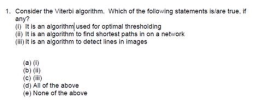 1. Consider the Viterbi algorithm. Which of the following statements is/are true. if any? (i) It is an algorithmused for optimal thresholding (ii) It is an algorithm to find shortest paths in on a network (ii)It is an algorithm to detect lines in images (a) (i) (b) (ii) (c) (ii) (d) All of the above (e) None of the above 4. If we apply a binary opening to the same object twice using the same structuring element, the effect. if...
In the following statement: foo = 'C' + 1; Which of the following could be a...
In the following statement: foo = 'C' + 1; Which of the following could be a valid data type for the variable foo? (More than one may be correct) 1) int 2) char 3) none of the above
1) In the Quiz class, the foo method has the following API: public void foo( int...
1) In the Quiz class, the foo method has the following API: public void foo( int x, String s) Which method call(s) would be correct assuming both a and y are integer values and assuming each statement is complete? a. Quiz q = new Quiz(); a = q.foo( y, “Maybe?” ); b. Quiz q = new Quiz(); q.foo( 1, “Hmmm!” ); c. Quiz q = new Quiz(); Quiz.foo( y, “You think” ); d. Both b and c 2) In the...
2. Consider the following programs (using C's syntax): #include <stdio.h> int a- 1, b-2; int foo...
 2. Consider the following programs (using C's syntax): #include <stdio.h> int a- 1, b-2; int foo (int x) 1 return (x+a); void ba r () { printf("%d, %d\n",a,b); void foobar) } printf("%d, %d\n", a, b) ; int a -4; bar bfoo (b); bar int main)( int b 8; foobar printf ("%d, %d\n", a, b) ; return 0; (a) What does the program print under static scoping? (b) What does the program print under dynamic scoping?
Consider the following Java classes: class A{ public int foo () { return 1; } public...
Consider the following Java classes: class A{ public int foo () { return 1; } public void message () { System.out.println( "A" + foo()); } } class B extends A { public int foo() {return 2; } } class C extends B { public void message () { System.out.println( "C" + foo()); } } (i) What are the outputs of the following code? (ii) What would be the outputs if Java used static dispatching rather than dynamic dispatching? B b...
22. Consider the case of a radioactive element X which decays by electron (beta) emission with...
 22. Consider the case of a radioactive element X which decays by electron (beta) emission with a half-life of 4 days to a stable nuclide of element Z. Which of the following statements is CORRECT? (a) After 8 days the sample will consist of one-fourth element Z and three-fourths element X. (b) Element Z will weigh exactly the same as element X when decay is complete (weighed to an infinite number of significant figures). (c) 2.0 g of element X...
 Haskell question, please give an explanation as well.
QUESTION 1 Consider the algebraic type definition: data Foo Bar | Baz Int and the function definition frob Foo->Foo ->Bool frob (Baz j) (Baz k)k frob-False which one of the following is the most concise deriving clause that must be added to the definition of Foo so that the function frob compiles correctly and does the expected computation? deriving (Show, Eq, Ord) deriving Eq deriving (Show, Eq) deriving (Show, Ord) No deriving...
Haskell question, please give an explanation as well.
QUESTION 1 Consider the algebraic type definition: data Foo Bar | Baz Int and the function definition frob Foo->Foo ->Bool frob (Baz j) (Baz k)k frob-False which one of the following is the most concise deriving clause that must be added to the definition of Foo so that the function frob compiles correctly and does the expected computation? deriving (Show, Eq, Ord) deriving Eq deriving (Show, Eq) deriving (Show, Ord) No deriving...
 Consider the following piece of code int adjust = 0; int foo(int factor, function qux) { int offset = bar(factor) + adjust adjust = (qux (offset) + adjust) / 2; return offset; } Which of the names (symbols) are bound at run-time? factor, qux, and offset foo, factor, and qux All the symbols. adjust, factor and offset
 1. Consider the Viterbi algorithm. Which of the following statements is/are true. if any? (i) It is an algorithmused for optimal thresholding (ii) It is an algorithm to find shortest paths in on a network (ii)It is an algorithm to detect lines in images (a) (i) (b) (ii) (c) (ii) (d) All of the above (e) None of the above 4. If we apply a binary opening to the same object twice using the same structuring element, the effect. if...
 2. Consider the following programs (using C's syntax): #include <stdio.h> int a- 1, b-2; int foo (int x) 1 return (x+a); void ba r () { printf("%d, %d\n",a,b); void foobar) } printf("%d, %d\n", a, b) ; int a -4; bar bfoo (b); bar int main)( int b 8; foobar printf ("%d, %d\n", a, b) ; return 0; (a) What does the program print under static scoping? (b) What does the program print under dynamic scoping?
 22. Consider the case of a radioactive element X which decays by electron (beta) emission with a half-life of 4 days to a stable nuclide of element Z. Which of the following statements is CORRECT? (a) After 8 days the sample will consist of one-fourth element Z and three-fourths element X. (b) Element Z will weigh exactly the same as element X when decay is complete (weighed to an infinite number of significant figures). (c) 2.0 g of element X...
Most questions answered within 3 hours.
-
Where is the error in this code sequence?
String s1 = "Hello";
String s2 = "ello";...
asked 10 months ago -
Financial data for Joel de Paris, Inc., for last year
follow:
Joel de Paris, Inc.
Balance...
asked 10 months ago -
Consider this reaction:
Al2(SO4)3 (aq)+ BaCl3
(aq) Al2Cl6 (aq)- +
3BaSO4(s) . What is the...
asked 10 months ago -
Suppose that Savneet is considering increasing her
recent random sample from 20 car rentals to 40...
asked 10 months ago -
Trucks arrive at an unloading terminal at an average rate of 120
per hour.
Trucks arrive...
asked 10 months ago -
Why are methanol and ethanol completely soluble in water while
octanol is not very little soluble....
asked 10 months ago -
A facilities manager at a university reads in a research report
that the mean amount of...
asked 10 months ago -
When the CuSO4 is rehydrated by adding water to the anhydrous
compound, is this an endothermic...
asked 10 months ago -
A ray of sunlight is passing from diamond into crown glass; the
angle of incidence is...
asked 10 months ago -
A block of mass 0.249 kg is placed on top of a light, vertical
spring of...
asked 10 months ago -
how do the kidneys compensate in the presences of acidosis
a) trigger hyperventilate
b) reserve acid...
asked 10 months ago -
Question 501 pts
The rental rate of capital to the firm increases. Which of the
following...
asked 10 months ago