Give the temperature when 1.000 atm of Ar in 6.000 L at 25.00 oC is compressed...
Give the temperature when 1.000 atm of Ar in 6.000 L at 25.00 oC is compressed to 1.00 L and 2.000 atm.
Homework Answers

Add Answer to:
Give the temperature when 1.000 atm of Ar in 6.000 L at 25.00 oC
is compressed...
The standard enthalpies of formation, at 25.00 oC, of methanol (CH4O(l)), water (H2O(l)), and carbon dioxide...
The standard enthalpies of formation, at 25.00 oC, of methanol (CH4O(l)), water (H2O(l)), and carbon dioxide (CO2(g)) are, respectively, -238.7 kJ/mol, -285.8 kJ/mol, and -393.5 kJ/mol. Calculate the change in the entropy of the surroundings (in J/K) upon the combustion of 16.9 g of methanol under a constant pressure of 1.000 atm and a temperature of 25.00 oC. N.B. combustion is the reaction of this substance with molecular oxygen to produce water and carbon dioxide.
A 1.75 L volume of helium gas stored at 0.873 atm will have a temperature of 46.9oC. If the helium is compressed down to...
A 1.75 L volume of helium gas stored at 0.873 atm will have a temperature of 46.9oC. If the helium is compressed down to a volume of 523 mL while allowing the pressure to settle at 1,662 mmHg, what will the temperature of the helium gas now be, in oC? Give your answer to one decimal place, and in units of oC. Data: 1 atm = 760 mmHg, 0oC = 273 K, PV = nRT, R = 0.0821 L.atm.mol-1.K-1.
One mole of Ar gas is compressed by an external pressure of 2.00 atm, to a...
One mole of Ar gas is compressed by an external pressure of 2.00 atm, to a final volume of 10.0 L from an initial volume of 20.0 L. Using calorimetry, 1.00 kJ of heat is observed to flow from the gas. What is the work for this process? Please show all steps.
In an experiment, 1.000 atm of H2(g) in a 5.00 L container at 25.00°C was reacted under standard ...
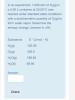 In an experiment, 1.000 atm of H2(g) in a 5.00 L container at 25.00°C was reacted under standard state conditions with a stoichiometric quantity of O2(g) to form water vapor. Determine the entropy change. (answer in J/K) Substance S (J/mol K H2(g) 02(g) H20(g) 188.83 H20)69.95 30.58 205.0 Answer: Check
In an experiment, 1.000 atm of H2(g) in a 5.00 L container at 25.00°C was reacted under standard state conditions with a stoichiometric quantity of O2(g) to form water vapor....
In an experiment, 1.000 atm of H2(g) in a 5.00 L container at 25.00°C was reacted under standard state conditions with a stoichiometric quantity of O2(g) to form water vapor. Determine the entropy change. (answer in J/K) Substance S (J/mol K H2(g) 02(g) H20(g) 188.83 H20)69.95 30.58 205.0 Answer: Check
In an experiment, 1.000 atm of H2(g) in a 5.00 L container at 25.00°C was reacted under standard state conditions with a stoichiometric quantity of O2(g) to form water vapor....
In an experiment, 1.000 atm of H2(g) in a 10.00 L container at 25.00°C was reacted...
 In an experiment, 1.000 atm of H2(g) in a 10.00 L container at 25.00°C was reacted under standard state conditions with a stoichiometric quantity of O2(g) to form water vapor. Determine the entropy change. (answer in J/K) Substance Hag) O2(g) H2O(g) H2O( /mol.) 130.58 205.0 188.83 69.95
A sample of gas has a volume of 3.0 L at a pressure of 2.0 atm....
A sample of gas has a volume of 3.0 L at a pressure of 2.0 atm. What is the volume of the gas in L at 10.0 atm? Temperature is constant. A sample of gas has a volume of 20.0 L at a pressure of 1.0 atm. What is the volume of the gas in L at 5.0 atm? Temperature is constant. A sample of gas has a volume of 4.0 L at a pressure of 0.50 atm. What is...
An ideal gas is compressed at a constant pressure of 0.80 atm from 19.0 L to...
 An ideal gas is compressed at a constant pressure of 0.80 atm from 19.0 L to 12.0 L. The initial temperature of the gas is 27°C. 1 atm (atmosphere) = 1.013 ~ 10% Pa, 1 L (liter) = 10² m². What is the final temperature of the gas in °C? Hint: pV / T = nR, and n does not change, so you can use piVi / T1 = p2V2 / T2. Do not forget to convert the unit of...
At constant temperature, a sample of helium at 3.46 atm in a closed container was compressed...
At constant temperature, a sample of helium at 3.46 atm in a closed container was compressed from 11.00 L to 4.00 L. What was the new pressure exerted by the helium on its container?
A gas is compressed at a constant pressure of 0.800 atm from 10.00 L to 1.00...
A gas is compressed at a constant pressure of 0.800 atm from 10.00 L to 1.00 L. In the process, 340 J of energy leaves the gas by heat. (a) What is the work done on the gas?
(III) If 3.25 L of gas at 16.0 °C and 1.00 atm is compressed at a...
 (III) If 3.25 L of gas at 16.0 °C and 1.00 atm is compressed at a pressure of 125 atm at 20.0 °C, calculate the new volume of the gas. (IV) Calculate its volume (in liters) of 88.4 g of CO2 at STP. (V) H20 and CH4 are gases at 150 °C. Which exhibits more ideal behavior? Why? (VI) Assume that you have a cylinder with a movable piston. What would happen to the gas pressure inside the cylinder if...
 In an experiment, 1.000 atm of H2(g) in a 5.00 L container at 25.00°C was reacted under standard state conditions with a stoichiometric quantity of O2(g) to form water vapor. Determine the entropy change. (answer in J/K) Substance S (J/mol K H2(g) 02(g) H20(g) 188.83 H20)69.95 30.58 205.0 Answer: Check
In an experiment, 1.000 atm of H2(g) in a 5.00 L container at 25.00°C was reacted under standard state conditions with a stoichiometric quantity of O2(g) to form water vapor....
In an experiment, 1.000 atm of H2(g) in a 5.00 L container at 25.00°C was reacted under standard state conditions with a stoichiometric quantity of O2(g) to form water vapor. Determine the entropy change. (answer in J/K) Substance S (J/mol K H2(g) 02(g) H20(g) 188.83 H20)69.95 30.58 205.0 Answer: Check
In an experiment, 1.000 atm of H2(g) in a 5.00 L container at 25.00°C was reacted under standard state conditions with a stoichiometric quantity of O2(g) to form water vapor....
 In an experiment, 1.000 atm of H2(g) in a 10.00 L container at 25.00°C was reacted under standard state conditions with a stoichiometric quantity of O2(g) to form water vapor. Determine the entropy change. (answer in J/K) Substance Hag) O2(g) H2O(g) H2O( /mol.) 130.58 205.0 188.83 69.95
 An ideal gas is compressed at a constant pressure of 0.80 atm from 19.0 L to 12.0 L. The initial temperature of the gas is 27°C. 1 atm (atmosphere) = 1.013 ~ 10% Pa, 1 L (liter) = 10² m². What is the final temperature of the gas in °C? Hint: pV / T = nR, and n does not change, so you can use piVi / T1 = p2V2 / T2. Do not forget to convert the unit of...
 (III) If 3.25 L of gas at 16.0 °C and 1.00 atm is compressed at a pressure of 125 atm at 20.0 °C, calculate the new volume of the gas. (IV) Calculate its volume (in liters) of 88.4 g of CO2 at STP. (V) H20 and CH4 are gases at 150 °C. Which exhibits more ideal behavior? Why? (VI) Assume that you have a cylinder with a movable piston. What would happen to the gas pressure inside the cylinder if...
Most questions answered within 3 hours.
-
Where is the error in this code sequence?
String s1 = "Hello";
String s2 = "ello";...
asked 11 months ago -
Financial data for Joel de Paris, Inc., for last year
follow:
Joel de Paris, Inc.
Balance...
asked 11 months ago -
Consider this reaction:
Al2(SO4)3 (aq)+ BaCl3
(aq) Al2Cl6 (aq)- +
3BaSO4(s) . What is the...
asked 11 months ago -
Suppose that Savneet is considering increasing her
recent random sample from 20 car rentals to 40...
asked 11 months ago -
Trucks arrive at an unloading terminal at an average rate of 120
per hour.
Trucks arrive...
asked 11 months ago -
Why are methanol and ethanol completely soluble in water while
octanol is not very little soluble....
asked 11 months ago -
A facilities manager at a university reads in a research report
that the mean amount of...
asked 11 months ago -
When the CuSO4 is rehydrated by adding water to the anhydrous
compound, is this an endothermic...
asked 11 months ago -
A ray of sunlight is passing from diamond into crown glass; the
angle of incidence is...
asked 11 months ago -
A block of mass 0.249 kg is placed on top of a light, vertical
spring of...
asked 11 months ago -
how do the kidneys compensate in the presences of acidosis
a) trigger hyperventilate
b) reserve acid...
asked 11 months ago -
Question 501 pts
The rental rate of capital to the firm increases. Which of the
following...
asked 11 months ago