1-Make two identical models of methane with four different colored balls attached to each carbon. on...
1-Make two identical models of methane with four different colored balls attached to each carbon. on one model switches two of the balls. drwa the two structure in steroscopic projection with dashes, wedges and label each hydrogen.
2- Are these structures identical or are they different? if they are different how are they different? what is the relationship between the two structures?
Homework Answers
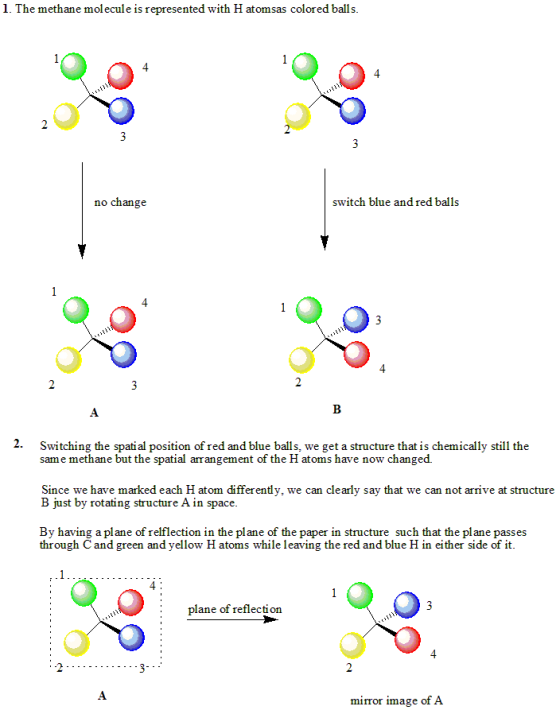
Hence, we see that structure B is actually exactly similar to the mirror image of structure A. Hence, as we have marked the hydrogens, the two structures are non-identical non-superimposable mirror images which are called enantiomers. Hence, they differ only by the spatial arrangement of atoms in space, but have the same bonds.
Note that if the hydrogens are not numbered or color coded, we can not distinguish between the hydrogens and the structures will be indistinguishable. That is why a carbon stereocenter has four different groups attached.
Add Answer to:
1-Make two identical models of methane with four different
colored balls attached to each carbon. on...
1. Construct a model that has a central carbon atom with 4 different colored spheres attached...
 1. Construct a model that has a central carbon atom with 4 different colored spheres attached to it, representing four different atoms or groups. Draw a solid/dashed-wedge structure of this model here and answer the following questions. C (a blue ball) D Fig. 1 B 2. Reconstruct the original stereogenic carbon with the four different colored balls again. Set the model on the table so that the blue ball (C In the Fig 1) points upwards. a. Looking down on...
1. Construct a model consisting of a tetrahedral carbon center with four different component atoms attached:...
 1. Construct a model consisting of a tetrahedral carbon center with four different component atoms attached: red, white, blue, green; each color represents a different group or atom attached to carbon. Does this model have a plane of symmetry (1a)? A plane of symmetry can be described as a cutting plane-a plane that when passed through a model or object divides it into two equivalent halves; the elements on one side of the plane are the exact reflection of the...
1. Construct a model that has a central carbon atom with 4 different colored spheres attached...
 1. Construct a model that has a central carbon atom with 4 different colored spheres attached to it, representing four different atoms or groups. Draw a solid/dashed-wedge structure of this model here and answer the following questions. ç (a blue ball) IND Fig. 1 B a. Does the model have a plane of symmetry? Yes No The central carbon is said to be a stereocenter, stereogenic center, or chiral carbon. Change one of the colored spheres so that two of...
CHCH(OH)-CH(OH)-CH3 PART 3: 23-BUTANEDIOL Build as many models of 2.3-butanediol as you can. First, attach two...
 CHCH(OH)-CH(OH)-CH3 PART 3: 23-BUTANEDIOL Build as many models of 2.3-butanediol as you can. First, attach two carbons with a single bond To each carbon add one carbon, one hydrogen, and one oxygen. To complete the structure. fill in the remaining hydrogen atoms. Remember, a model is not different if it is completelv superimposable on one already constructed! 13. How many stereochemically different models are possible for 2.3-butanediol? 14. What characteristic does one of these models have that makes it different?...
19-26 thanks! 19-29* PART 3: 2,3-BUTANEDIOL CH-CH(OH)-CH(OH)-CH, mirror images, not superimposable Build as many models of...
 19-26 thanks!
19-29*
PART 3: 2,3-BUTANEDIOL CH-CH(OH)-CH(OH)-CH, mirror images, not superimposable Build as many models of 2,3-butanediol as you can. First, attach two carbons with a single bond. To each carbon add one carbon, one hydrogen, and one oxygen. To complete the structure, Ti the remaining hydrogen atoms. Remember, a model is not different if it is completely superimposable on one already constructed! 13. How many stereochemically different models are possible for 2,3-butanediol? 14. What characteristic does one of these...
19-26 thanks!
19-29*
PART 3: 2,3-BUTANEDIOL CH-CH(OH)-CH(OH)-CH, mirror images, not superimposable Build as many models of 2,3-butanediol as you can. First, attach two carbons with a single bond. To each carbon add one carbon, one hydrogen, and one oxygen. To complete the structure, Ti the remaining hydrogen atoms. Remember, a model is not different if it is completely superimposable on one already constructed! 13. How many stereochemically different models are possible for 2,3-butanediol? 14. What characteristic does one of these...
rojection Formulas for each model in #16 (again orient the carbon chain up and down). Are...
 rojection Formulas for each model in #16 (again orient the carbon chain up and down). Are the mirror images "superimposable?" Interchange any two of the groups located at one of the chiral centers on one of the models in # 1 6. What is the stereochemical relationship of the resulting structure with the one that used to be its mirror image? Will this 'new' model be "optically active?" Why or why not? 18. PART 4:2,3-DICHLOROPENTANE CH, CH(C)-CHC)-CH2CH Build a model...
The molecular models of two sugars have been built for you. Sugar A is a mono...
 The molecular models of two sugars have been built for you. Sugar A is a mono ugar B is a disaccharide. In these models, the different colored balls represent the follow saccharide and groups of atoms: black - carbon, yellow - hydrogen, red -oxygen, and grem -cHoH. 1. Draw the Haworth and Fischer projections of sugar A in the boxes below Sugar Fischer Projection Fischer Projection Cyelic Model A Haworth Projection Open-chain Glucose a. Is sugar model A an aldohexose...
3. Diastereomers and Meso Forms. When a molecule has two or more stereogenic centers, stereoisomers that...
 3. Diastereomers and Meso Forms. When a molecule has two or more stereogenic centers, stereoisomers that are not mirror images can exist; these are called diastereoisomers. Within this general class, there are special types of stereoisomers that are always optically inactive and are called meso forms. Construct a model with four different colored balls about a carbon center. Construct another identical to the first and verify this by the superimposition test. Now remove the same colored balls, blue (C from...
3. Diastereomers and Meso Forms. When a molecule has two or more stereogenic centers, stereoisomers that...
 3. Diastereomers and Meso Forms. When a molecule has two or more stereogenic centers, stereoisomers that are not mirror images can exist; these are called diastereoisomers. Within this general class, there are special types of stereoisomers that are always optically inactive and are called meso forms. Construct a model with four different colored balls about a carbon center. Construct another identical to the first and verify this by the superimposition test. Now remove the same colored balls, blue (C from...
Q.1. Draw structures and make models for the following compounds. Predict the angle(s) around each carbon...
 Q.1. Draw structures and make models for the following compounds. Predict the angle(s) around each carbon atom(s) of methane and ethane. a) Methane, CH4 Angle: b) Ethane, C2H6 Angles c) Two isomers of butane, C4H10.
 1. Construct a model that has a central carbon atom with 4 different colored spheres attached to it, representing four different atoms or groups. Draw a solid/dashed-wedge structure of this model here and answer the following questions. C (a blue ball) D Fig. 1 B 2. Reconstruct the original stereogenic carbon with the four different colored balls again. Set the model on the table so that the blue ball (C In the Fig 1) points upwards. a. Looking down on...
 1. Construct a model consisting of a tetrahedral carbon center with four different component atoms attached: red, white, blue, green; each color represents a different group or atom attached to carbon. Does this model have a plane of symmetry (1a)? A plane of symmetry can be described as a cutting plane-a plane that when passed through a model or object divides it into two equivalent halves; the elements on one side of the plane are the exact reflection of the...
 1. Construct a model that has a central carbon atom with 4 different colored spheres attached to it, representing four different atoms or groups. Draw a solid/dashed-wedge structure of this model here and answer the following questions. ç (a blue ball) IND Fig. 1 B a. Does the model have a plane of symmetry? Yes No The central carbon is said to be a stereocenter, stereogenic center, or chiral carbon. Change one of the colored spheres so that two of...
 CHCH(OH)-CH(OH)-CH3 PART 3: 23-BUTANEDIOL Build as many models of 2.3-butanediol as you can. First, attach two carbons with a single bond To each carbon add one carbon, one hydrogen, and one oxygen. To complete the structure. fill in the remaining hydrogen atoms. Remember, a model is not different if it is completelv superimposable on one already constructed! 13. How many stereochemically different models are possible for 2.3-butanediol? 14. What characteristic does one of these models have that makes it different?...
 19-26 thanks!
19-29*
PART 3: 2,3-BUTANEDIOL CH-CH(OH)-CH(OH)-CH, mirror images, not superimposable Build as many models of 2,3-butanediol as you can. First, attach two carbons with a single bond. To each carbon add one carbon, one hydrogen, and one oxygen. To complete the structure, Ti the remaining hydrogen atoms. Remember, a model is not different if it is completely superimposable on one already constructed! 13. How many stereochemically different models are possible for 2,3-butanediol? 14. What characteristic does one of these...
19-26 thanks!
19-29*
PART 3: 2,3-BUTANEDIOL CH-CH(OH)-CH(OH)-CH, mirror images, not superimposable Build as many models of 2,3-butanediol as you can. First, attach two carbons with a single bond. To each carbon add one carbon, one hydrogen, and one oxygen. To complete the structure, Ti the remaining hydrogen atoms. Remember, a model is not different if it is completely superimposable on one already constructed! 13. How many stereochemically different models are possible for 2,3-butanediol? 14. What characteristic does one of these...
 rojection Formulas for each model in #16 (again orient the carbon chain up and down). Are the mirror images "superimposable?" Interchange any two of the groups located at one of the chiral centers on one of the models in # 1 6. What is the stereochemical relationship of the resulting structure with the one that used to be its mirror image? Will this 'new' model be "optically active?" Why or why not? 18. PART 4:2,3-DICHLOROPENTANE CH, CH(C)-CHC)-CH2CH Build a model...
 The molecular models of two sugars have been built for you. Sugar A is a mono ugar B is a disaccharide. In these models, the different colored balls represent the follow saccharide and groups of atoms: black - carbon, yellow - hydrogen, red -oxygen, and grem -cHoH. 1. Draw the Haworth and Fischer projections of sugar A in the boxes below Sugar Fischer Projection Fischer Projection Cyelic Model A Haworth Projection Open-chain Glucose a. Is sugar model A an aldohexose...
 3. Diastereomers and Meso Forms. When a molecule has two or more stereogenic centers, stereoisomers that are not mirror images can exist; these are called diastereoisomers. Within this general class, there are special types of stereoisomers that are always optically inactive and are called meso forms. Construct a model with four different colored balls about a carbon center. Construct another identical to the first and verify this by the superimposition test. Now remove the same colored balls, blue (C from...
 3. Diastereomers and Meso Forms. When a molecule has two or more stereogenic centers, stereoisomers that are not mirror images can exist; these are called diastereoisomers. Within this general class, there are special types of stereoisomers that are always optically inactive and are called meso forms. Construct a model with four different colored balls about a carbon center. Construct another identical to the first and verify this by the superimposition test. Now remove the same colored balls, blue (C from...
 Q.1. Draw structures and make models for the following compounds. Predict the angle(s) around each carbon atom(s) of methane and ethane. a) Methane, CH4 Angle: b) Ethane, C2H6 Angles c) Two isomers of butane, C4H10.
Most questions answered within 3 hours.
-
Where is the error in this code sequence?
String s1 = "Hello";
String s2 = "ello";...
asked 10 months ago -
Financial data for Joel de Paris, Inc., for last year
follow:
Joel de Paris, Inc.
Balance...
asked 10 months ago -
Consider this reaction:
Al2(SO4)3 (aq)+ BaCl3
(aq) Al2Cl6 (aq)- +
3BaSO4(s) . What is the...
asked 10 months ago -
Suppose that Savneet is considering increasing her
recent random sample from 20 car rentals to 40...
asked 10 months ago -
Trucks arrive at an unloading terminal at an average rate of 120
per hour.
Trucks arrive...
asked 10 months ago -
Why are methanol and ethanol completely soluble in water while
octanol is not very little soluble....
asked 10 months ago -
A facilities manager at a university reads in a research report
that the mean amount of...
asked 10 months ago -
When the CuSO4 is rehydrated by adding water to the anhydrous
compound, is this an endothermic...
asked 10 months ago -
A ray of sunlight is passing from diamond into crown glass; the
angle of incidence is...
asked 10 months ago -
A block of mass 0.249 kg is placed on top of a light, vertical
spring of...
asked 10 months ago -
how do the kidneys compensate in the presences of acidosis
a) trigger hyperventilate
b) reserve acid...
asked 10 months ago -
Question 501 pts
The rental rate of capital to the firm increases. Which of the
following...
asked 10 months ago