8. A geostationary satellite above the equator (GEO) undergoes uniform circular motion and orbits the Earth...
8. A geostationary satellite above the equator (GEO) undergoes uniform circular motion and orbits the Earth matching the same period of rotation as the Earth (24 hours). If the GEO is at orbital altitude of 35, 786 km above sea level at the equator, what is the centripetal acceleration this GEO would experience?
Homework Answers


Add Answer to:
8. A geostationary satellite above the equator (GEO) undergoes
uniform circular motion and orbits the Earth...
A geostationary communications satellite orbits the earth directly above the equator at an altitude of 34800...
A geostationary communications satellite orbits the earth directly above the equator at an altitude of 34800 km .Calculate the time it would take a cell phone signal to travel from a point on the equator to the satellite and back.Would this delay be noticeable in a conversation?
A geostationary orbit is one in which a satellite orbits the Earth (in a circular orbit)...
A geostationary orbit is one in which a satellite orbits the Earth (in a circular orbit) in the same time as it takes the Earth to make one full rotation with respect to the stars. a) Given the mass of the Earth, calculate the distance of a geostationary satellite from the center of the Earth. b) If you were standing on the equator with the geostationary satellite at your zenith, how long would it take to receive a radio signal?...
Exercise 9.5 A geostationary satellite orbits the earth in 24 hours along an orbital path that...
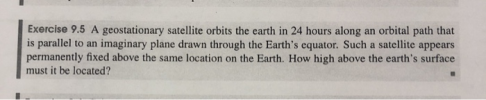 Exercise 9.5 A geostationary satellite orbits the earth in 24 hours along an orbital path that is parallel to an imaginary plane drawn through the Earth's equator. Such a satellite appears permanently fixed above the same location on the Earth. How high above the earth's surface must it be located?
A satellite travels around Earth in uniform circular motion at an altitude of 35,850 km above...
A satellite travels around Earth in uniform circular motion at an altitude of 35,850 km above Earth’s surface. The satellite is in geosynchronous orbit. In the below figure, the satellite moves counterclockwise (ABCDA). (State directions in terms of the x- and y-axes.) The radius of Earth is 6371 km. What is the direction of the satellite’s average velocity for one quarter of an orbit, starting at A and ending at B? Enter the answer in degrees where negative indicates an...
Geostationary satellites have orbits that have an altitude of about 36,000 km and a period of...
Geostationary satellites have orbits that have an altitude of about 36,000 km and a period of exactly 24 hours. Estimate the orbital period of a GPS satellite (these orbit at altitudes of roughly 20,000 km). Explain how you get your answer. [Hint: use one of Kepler's laws to do the calculation].
Two satellites are in circular orbits around the earth. The orbit for satellite A is at...
Two satellites are in circular orbits around the earth. The orbit for satellite A is at a height of 502 km above the earth’s surface, while that for satellite B is at a height of 747 km. Find the orbital speed for (a) satellite A and (b) satellite B.
Two satellites are in circular orbits around the earth. The orbit for satellite A is at...
Two satellites are in circular orbits around the earth. The orbit for satellite A is at a height of 460 km above the earth’s surface, while that for satellite B is at a height of 774 km. Find the orbital speed for (a) satellite A and (b) satellite B.
Two satellites are in circular orbits around the earth. The orbit for satellite A is at...
Two satellites are in circular orbits around the earth. The orbit for satellite A is at a height of 364 km above the earth's surface, while that for satellite B is at a height of 880. km. Find the orbital speed for satellite A and satellite B. (a) VA = (b) VB =
A satellite travels around Earth in uniform circular motion, at a height of 35,800 km above...
A satellite travels around Earth in uniform circular motion, at a height of 35,800 km above Earth's atoms. The satellite has a mass of 580 kg. a) what is the gravitational force exerted on the satellite by Earth? b) How fast must the satellite be moving to retain this orbit (relative to the center of Earth)
+-6.66 points HRW10 4.PO56 An Earth satellite moves in a circular orbit 759 km above the...
 +-6.66 points HRW10 4.PO56 An Earth satellite moves in a circular orbit 759 km above the Earth's surface. The period of the motion is 99.8 min. (a) What is the speed of the satellite? m/s (b) What is the magnitude of the centripetal acceleration of the satellite? m/s2 Additional Materials Section 4.5 H Aigebra Squareroots & Squares
 Exercise 9.5 A geostationary satellite orbits the earth in 24 hours along an orbital path that is parallel to an imaginary plane drawn through the Earth's equator. Such a satellite appears permanently fixed above the same location on the Earth. How high above the earth's surface must it be located?
 +-6.66 points HRW10 4.PO56 An Earth satellite moves in a circular orbit 759 km above the Earth's surface. The period of the motion is 99.8 min. (a) What is the speed of the satellite? m/s (b) What is the magnitude of the centripetal acceleration of the satellite? m/s2 Additional Materials Section 4.5 H Aigebra Squareroots & Squares
Most questions answered within 3 hours.
-
Where is the error in this code sequence?
String s1 = "Hello";
String s2 = "ello";...
asked 10 months ago -
Financial data for Joel de Paris, Inc., for last year
follow:
Joel de Paris, Inc.
Balance...
asked 10 months ago -
Consider this reaction:
Al2(SO4)3 (aq)+ BaCl3
(aq) Al2Cl6 (aq)- +
3BaSO4(s) . What is the...
asked 10 months ago -
Suppose that Savneet is considering increasing her
recent random sample from 20 car rentals to 40...
asked 10 months ago -
Trucks arrive at an unloading terminal at an average rate of 120
per hour.
Trucks arrive...
asked 10 months ago -
Why are methanol and ethanol completely soluble in water while
octanol is not very little soluble....
asked 10 months ago -
A facilities manager at a university reads in a research report
that the mean amount of...
asked 10 months ago -
When the CuSO4 is rehydrated by adding water to the anhydrous
compound, is this an endothermic...
asked 10 months ago -
A ray of sunlight is passing from diamond into crown glass; the
angle of incidence is...
asked 10 months ago -
A block of mass 0.249 kg is placed on top of a light, vertical
spring of...
asked 10 months ago -
how do the kidneys compensate in the presences of acidosis
a) trigger hyperventilate
b) reserve acid...
asked 10 months ago -
Question 501 pts
The rental rate of capital to the firm increases. Which of the
following...
asked 10 months ago