Suppose the ski patrol lowers a rescue sled and victim down a 60 degree slope at...
Suppose the ski patrol lowers a rescue sled and victim down a 60 degree slope at constant speed. The coefficient of friction between the sled and the snow is 0.100. The work due to gravity is 40,000J. What is the mass of the rescue sled and victim if lowered 30 m along the slope? image 79 kg 157 kg 137 kg Correct answer not shown 118 kg 92 kg
Homework Answers

Add Answer to:
Suppose the ski patrol lowers a rescue sled and victim down a 60
degree slope at...
Suppose the ski patrol lowers a rescue sled and victim, having a total mass of 95.0 kg
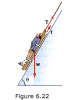 Suppose the ski patrol lowers a rescue sled and victim, having a total mass of 95.0 kg, down a θ = 68.0° slope at constant speed, as shown in Figure 6.22. The coefficient of friction between the sled and the snow is 0.100.(a) How much work is done by friction as the sled moves 30.0 m along the hill? (b) How much work is done by the rope on the sled in this distance? (c) What is the work done by gravity...
Suppose the ski patrol lowers a rescue sled and victim, having a total mass of 80.0...
Suppose the ski patrol lowers a rescue sled and victim, having a total mass of 80.0 kg, down a θ = 70.0° slope at constant speed, as shown in the figure. coefficient of friction between the sled and the snow is 0.100. (a) How much work is done (in J) by friction as the sled moves 30.0 m along the hill? -805.25 J (b) How much work is done (in J) by the rope on the sled in this distance?...
Suppose the ski patrol lowers a rescue sled and victim, having a total mass of 55.05...
Suppose the ski patrol lowers a rescue sled and victim, having a total mass of 55.05 kg, down a theta= 64.84º slope at constant acceleration a=-2.00 m/s2, as shown in Figure. The positive direction is downward along the slope. Hence, the negative sign in acceleration, if present, means the direction of the acceleration is pointing along the slope upwards. The coefficient of friction between the sled and the snow is 0.100. How many Joules of work is done by the...
(25%) Problem 2: Suppose the ski patrol lowers a resese sled carrying an injured skier with...
 (25%) Problem 2: Suppose the ski patrol lowers a resese sled carrying an injured skier with a combined mass of 97.5 kg, domm a 60.0 slope at constant speed, as shown in the Fisgure. The coefficient of kinetic friction betwen the sled and the seow is 0 100 23% Partai How much work. minules,"done by frirtan ak the sled mom :d m along th, him. pletes mpleea l 1 1- 25% Parr 0) How trmch trork, iz jeu Iti, is...
A ski starts from rest and slides down a 28 degree incline 60 m long. a)...
A ski starts from rest and slides down a 28 degree incline 60 m long. a) If the coefficient of friction is 0.090, what is the ski's speed at the base of the incline? b) If the snow is level at the foot of the incline and has the same coefficient of friction, how far will the ski travel along the level? Use energy methods.
Starting from rest, a 30.6 kg child rides a 7.75 kg sled down a frictionless ski...
Starting from rest, a 30.6 kg child rides a 7.75 kg sled down a frictionless ski slope. At the bottom of the hill, her speed is 6.0 m/s . If the slope makes an angle of 13.3° with respect to the horizontal, how far along the hill did she slide on her sled? Child on a sled sliding down a slope from right to left. distance= __________
Starting from rest, a 31.6 kg child rides a 8.50 kg sled down a frictionless ski...
Starting from rest, a 31.6 kg child rides a 8.50 kg sled down a frictionless ski slope. At the bottom of the hill, her speed is 6.4 m/s . If the slope makes an angle of 14.1° with respect to the horizontal, how far along the hill did she slide on her sled?
Starting from rest, a 28.6 kg child rides a 8.75 kg sled down a frictionless ski...
Starting from rest, a 28.6 kg child rides a 8.75 kg sled down a frictionless ski slope. At the bottom of the hill, her speed is 7.2 m/s . If the slope makes an angle of 14.5° with respect to the horizontal, how far along the hill did she slide on her sled?
A dog sledding team is composed of a 80.8 kg musher (the person driving the sled),...
A dog sledding team is composed of a 80.8 kg musher (the person driving the sled), a 23.0 kg sled, and four dogs. Assume that each dog's pull is fully transmitted to the sled, applied parallel to the ground, and the sled travels along level ground. How much power does each dog supply to pull the sled and driver system at a constant speed of 9.10 m/s if the coefficient of friction between the sled and the snow is 0.140?...
In Madagascar, where snow is in short supply, children sled down steep dirt hills on wood...
 In Madagascar, where snow is in short supply, children sled down steep dirt hills on wood and cardboard planks. Two boys want to figure out how much faster one sled is compared to the other. The coefficient of kinetic friction between a dirt surface and wood is uk = 0.158; the coefficient of kinetic friction between a dirt surface and cardboard is uk = 0.390. If they both start from rest at the top of the hill, which has a...
 (25%) Problem 2: Suppose the ski patrol lowers a resese sled carrying an injured skier with a combined mass of 97.5 kg, domm a 60.0 slope at constant speed, as shown in the Fisgure. The coefficient of kinetic friction betwen the sled and the seow is 0 100 23% Partai How much work. minules,"done by frirtan ak the sled mom :d m along th, him. pletes mpleea l 1 1- 25% Parr 0) How trmch trork, iz jeu Iti, is...
 In Madagascar, where snow is in short supply, children sled down steep dirt hills on wood and cardboard planks. Two boys want to figure out how much faster one sled is compared to the other. The coefficient of kinetic friction between a dirt surface and wood is uk = 0.158; the coefficient of kinetic friction between a dirt surface and cardboard is uk = 0.390. If they both start from rest at the top of the hill, which has a...
Most questions answered within 3 hours.
-
Where is the error in this code sequence?
String s1 = "Hello";
String s2 = "ello";...
asked 11 months ago -
Financial data for Joel de Paris, Inc., for last year
follow:
Joel de Paris, Inc.
Balance...
asked 11 months ago -
Consider this reaction:
Al2(SO4)3 (aq)+ BaCl3
(aq) Al2Cl6 (aq)- +
3BaSO4(s) . What is the...
asked 11 months ago -
Suppose that Savneet is considering increasing her
recent random sample from 20 car rentals to 40...
asked 11 months ago -
Trucks arrive at an unloading terminal at an average rate of 120
per hour.
Trucks arrive...
asked 11 months ago -
Why are methanol and ethanol completely soluble in water while
octanol is not very little soluble....
asked 11 months ago -
A facilities manager at a university reads in a research report
that the mean amount of...
asked 11 months ago -
When the CuSO4 is rehydrated by adding water to the anhydrous
compound, is this an endothermic...
asked 11 months ago -
A ray of sunlight is passing from diamond into crown glass; the
angle of incidence is...
asked 11 months ago -
A block of mass 0.249 kg is placed on top of a light, vertical
spring of...
asked 11 months ago -
how do the kidneys compensate in the presences of acidosis
a) trigger hyperventilate
b) reserve acid...
asked 11 months ago -
Question 501 pts
The rental rate of capital to the firm increases. Which of the
following...
asked 11 months ago