Illustrate the operation of PARTITION on the array ? = < 15, 1,9, 5, 13,6, 8,...
Illustrate the operation of PARTITION on the array ? = < 15, 1,9, 5, 13,6, 8, 4, 21, 2, 6, 11 >
Following is the algorithm we used in class:
PARTITION(A, p, r)
1 x = A[r]
2 i = p -1
3 for j = p to r -1
4 if A[j] ≤ x
5 i = i +1
6 exchange A[i] with A[j]
7 exchange A[i+1] with A[r]
8 return i + 1
**Please use p,j,i, and r on the array so I can clearly see the steps to better understand. Any help is appreciated. Thank you!
Homework Answers
? = < 15, 1,9, 5, 13,6, 8, 4, 21, 2, 6, 11 >
Initially p = 1 and r = 12 [I.e size]
Line 1. x = A[r] i.e x = A[12] = 11 i.e last value in
array
Line 2. i = p-1 i.e i = 0
Line 3. Loop starts from j = 1 to 11 (r-1) [ Last element
is omitted]
----------------if A[1] i.e 15 < 11 false , i remains as 0
----------------if A[2] i.e 1 < 11 true , i is incremented by 1
i.e its 1 now
------------------------------------Swap A[1] and A[2] i.e [ 1,
15,9, 5, 13,6, 8, 4, 21, 2, 6, 11 ]
----------------if A[3] i.e 9 < 11 true , i is
incremented by 1 i.e its 2 now
------------------------------------Swap A[2] and A[3] i.e
[ 1, 9,15, 5, 13,6, 8, 4, 21, 2, 6, 11
]
----------------if A[4] i.e 5 < 11 true , i is
incremented by 1 i.e its 3 now
------------------------------------Swap A[3] and A[4] i.e
[ 1, 9,5, 15, 13,6, 8, 4, 21, 2, 6, 11 ]
----------------if A[5] i.e 13 < 11 false , i remains as
3
----------------if A[6] i.e 6 < 11 true , i is incremented by 1
i.e its 4 now
------------------------------------Swap A[4] and A[6] i.e
[ 1, 9,5, 6, 13,15, 8, 4, 21, 2, 6, 11 ]
----------------if A[7] i.e 8 < 11 true , i is
incremented by 1 i.e its 5 now
------------------------------------Swap A[5] and A[7] i.e
[ 1, 9,5, 6, 8,15, 13, 4, 21, 2, 6, 11 ]
----------------if A[8] i.e 4 < 11 true , i is
incremented by 1 i.e its 6 now
------------------------------------Swap A[6] and A[8] i.e
[ 1, 9,5, 6, 8,4, 13, 15, 21, 2, 6, 11 ]
----------------if A[9] i.e 21 < 11 false , i remains as
6
----------------if A[10] i.e 2 < 11 true , i is incremented by 1
i.e its 7 now
------------------------------------Swap A[7] and A[10]
i.e [ 1, 9,5, 6, 8,4, 2, 15, 21, 13, 6,
11 ]
----------------if A[11] i.e 6 < 11 true , i is
incremented by 1 i.e its 8 now
------------------------------------Swap A[8] and A[11]
i.e [ 1, 9,5, 6, 8,4, 2, 6, 21, 13, 15,
11 ]
Now Since the LOOP IS COMPLETE IT WILL EXCHANGE [i+1] with 11
[ 1, 9,5, 6, 8,4, 2, 6, 11, 21,
13, 15, 21 ]
Now we can see that elements to left of 11 are less and elements to
right of 11 are greater ..Hence it partitions the Array.
PLEASE UPVOTE, Thanks, PLEASE COMMENT if there is any
concern.
Add Answer to:
Illustrate the operation of PARTITION on the array ? = < 15,
1,9, 5, 13,6, 8,...
Question 5 (10 points) Below is the PARTITION(A, p. r) pseudocode where pivot is always selected...
 Question 5 (10 points) Below is the PARTITION(A, p. r) pseudocode where pivot is always selected as the last element and array A=(-23,7,-14,1,5,1). a. Illustrate the PARTITIONCA, P.7) module operation like below when call it with the above array A. Show clearly the position of i and ; in each picture. Pj PARTITIONCA, p,r) 1. x=A[r] 2. i=p - 1 3. for j =p tor-1 4. if Allsx 5. i=i+1 exchange A[i] with AD 7. exchange A[i+1] with 4[r] 8....
Illustrate the operation of randomized quicksort on the array: A = (19, 2, 11, 14, 7,...
Illustrate the operation of randomized quicksort on the array: A = (19, 2, 11, 14, 7, 17, 4, 3, 5, 15) by showing the values in A after each call to partition. Assume that the randomly chosen pivots were, in order, 〈19, 14, 2, 5, 4, 7, 15〉.
Use Figure 6.4 as a model, illustrate the operation of HEAPSORT on the array A =...
 Use Figure 6.4 as a model, illustrate the operation of HEAPSORT
on the array
A = <4, 10, 7, 25, 8, 3>. Show all intermediate steps how the
heap is transformed.
6.4/
91|11|016 | 8|4|||7|V (9) 09
Use Figure 6.4 as a model, illustrate the operation of HEAPSORT
on the array
A = <4, 10, 7, 25, 8, 3>. Show all intermediate steps how the
heap is transformed.
6.4/
91|11|016 | 8|4|||7|V (9) 09
6. Consider the following algorithm, where P is an array containing random numbers. The function swap(v1,v2)...
 6. Consider the following algorithm, where P is an array containing random numbers. The function swap(v1,v2) will swap the values stored in the variables v1 and v2. Note that % is the modulus operation, and will return the integer remainder r of a/b, i.e., r-a%b Require: Array P with n > 0 values 1: i-1, j-n-l 2: while i<=j do for a=i to j by i do 4: 5: 6: 7: if Pla>Pat 11 and Pla]%2--0 then swap(Plal, Pla+1l) end...
you will analyse two algorithms for finding the median of an array of integers. You will...
you will analyse two algorithms for finding the median of an array of integers. You will compare both algorithms in terms of timing, and hopefully design a hybrid algorithm that uses both, depending on input size. You will write a report describing your experiments and results. the following Java program implements two algorithms for finding the median of an array of integers. The first uses merge sort, and the other implements the recursive linear time selection algorithm, the task is...
Algorithm Illustrate the HeapSort on the following array. [ 7, 2, 4, 6, 3, 1, 5...
Algorithm Illustrate the HeapSort on the following array. [ 7, 2, 4, 6, 3, 1, 5 ] Show the array and the heap after each call to ReHeap.
Data Structures and Algorithm Analysis illustrate the result of each operation in the sequence PUSH(S, 4),...
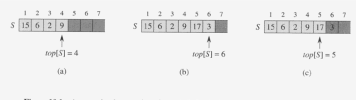 Data Structures and Algorithm Analysis
illustrate the result of each operation in the sequence PUSH(S,
4), PUSH(S, 2), POP(), PUSH(S, 3), PUSH(S, 9), POP(), and PUSH(S,
0) on an initially empty stack S stored in array S[1..6].
1 2 3 4 5 6 7 1 2 3 4 5 6 7 15 6 2 9 17 3 S15 6 29 173 top[S] = 4 top[S] = 6 top[S] = 5
Data Structures and Algorithm Analysis
illustrate the result of each operation in the sequence PUSH(S,
4), PUSH(S, 2), POP(), PUSH(S, 3), PUSH(S, 9), POP(), and PUSH(S,
0) on an initially empty stack S stored in array S[1..6].
1 2 3 4 5 6 7 1 2 3 4 5 6 7 15 6 2 9 17 3 S15 6 29 173 top[S] = 4 top[S] = 6 top[S] = 5
Hi, I have programming problem related to array, sorting, and. swap operation Thank you, Best Regards.....
 Hi, I have programming problem related to array, sorting, and.
swap operation
Thank you,
Best Regards..
A non-empty array A consisting of N integers is given. You can perform a single swap operation in array A. This operation takes two indices I and J, such that 0 S13 J<N, and exchanges the values of A[i] and A[J]. The goal is to check whether array A can be sorted into non-decreasing order by performing at most one swap operation. For example,...
Hi, I have programming problem related to array, sorting, and.
swap operation
Thank you,
Best Regards..
A non-empty array A consisting of N integers is given. You can perform a single swap operation in array A. This operation takes two indices I and J, such that 0 S13 J<N, and exchanges the values of A[i] and A[J]. The goal is to check whether array A can be sorted into non-decreasing order by performing at most one swap operation. For example,...
1. What is the output of the following code segment? int array[] = { 8, 6,...
1. What is the output of the following code segment? int array[] = { 8, 6, 9, 7, 6, 4, 4, 5, 8, 10 }; System.out.println( "Index Value" ); for ( int i = 0; i < array.length; i++ ) System.out.printf( "%d %d\n", i, array[ i ] ); 2. What is the output of the following code segment? char sentence[] = {'H', 'o', 'w', ' ', 'a', 'r', 'e', ' ', 'y', 'o', 'u' }; String output = "The sentence...
In C++, develop a class that supports array rotation. Rotating an array is an operation where...
In C++, develop a class that supports array rotation. Rotating an array is an operation where you shift all elements of the array some number of positions left or right, and elements that are shifted off of the left or right end of the array "wrap around" to the right or left end, respectively. For example, if we rotate the array [1, 2, 3, 4, 5] to the right by 1, we get the array [5, 1, 2, 3, 4]....
 Question 5 (10 points) Below is the PARTITION(A, p. r) pseudocode where pivot is always selected as the last element and array A=(-23,7,-14,1,5,1). a. Illustrate the PARTITIONCA, P.7) module operation like below when call it with the above array A. Show clearly the position of i and ; in each picture. Pj PARTITIONCA, p,r) 1. x=A[r] 2. i=p - 1 3. for j =p tor-1 4. if Allsx 5. i=i+1 exchange A[i] with AD 7. exchange A[i+1] with 4[r] 8....
 Use Figure 6.4 as a model, illustrate the operation of HEAPSORT
on the array
A = <4, 10, 7, 25, 8, 3>. Show all intermediate steps how the
heap is transformed.
6.4/
91|11|016 | 8|4|||7|V (9) 09
Use Figure 6.4 as a model, illustrate the operation of HEAPSORT
on the array
A = <4, 10, 7, 25, 8, 3>. Show all intermediate steps how the
heap is transformed.
6.4/
91|11|016 | 8|4|||7|V (9) 09
 6. Consider the following algorithm, where P is an array containing random numbers. The function swap(v1,v2) will swap the values stored in the variables v1 and v2. Note that % is the modulus operation, and will return the integer remainder r of a/b, i.e., r-a%b Require: Array P with n > 0 values 1: i-1, j-n-l 2: while i<=j do for a=i to j by i do 4: 5: 6: 7: if Pla>Pat 11 and Pla]%2--0 then swap(Plal, Pla+1l) end...
 Data Structures and Algorithm Analysis
illustrate the result of each operation in the sequence PUSH(S,
4), PUSH(S, 2), POP(), PUSH(S, 3), PUSH(S, 9), POP(), and PUSH(S,
0) on an initially empty stack S stored in array S[1..6].
1 2 3 4 5 6 7 1 2 3 4 5 6 7 15 6 2 9 17 3 S15 6 29 173 top[S] = 4 top[S] = 6 top[S] = 5
Data Structures and Algorithm Analysis
illustrate the result of each operation in the sequence PUSH(S,
4), PUSH(S, 2), POP(), PUSH(S, 3), PUSH(S, 9), POP(), and PUSH(S,
0) on an initially empty stack S stored in array S[1..6].
1 2 3 4 5 6 7 1 2 3 4 5 6 7 15 6 2 9 17 3 S15 6 29 173 top[S] = 4 top[S] = 6 top[S] = 5
 Hi, I have programming problem related to array, sorting, and.
swap operation
Thank you,
Best Regards..
A non-empty array A consisting of N integers is given. You can perform a single swap operation in array A. This operation takes two indices I and J, such that 0 S13 J<N, and exchanges the values of A[i] and A[J]. The goal is to check whether array A can be sorted into non-decreasing order by performing at most one swap operation. For example,...
Hi, I have programming problem related to array, sorting, and.
swap operation
Thank you,
Best Regards..
A non-empty array A consisting of N integers is given. You can perform a single swap operation in array A. This operation takes two indices I and J, such that 0 S13 J<N, and exchanges the values of A[i] and A[J]. The goal is to check whether array A can be sorted into non-decreasing order by performing at most one swap operation. For example,...
Most questions answered within 3 hours.
-
Where is the error in this code sequence?
String s1 = "Hello";
String s2 = "ello";...
asked 11 months ago -
Financial data for Joel de Paris, Inc., for last year
follow:
Joel de Paris, Inc.
Balance...
asked 11 months ago -
Consider this reaction:
Al2(SO4)3 (aq)+ BaCl3
(aq) Al2Cl6 (aq)- +
3BaSO4(s) . What is the...
asked 11 months ago -
Suppose that Savneet is considering increasing her
recent random sample from 20 car rentals to 40...
asked 11 months ago -
Trucks arrive at an unloading terminal at an average rate of 120
per hour.
Trucks arrive...
asked 11 months ago -
Why are methanol and ethanol completely soluble in water while
octanol is not very little soluble....
asked 11 months ago -
A facilities manager at a university reads in a research report
that the mean amount of...
asked 11 months ago -
When the CuSO4 is rehydrated by adding water to the anhydrous
compound, is this an endothermic...
asked 11 months ago -
A ray of sunlight is passing from diamond into crown glass; the
angle of incidence is...
asked 11 months ago -
A block of mass 0.249 kg is placed on top of a light, vertical
spring of...
asked 11 months ago -
how do the kidneys compensate in the presences of acidosis
a) trigger hyperventilate
b) reserve acid...
asked 11 months ago -
Question 501 pts
The rental rate of capital to the firm increases. Which of the
following...
asked 11 months ago