Water is forced through a contraction causing low pressure. The water is observed to boil at...
Water is forced through a contraction causing low pressure. The water is observed to boil at a pressure of -13.01 psi. If atmospheric pressure is 14.70 psi, what is the temperature, in oF, of the water?
Homework Answers
saturation temperature for Gauge Pressure-13.01Psi is equal to 119.79 F.
So, Water will start boiling at 119.79 F
Ans- 119.79 F
Add Answer to:
Water is forced through a contraction causing low pressure. The
water is observed to boil at...
3: Water in an hl=17 cm deep pan is observed to boil at 101 C. Assume...
 3: Water in an hl=17 cm deep pan is observed to boil at 101 C. Assume the saturation pressure is 101 kPa. At what temperature will the water in an h2=87 cm deep pan boil? The water density is 1000 kg/m”. Assume that the temperature difference is approximately proportional to the pressure difference in this region of temperature and pressure: the relationship is dT = 0.23 dp, in which the units of temperature and pressure are K and kPa, respectively....
The atmospheric pressure at the summit of Mt. Everest (8,848 m) is about 250 torr. At which temperature will water boil...
 The atmospheric pressure at the summit of Mt. Everest (8,848 m) is about 250 torr. At which temperature will water boil on the summit? Assume the molar enthalpy of vaporization to be 40.8 kJ/mol over the entire range.
At approximately what temperature will water boil at the top of Mount Kilimanjaro (elevation 5895 m...
At approximately what temperature will water boil at the top of Mount Kilimanjaro (elevation 5895 m above sea level with atmospheric pressure of 31.2 kPa.
In a 4.00-L pressure cooker, water is brought to a boil. If the final temperature is...
In a 4.00-L pressure cooker, water is brought to a boil. If the final temperature is 115°C at 3.20 atm, how many moles of steam (water vapor) are in the cooker?
1. [20 pts] An indraft wind tunnel pulls air into an inlet, through a contraction, the...
 1. [20 pts] An indraft wind tunnel pulls air into an inlet, through a contraction, the test section, and the diffuser, as shown below. The test section has a circular cross section and it has a diameter of 0.5 m. Assume the wind tunnel is at sea level and the temperature and pressure of the atmosphere are given by standard atmospheric conditions. (a) If the test section is designed to have a velocity of 200 m/s, determine the Mach number,...
The vapor pressure of a liquid is the pressure exerted by its vapor when the liquid...
The vapor pressure of a liquid is the pressure exerted by its vapor when the liquid and vapor states are in equilibrium. The relationship between vapor pressure P and temperature T is expressed by the Clausius-Clapeyron equation. lnP2P1=ΔHvapR(1T1−1T2) where P1 and P2 are the vapor pressures at the absolute temperatures T1 and T2, respectively, ΔHvap is the heat of vaporization of the substance in joules per mole, and R is the ideal gas constant, which is equal to 8.3145 J/(mol⋅K)....
Your Instant Pot pressure cooker operates at 11.6 psi above atmospheric pressure. Considering the boiling point...
Your Instant Pot pressure cooker operates at 11.6 psi above atmospheric pressure. Considering the boiling point of water (100 0C at 14.7 psi, which is normal atmospheric pressure) and the heat of vaporization of water (40.7 kJ/mol), at what temperature is the water inside the instant pot boiling when it reaches its operational pressure?
( points total) You have decided to boil a small pot of water immersed in another...
 ( points total) You have decided to boil a small pot of water immersed in another large water as shown in the sketch below. Will the water in the small pot ever boil at steady staa conditions when the water in the big pot boils? Explain your answe there is always water in both pots at steady state conditions. n another large pot r. You should assume that water 5 points total) Two flasks, shown in the figure below, are...
QUESTION 22 In a mountain location where the atmospheric pressure is less than 1,00 atm, water...
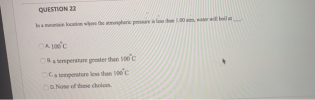 QUESTION 22 In a mountain location where the atmospheric pressure is less than 1,00 atm, water will boil at A. 100°C B. a temperature greater than 100°C C. a temperature less than 100°c D. None of these choices.
(a) At what depth in fresh water is the critical pressure of water reached, given that...
(a) At what depth in fresh water is the critical pressure of water reached, given that the surface is at sea level? (b) At what temperature will this water boil? (c) Is a significantly higher temperature needed to boil water at a greater depth? Define the context of the above problem. What information has been given? What are the units of the values given in the problem? What are the governing principles for this problem?
 3: Water in an hl=17 cm deep pan is observed to boil at 101 C. Assume the saturation pressure is 101 kPa. At what temperature will the water in an h2=87 cm deep pan boil? The water density is 1000 kg/m”. Assume that the temperature difference is approximately proportional to the pressure difference in this region of temperature and pressure: the relationship is dT = 0.23 dp, in which the units of temperature and pressure are K and kPa, respectively....
 The atmospheric pressure at the summit of Mt. Everest (8,848 m) is about 250 torr. At which temperature will water boil on the summit? Assume the molar enthalpy of vaporization to be 40.8 kJ/mol over the entire range.
 1. [20 pts] An indraft wind tunnel pulls air into an inlet, through a contraction, the test section, and the diffuser, as shown below. The test section has a circular cross section and it has a diameter of 0.5 m. Assume the wind tunnel is at sea level and the temperature and pressure of the atmosphere are given by standard atmospheric conditions. (a) If the test section is designed to have a velocity of 200 m/s, determine the Mach number,...
 ( points total) You have decided to boil a small pot of water immersed in another large water as shown in the sketch below. Will the water in the small pot ever boil at steady staa conditions when the water in the big pot boils? Explain your answe there is always water in both pots at steady state conditions. n another large pot r. You should assume that water 5 points total) Two flasks, shown in the figure below, are...
 QUESTION 22 In a mountain location where the atmospheric pressure is less than 1,00 atm, water will boil at A. 100°C B. a temperature greater than 100°C C. a temperature less than 100°c D. None of these choices.
Most questions answered within 3 hours.
-
Where is the error in this code sequence?
String s1 = "Hello";
String s2 = "ello";...
asked 11 months ago -
Financial data for Joel de Paris, Inc., for last year
follow:
Joel de Paris, Inc.
Balance...
asked 11 months ago -
Consider this reaction:
Al2(SO4)3 (aq)+ BaCl3
(aq) Al2Cl6 (aq)- +
3BaSO4(s) . What is the...
asked 11 months ago -
Suppose that Savneet is considering increasing her
recent random sample from 20 car rentals to 40...
asked 11 months ago -
Trucks arrive at an unloading terminal at an average rate of 120
per hour.
Trucks arrive...
asked 11 months ago -
Why are methanol and ethanol completely soluble in water while
octanol is not very little soluble....
asked 11 months ago -
A facilities manager at a university reads in a research report
that the mean amount of...
asked 11 months ago -
When the CuSO4 is rehydrated by adding water to the anhydrous
compound, is this an endothermic...
asked 11 months ago -
A ray of sunlight is passing from diamond into crown glass; the
angle of incidence is...
asked 11 months ago -
A block of mass 0.249 kg is placed on top of a light, vertical
spring of...
asked 11 months ago -
how do the kidneys compensate in the presences of acidosis
a) trigger hyperventilate
b) reserve acid...
asked 11 months ago -
Question 501 pts
The rental rate of capital to the firm increases. Which of the
following...
asked 11 months ago