Gauss’ law states that the electric flux through a closed mathematical surface is proportional to the...
Gauss’ law states that the electric flux through a closed mathematical surface is proportional to the total charge enclosed by that surface, ΦE∝qenc. The symbol ΦE represents the process of performing an integral of the electric field over the closed surface, ΦE=∮E→⋅dA→. The full mathematical statement of Gauss’s law is:
Using the slider control in the simulation, move the center of the surface to the point x = 5 R / 4 and y = 0 . What is the electric flux through the surface now? Note: the gridlines in the x y plane are spaced by distance R / 2 .
Homework Answers

Add Answer to:
Gauss’ law states that the electric flux through a closed
mathematical surface is proportional to the...
Gauss' Law states that the flux through a closed surface A) is proportional to the size...
Gauss' Law states that the flux through a closed surface A) is proportional to the size of the surface B) is proportional to the enclosed charge squared C) is proportional to the enclosed charge D) is proportional to the inverse of the charge E) always has a net value of zero
Gauss's law indicates that the flux through a closed surface O is inversely proportional to the...
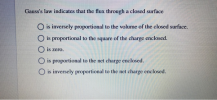 Gauss's law indicates that the flux through a closed surface O is inversely proportional to the volume of the closed surface. O is proportional to the square of the charge enclosed O is zero. O is proportional to the net charge enclosed. O is inversely proportional to the net charge enclosed.
Gauss's law indicates that the flux through a closed surface O is inversely proportional to the...
 Gauss's law indicates that the flux through a closed surface O is inversely proportional to the volume of the closed surface. O is proportional to the square of the charge enclosed O is zero. O is proportional to the net charge enclosed. O is inversely proportional to the net charge enclosed.
We find from Gauss's law that the flux through a closed surface: is proportional to the square of the charge enclosed....
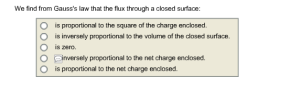 We find from Gauss's law that the flux through a closed surface: is proportional to the square of the charge enclosed. is inversely proportional to the volume of the closed surface. is zero. inversely proportional to the net charge enclosed. is proportional to the net charge enclosed.
Gauss' law Is expressed as the flux = Qenc/epsilon naught I have learned the flux as...
Gauss' law Is expressed as the flux = Qenc/epsilon naught I have learned the flux as the closed integral of e dot da I am wondering if I could get the flux equations for a few objects. A cylinder: A sphere: An infinite plane:
Electric charge produces an electric field, and the flux of that field passing through any closed...
Electric charge produces an electric field, and the flux of that field passing through any closed surface is proportional to the total charge contained within that surface. In other words, if you have a real or imaginary closed surface of any size and shape and there is no charge inside the surface, the electric flux through the surface must be zero. (i) In your own understanding kindly represent the above statement to its mathematical formula.
If the electric flux through a closed surface is determined to be 2.30 N⋅m2/C , how...
If the electric flux through a closed surface is determined to be 2.30 N⋅m2/C , how much charge is enclosed by the surface?
Use Gauss’ law to derive this (23-13) equation. Please show steps. Gauss' Law: Planar Symmetry Sheet...
 Use Gauss’ law to derive this (23-13) equation. Please show
steps.
Gauss' Law: Planar Symmetry Sheet 7 shows a portion of a thin, infinite, nonconducting s ve) surface charge density ơ.A sheet of thi one side, can serve as a simple model. Le n front of the sheet. ing heet with a uni- plastic wrap, uniformly t us find the electric field Gaussian surface is a closed cylinder with end caps of are ierce the sheet perpendicularly as shown. From...
Use Gauss’ law to derive this (23-13) equation. Please show
steps.
Gauss' Law: Planar Symmetry Sheet 7 shows a portion of a thin, infinite, nonconducting s ve) surface charge density ơ.A sheet of thi one side, can serve as a simple model. Le n front of the sheet. ing heet with a uni- plastic wrap, uniformly t us find the electric field Gaussian surface is a closed cylinder with end caps of are ierce the sheet perpendicularly as shown. From...
Learning Goal: To understand the definition of electric flux, and how to calculate it. Flux is...
Learning Goal: To understand the definition of electric flux, and how to calculate it. Flux is the amount of a vector field that "flows" through a surface. We now discuss the electric flux through a surface (a quantity needed in Gauss's law): ΦE=∫E⃗ ⋅dA⃗ , where ΦE is the flux through a surface with differential area element dA⃗ , and E⃗ is the electric field in which the surface lies. There are several important points to consider in this expression:...
Electric Fields, Flux and Gauss' Law. Help me please to answer on these questions. Thank you!...
 Electric Fields, Flux and Gauss' Law.
Help me please to answer on these questions. Thank you!
is the net electric flux through the closed surface in each case shown below? Assume that 5 lines leave a charge of +q or terminate on a charge of -q. (Assume that all of the surfaces are three-dimensional.) Use the net number of field lines leaving the 4. What suirtuce as a meusure of flux. Explain in the spuces below how you arrived at...
Electric Fields, Flux and Gauss' Law.
Help me please to answer on these questions. Thank you!
is the net electric flux through the closed surface in each case shown below? Assume that 5 lines leave a charge of +q or terminate on a charge of -q. (Assume that all of the surfaces are three-dimensional.) Use the net number of field lines leaving the 4. What suirtuce as a meusure of flux. Explain in the spuces below how you arrived at...
 Gauss's law indicates that the flux through a closed surface O is inversely proportional to the volume of the closed surface. O is proportional to the square of the charge enclosed O is zero. O is proportional to the net charge enclosed. O is inversely proportional to the net charge enclosed.
 Gauss's law indicates that the flux through a closed surface O is inversely proportional to the volume of the closed surface. O is proportional to the square of the charge enclosed O is zero. O is proportional to the net charge enclosed. O is inversely proportional to the net charge enclosed.
 We find from Gauss's law that the flux through a closed surface: is proportional to the square of the charge enclosed. is inversely proportional to the volume of the closed surface. is zero. inversely proportional to the net charge enclosed. is proportional to the net charge enclosed.
 Use Gauss’ law to derive this (23-13) equation. Please show
steps.
Gauss' Law: Planar Symmetry Sheet 7 shows a portion of a thin, infinite, nonconducting s ve) surface charge density ơ.A sheet of thi one side, can serve as a simple model. Le n front of the sheet. ing heet with a uni- plastic wrap, uniformly t us find the electric field Gaussian surface is a closed cylinder with end caps of are ierce the sheet perpendicularly as shown. From...
Use Gauss’ law to derive this (23-13) equation. Please show
steps.
Gauss' Law: Planar Symmetry Sheet 7 shows a portion of a thin, infinite, nonconducting s ve) surface charge density ơ.A sheet of thi one side, can serve as a simple model. Le n front of the sheet. ing heet with a uni- plastic wrap, uniformly t us find the electric field Gaussian surface is a closed cylinder with end caps of are ierce the sheet perpendicularly as shown. From...
 Electric Fields, Flux and Gauss' Law.
Help me please to answer on these questions. Thank you!
is the net electric flux through the closed surface in each case shown below? Assume that 5 lines leave a charge of +q or terminate on a charge of -q. (Assume that all of the surfaces are three-dimensional.) Use the net number of field lines leaving the 4. What suirtuce as a meusure of flux. Explain in the spuces below how you arrived at...
Electric Fields, Flux and Gauss' Law.
Help me please to answer on these questions. Thank you!
is the net electric flux through the closed surface in each case shown below? Assume that 5 lines leave a charge of +q or terminate on a charge of -q. (Assume that all of the surfaces are three-dimensional.) Use the net number of field lines leaving the 4. What suirtuce as a meusure of flux. Explain in the spuces below how you arrived at...
Most questions answered within 3 hours.
-
Where is the error in this code sequence?
String s1 = "Hello";
String s2 = "ello";...
asked 11 months ago -
Financial data for Joel de Paris, Inc., for last year
follow:
Joel de Paris, Inc.
Balance...
asked 11 months ago -
Consider this reaction:
Al2(SO4)3 (aq)+ BaCl3
(aq) Al2Cl6 (aq)- +
3BaSO4(s) . What is the...
asked 11 months ago -
Suppose that Savneet is considering increasing her
recent random sample from 20 car rentals to 40...
asked 11 months ago -
Trucks arrive at an unloading terminal at an average rate of 120
per hour.
Trucks arrive...
asked 11 months ago -
Why are methanol and ethanol completely soluble in water while
octanol is not very little soluble....
asked 11 months ago -
A facilities manager at a university reads in a research report
that the mean amount of...
asked 11 months ago -
When the CuSO4 is rehydrated by adding water to the anhydrous
compound, is this an endothermic...
asked 11 months ago -
A ray of sunlight is passing from diamond into crown glass; the
angle of incidence is...
asked 11 months ago -
A block of mass 0.249 kg is placed on top of a light, vertical
spring of...
asked 11 months ago -
how do the kidneys compensate in the presences of acidosis
a) trigger hyperventilate
b) reserve acid...
asked 11 months ago -
Question 501 pts
The rental rate of capital to the firm increases. Which of the
following...
asked 11 months ago