Consider the given CFG: S ⟶ aXaXa , X ⟶ aX | bX | Λ Is...
Consider the given CFG:
S ⟶ aXaXa , X ⟶ aX | bX | Λ
Is this language regular?
Homework Answers

Consider the given CFG: S ⟶ a X a X a , X ⟶ a X...
Consider the given CFG: S ⟶ a X a X a , X ⟶ a X | b X | Λ What is the language this CFG generates? a) a language with all strings of at least 3 a's b) a language with all strings of a's and b's c) a language with all strings that start and end with a's with at most 3 a's d) a language with all strings of at most 3 a's e) None of...
10. Consider the following CFG: Is the language generated by this CFG a regular language? If so, give a regular expression denoting it. If not, prove it. 10. Consider the following CFG: Is the l...
 10. Consider the following CFG: Is the language generated by this CFG a regular language? If so, give a regular expression denoting it. If not, prove it.
10. Consider the following CFG: Is the language generated by this CFG a regular language? If so, give a regular expression denoting it. If not, prove it.
10. Consider the following CFG: Is the language generated by this CFG a regular language? If so, give a regular expression denoting it. If not, prove it.
Find a CFG for the language with all words that start with a letter "a" or...
Find a CFG for the language with all words that start with a letter "a" or are of the form anb2n, n = 1, 2, 3, ... a) S-> aS | aSbb | null b) It is impossible to build such a CFG. c) S-> aS | abbS | null d) None of the above is correct. e) S-> aX; X->aX | bX | null
3) Eliminate Λ-productions for the CFG: S aXbX
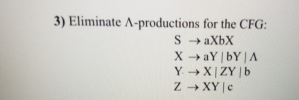 3) Eliminate Λ-productions for the CFG: S aXbX
3) Eliminate Λ-productions for the CFG: S aXbX
3) Eliminate Λ-productions for the CFG: S aXbX
Prove that the language given by the CFG below is not regular. S + PPQ P...
 Prove that the language given by the CFG below is not regular. S + PPQ P + OPPO | 1 Q +0000 1 Make sure that you give a formal proof with every step clearly erplained and justified with sentences (as seen in the tertbook), do not write just a sequence of mathematical erpressions.
Automata theory Q1: Assume S = {a, b}. Build a CFG for the language of all...
Automata theory Q1: Assume S = {a, b}. Build a CFG for the language of all strings with a triple a in them. Give a regular expression for the same language. Convert the CFG into CNF grammar. Q2: Assume S = {a, b}. Build a CFG for the language defined by (aaa+b)*. Convert the CFG into CNF grammar. Q3: Explain when a CFG is ambiguous. Give an example of an ambiguous CFG. give vedio link also
CFG questions 1. True or false? Given G: S → aSbSÍ bSaS | λ, L(G) =...
 CFG questions
1. True or false? Given G: S → aSbSÍ bSaS | λ, L(G) = EQUAL. 2. Provide a grammar for all words that are not palindromes. 3. Provide a grammar for L = { a,b' : is js 2 4. Provide a grammar for L = { aibak: i + j = k }. 5. Provide a grammar for L = { aba: i + k = j).
CFG questions
1. True or false? Given G: S → aSbSÍ bSaS | λ, L(G) = EQUAL. 2. Provide a grammar for all words that are not palindromes. 3. Provide a grammar for L = { a,b' : is js 2 4. Provide a grammar for L = { aibak: i + j = k }. 5. Provide a grammar for L = { aba: i + k = j).
3 (2) (x)(Ax Bx), (Ex)(Cx Bx), (x)(CXAX) (Ex) (Gx Hx) (3) (Ex)(Gx Fx), (ax)Fx, (Ex) Gx 3x) Fx (4) (x)(Fx Gx) (2...
 3
(2) (x)(Ax Bx), (Ex)(Cx Bx), (x)(CXAX) (Ex) (Gx Hx) (3) (Ex)(Gx Fx), (ax)Fx, (Ex) Gx 3x) Fx (4) (x)(Fx Gx)
(2) (x)(Ax Bx), (Ex)(Cx Bx), (x)(CXAX) (Ex) (Gx Hx) (3) (Ex)(Gx Fx), (ax)Fx, (Ex) Gx 3x) Fx (4) (x)(Fx Gx)
3
(2) (x)(Ax Bx), (Ex)(Cx Bx), (x)(CXAX) (Ex) (Gx Hx) (3) (Ex)(Gx Fx), (ax)Fx, (Ex) Gx 3x) Fx (4) (x)(Fx Gx)
(2) (x)(Ax Bx), (Ex)(Cx Bx), (x)(CXAX) (Ex) (Gx Hx) (3) (Ex)(Gx Fx), (ax)Fx, (Ex) Gx 3x) Fx (4) (x)(Fx Gx)
Convert the high level language programming statementts to 80x86 assembly, Assume X=AX and y=BX for (i=1;...
Convert the high level language programming statementts to 80x86 assembly, Assume X=AX and y=BX for (i=1; i<10; ++i){ x=x+1; y=y-1; } if(x>=y) y=x-1; else y=x+1;
Consider the function S Ax? f(x) = - { x < 3 17 - Ax x3...
 Consider the function S Ax? f(x) = - { x < 3 17 - Ax x3 Find a value of A so that the function is continuous at x = 3. - 12/17 17/12 12/17 17/3 - 17/12
 10. Consider the following CFG: Is the language generated by this CFG a regular language? If so, give a regular expression denoting it. If not, prove it.
10. Consider the following CFG: Is the language generated by this CFG a regular language? If so, give a regular expression denoting it. If not, prove it.
10. Consider the following CFG: Is the language generated by this CFG a regular language? If so, give a regular expression denoting it. If not, prove it.
 3) Eliminate Λ-productions for the CFG: S aXbX
3) Eliminate Λ-productions for the CFG: S aXbX
3) Eliminate Λ-productions for the CFG: S aXbX
 Prove that the language given by the CFG below is not regular. S + PPQ P + OPPO | 1 Q +0000 1 Make sure that you give a formal proof with every step clearly erplained and justified with sentences (as seen in the tertbook), do not write just a sequence of mathematical erpressions.
 CFG questions
1. True or false? Given G: S → aSbSÍ bSaS | λ, L(G) = EQUAL. 2. Provide a grammar for all words that are not palindromes. 3. Provide a grammar for L = { a,b' : is js 2 4. Provide a grammar for L = { aibak: i + j = k }. 5. Provide a grammar for L = { aba: i + k = j).
CFG questions
1. True or false? Given G: S → aSbSÍ bSaS | λ, L(G) = EQUAL. 2. Provide a grammar for all words that are not palindromes. 3. Provide a grammar for L = { a,b' : is js 2 4. Provide a grammar for L = { aibak: i + j = k }. 5. Provide a grammar for L = { aba: i + k = j).
 3
(2) (x)(Ax Bx), (Ex)(Cx Bx), (x)(CXAX) (Ex) (Gx Hx) (3) (Ex)(Gx Fx), (ax)Fx, (Ex) Gx 3x) Fx (4) (x)(Fx Gx)
(2) (x)(Ax Bx), (Ex)(Cx Bx), (x)(CXAX) (Ex) (Gx Hx) (3) (Ex)(Gx Fx), (ax)Fx, (Ex) Gx 3x) Fx (4) (x)(Fx Gx)
3
(2) (x)(Ax Bx), (Ex)(Cx Bx), (x)(CXAX) (Ex) (Gx Hx) (3) (Ex)(Gx Fx), (ax)Fx, (Ex) Gx 3x) Fx (4) (x)(Fx Gx)
(2) (x)(Ax Bx), (Ex)(Cx Bx), (x)(CXAX) (Ex) (Gx Hx) (3) (Ex)(Gx Fx), (ax)Fx, (Ex) Gx 3x) Fx (4) (x)(Fx Gx)
 Consider the function S Ax? f(x) = - { x < 3 17 - Ax x3 Find a value of A so that the function is continuous at x = 3. - 12/17 17/12 12/17 17/3 - 17/12
Most questions answered within 3 hours.
-
Where is the error in this code sequence?
String s1 = "Hello";
String s2 = "ello";...
asked 10 months ago -
Financial data for Joel de Paris, Inc., for last year
follow:
Joel de Paris, Inc.
Balance...
asked 10 months ago -
Consider this reaction:
Al2(SO4)3 (aq)+ BaCl3
(aq) Al2Cl6 (aq)- +
3BaSO4(s) . What is the...
asked 10 months ago -
Suppose that Savneet is considering increasing her
recent random sample from 20 car rentals to 40...
asked 10 months ago -
Trucks arrive at an unloading terminal at an average rate of 120
per hour.
Trucks arrive...
asked 10 months ago -
Why are methanol and ethanol completely soluble in water while
octanol is not very little soluble....
asked 10 months ago -
A facilities manager at a university reads in a research report
that the mean amount of...
asked 10 months ago -
When the CuSO4 is rehydrated by adding water to the anhydrous
compound, is this an endothermic...
asked 10 months ago -
A ray of sunlight is passing from diamond into crown glass; the
angle of incidence is...
asked 10 months ago -
A block of mass 0.249 kg is placed on top of a light, vertical
spring of...
asked 10 months ago -
how do the kidneys compensate in the presences of acidosis
a) trigger hyperventilate
b) reserve acid...
asked 10 months ago -
Question 501 pts
The rental rate of capital to the firm increases. Which of the
following...
asked 10 months ago