If we sample from a small finite population without replacement, the binomial distribution should not be...
If we sample from a small finite population without replacement, the binomial distribution should not be used because the events are not independent. If sampling is done without replacement and the outcomes belong to one of two types, we can use the hypergeometric distribution. If a population has A objects of one type, while the remaining B objects are of the other type, and if n objects are sampled without replacement, then the probability of getting x objects of type A and
n minus−x objects of type B under the hypergeometric distribution is given by the following formula. In a lottery game, a bettor selects
five numbers from 1 to55(without repetition), and a winning five-number combination is later randomly selected. Find the probabilities of getting exactly three winning numbers with one ticket. (Hint: Use A equals=5,B equals=50,n equals=5,and
x equals=3.)
P(x)equals=A!/(A−x)!x!•B!/(B−n+x)!(n−x)!÷(A+B)!/(A+B−n)!n!
P(3)equals=
(Round to four decimal places as needed.)
Homework Answers


Add Answer to:
If we sample from a small finite population without
replacement, the binomial distribution should not be...
Save Homework: Homework Chapter 5 Score: 0 of 1 pt 5.2.43 46 of 55 (46 complete)...
 Save Homework: Homework Chapter 5 Score: 0 of 1 pt 5.2.43 46 of 55 (46 complete) HW Score: 72.74%, 40.01 of 55 pts is Question Help If we sample from a small finite population without replacement, the binomial distribution should not be used because the events are not independent. If sampling is done without replacement and the outcomes belong to one of two types, we can use the hypergeometric distribution. If a population has A objects of one type, while...
In a lottery game, the jackpot is won by selecting five different whole numbers from 1...
In a lottery game, the jackpot is won by selecting five different whole numbers from 1 through 38 and getting the same five numbers (in any order) that are later drawn. In the Pick 4 game, you win a straight bet by selecting four digits (with repetition allowed), each one from 0 to 9, and getting the same four digits in the exact order they are later drawn. The Pick 4 game returns $5 comma 000 for a winning $1...
Conceptual: Circle the best answer(s) as indicated, or (1 Point) The distribution shown in Figure 1...
 Conceptual: Circle the best answer(s) as indicated, or (1 Point) The distribution shown in Figure 1 depicts a distribution that is: 1. Skewed Left Not Skewed Skewed Right Normal None of the above 04 06 08 10 Figure 1 2. ( Point) You decided to play the lottery. This lottery is conducted by selecting 6 numbered balls at random, without replacement, from a population of 40 numbered balls. You win if 5 or more of the numbers you picked match...
11.In a lottery game, the jackpot is won by selecting six different whole numbers from 1...
11.In a lottery game, the jackpot is won by selecting six different whole numbers from 1 through 38 and getting the same six numbers (in any order) that are later drawn. In the Pick 3 game, you win a straight bet by selecting three digits (with repetition allowed), each one from 0 to 9, and getting the same three digits in the exact order they are later drawn. The Pick 3 game returns $500 for a winning $1 ticket. Complete...
In a lottery game, the jackpot is won by selecting four different whole numbers from 1 through 38 and getting the same four numbers
In a lottery game, the jackpot is won by selecting four different whole numbers from 1 through 38 and getting the same four numbers (in any order) that are later drawn. In the Pick 5 game, you win a straight bet by selecting five digits (with repetition allowed), each one from 0 to 9, and getting the same five digits in the exact order they are later drawn. The Pick 5 game retuns $50,000 for a winning $1 ticket. Complete...
4.26 In a lottery game, three winning numbers are chosen uniformly at random from (1, ,100), samp...
 4.26 In a lottery game, three winning numbers are chosen uniformly at random from (1, ,100), sampling without replacement. Lottery tickets cost $1 and allow a player to pick three numbers. If a player matches the three winning numbers they win the jackpot prize of $1,000. For matching exactly two numbers, they win $15. For matching exactly one number they win $3 d) Hoppe shows that the probability that a single parlayed ticket will ulti- mately win the jackpot is...
A state lotery randomly chooses 7 balls numbered from 1 through 39 without replacement. You choose...
 A state lotery randomly chooses 7 balls numbered from 1 through 39 without replacement. You choose represents the number of matches on your ticket to the numbers drawn in the lottery. Determine whether this experiment is binomial. If values n, p, and q and list the possible values of the random variable x. 7 numbers and purchase a lottery ticket. The random variable so, identify a success, specify the Is the experiment binomial? O A. O B. Yes, the probability...
For 1.5, I need to do this with and without replacement. Thank you Exercise 1.5. In...
 For 1.5, I need to do this with and without
replacement. Thank you
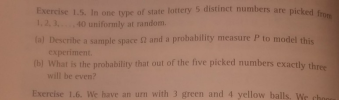
Exercise 1.5. In one type of state lottery 5 distinct numbers are picked fro 1,2,3, 40 uniformly at random. Describe a sample space 2 and a probability measure P to model this experiment. (b) What is the probability that out of the five picked numbers exactly three will be even? Exercise 1.6. We have an urn with 3 green and 4 yellow balls. We ch
For 1.5, I need to do this with and without
replacement. Thank you
Exercise 1.5. In one type of state lottery 5 distinct numbers are picked fro 1,2,3, 40 uniformly at random. Describe a sample space 2 and a probability measure P to model this experiment. (b) What is the probability that out of the five picked numbers exactly three will be even? Exercise 1.6. We have an urn with 3 green and 4 yellow balls. We ch
9. The four conditions required for using a Binomial distribution are. (a) A fixed number of...
 9. The four conditions required for using a Binomial distribution are. (a) A fixed number of trials (n). b) On each trial, there are two possible outcomes, one of which we call a "success" (c) On each trial, P(success) is the same (d) The outcomes of each trial are independent For each of the following decide if the random variable defined (X) is a Binomial variable or not. If it is not a Binomial variable, say which of the four...
Suppose you are asked to draw ten cards without replacement from a regular deck of 52 playing car...
 Suppose you are asked to draw
ten cards without replacement from a regular deck of 52 playing
cards. What is the probability of getting exactly 3 Queens or
exactly 3 Kings (or both)?
I also need help with the other two, please provide an
explanation with your work and I will promptly give a positive
rating.
С https://drive.google.com/drive/folders/lyinXTMXuBMbKU3nO0oRbVKV ug pg 1 Yrmu (18) Suppose you are asked to draw 5 cards from a deck of 52 regular playing cards (a)...
Suppose you are asked to draw
ten cards without replacement from a regular deck of 52 playing
cards. What is the probability of getting exactly 3 Queens or
exactly 3 Kings (or both)?
I also need help with the other two, please provide an
explanation with your work and I will promptly give a positive
rating.
С https://drive.google.com/drive/folders/lyinXTMXuBMbKU3nO0oRbVKV ug pg 1 Yrmu (18) Suppose you are asked to draw 5 cards from a deck of 52 regular playing cards (a)...
 Save Homework: Homework Chapter 5 Score: 0 of 1 pt 5.2.43 46 of 55 (46 complete) HW Score: 72.74%, 40.01 of 55 pts is Question Help If we sample from a small finite population without replacement, the binomial distribution should not be used because the events are not independent. If sampling is done without replacement and the outcomes belong to one of two types, we can use the hypergeometric distribution. If a population has A objects of one type, while...
 Conceptual: Circle the best answer(s) as indicated, or (1 Point) The distribution shown in Figure 1 depicts a distribution that is: 1. Skewed Left Not Skewed Skewed Right Normal None of the above 04 06 08 10 Figure 1 2. ( Point) You decided to play the lottery. This lottery is conducted by selecting 6 numbered balls at random, without replacement, from a population of 40 numbered balls. You win if 5 or more of the numbers you picked match...
 4.26 In a lottery game, three winning numbers are chosen uniformly at random from (1, ,100), sampling without replacement. Lottery tickets cost $1 and allow a player to pick three numbers. If a player matches the three winning numbers they win the jackpot prize of $1,000. For matching exactly two numbers, they win $15. For matching exactly one number they win $3 d) Hoppe shows that the probability that a single parlayed ticket will ulti- mately win the jackpot is...
 A state lotery randomly chooses 7 balls numbered from 1 through 39 without replacement. You choose represents the number of matches on your ticket to the numbers drawn in the lottery. Determine whether this experiment is binomial. If values n, p, and q and list the possible values of the random variable x. 7 numbers and purchase a lottery ticket. The random variable so, identify a success, specify the Is the experiment binomial? O A. O B. Yes, the probability...
 For 1.5, I need to do this with and without
replacement. Thank you
Exercise 1.5. In one type of state lottery 5 distinct numbers are picked fro 1,2,3, 40 uniformly at random. Describe a sample space 2 and a probability measure P to model this experiment. (b) What is the probability that out of the five picked numbers exactly three will be even? Exercise 1.6. We have an urn with 3 green and 4 yellow balls. We ch
For 1.5, I need to do this with and without
replacement. Thank you
Exercise 1.5. In one type of state lottery 5 distinct numbers are picked fro 1,2,3, 40 uniformly at random. Describe a sample space 2 and a probability measure P to model this experiment. (b) What is the probability that out of the five picked numbers exactly three will be even? Exercise 1.6. We have an urn with 3 green and 4 yellow balls. We ch
 9. The four conditions required for using a Binomial distribution are. (a) A fixed number of trials (n). b) On each trial, there are two possible outcomes, one of which we call a "success" (c) On each trial, P(success) is the same (d) The outcomes of each trial are independent For each of the following decide if the random variable defined (X) is a Binomial variable or not. If it is not a Binomial variable, say which of the four...
 Suppose you are asked to draw
ten cards without replacement from a regular deck of 52 playing
cards. What is the probability of getting exactly 3 Queens or
exactly 3 Kings (or both)?
I also need help with the other two, please provide an
explanation with your work and I will promptly give a positive
rating.
С https://drive.google.com/drive/folders/lyinXTMXuBMbKU3nO0oRbVKV ug pg 1 Yrmu (18) Suppose you are asked to draw 5 cards from a deck of 52 regular playing cards (a)...
Suppose you are asked to draw
ten cards without replacement from a regular deck of 52 playing
cards. What is the probability of getting exactly 3 Queens or
exactly 3 Kings (or both)?
I also need help with the other two, please provide an
explanation with your work and I will promptly give a positive
rating.
С https://drive.google.com/drive/folders/lyinXTMXuBMbKU3nO0oRbVKV ug pg 1 Yrmu (18) Suppose you are asked to draw 5 cards from a deck of 52 regular playing cards (a)...
Most questions answered within 3 hours.
-
Where is the error in this code sequence?
String s1 = "Hello";
String s2 = "ello";...
asked 11 months ago -
Financial data for Joel de Paris, Inc., for last year
follow:
Joel de Paris, Inc.
Balance...
asked 11 months ago -
Consider this reaction:
Al2(SO4)3 (aq)+ BaCl3
(aq) Al2Cl6 (aq)- +
3BaSO4(s) . What is the...
asked 11 months ago -
Suppose that Savneet is considering increasing her
recent random sample from 20 car rentals to 40...
asked 11 months ago -
Trucks arrive at an unloading terminal at an average rate of 120
per hour.
Trucks arrive...
asked 11 months ago -
Why are methanol and ethanol completely soluble in water while
octanol is not very little soluble....
asked 11 months ago -
A facilities manager at a university reads in a research report
that the mean amount of...
asked 11 months ago -
When the CuSO4 is rehydrated by adding water to the anhydrous
compound, is this an endothermic...
asked 11 months ago -
A ray of sunlight is passing from diamond into crown glass; the
angle of incidence is...
asked 11 months ago -
A block of mass 0.249 kg is placed on top of a light, vertical
spring of...
asked 11 months ago -
how do the kidneys compensate in the presences of acidosis
a) trigger hyperventilate
b) reserve acid...
asked 11 months ago -
Question 501 pts
The rental rate of capital to the firm increases. Which of the
following...
asked 11 months ago