gdojoijdh
intenioanl;lyintenioanl;lyintenioanl;lyintenioanl;lyintenioanl;lyintenioanl;lyintenioanl;lyintenioanl;lyintenioanl;lyintenioanl;lyintenioanl;lyintenioanl;lyintenioanl;lyintenioanl;lyintenioanl;lyintenioanl;lyintenioanl;lyintenioanl;lyintenioanl;lyintenioanl;lyintenioanl;ly
Homework Answers
intenioanl;lyintenioanl;lyintenioanl;lyintenioanl;lyintenioanl;lyintenioanl;lyintenioanl;lyintenioanl;lyintenioanl;lyintenioanl;lyintenioanl;lyintenioanl;lyintenioanl;lyintenioanl;lyintenioanl;lyintenioanl;lyintenioanl;ly
To find the conversion between two of these units, divide the number of kilometers in one...
To find the conversion between two of these units, divide the number of kilometers in one by the number of kilometers in another. For example, 1 mile = 1.61 kilometers and 1 meter = 10-3 kilometers. So 1 meter/ 1 mile = 10-3 kilometers / 1.61 kilometers = 6.21 x 10⁻⁴. Therefore, 1 meter = 6.21 x 10⁻⁴ miles. Either calculate from the information above or find the following unit conversions: 1 A.U. = ly 1 A.U. = pc 1...
List the correct order of lengths, from the smallest to the largest. nanometer, meter, kilometer, ls,...
List the correct order of lengths, from the smallest to the largest. nanometer, meter, kilometer, ls, AU, ly meter, nanometer, kilometer, ls, AU, ly nanometer, meter, kilometer, AU, ls, ly nanometer, meter, kilometer, ls, ly, AU
suppose man offers to trade him a unit of x for six units of y. calculate...
 suppose man offers to trade him a unit of x for six units of
y. calculate new utilty maximizing production and consumption. show
results in graph
2:49 Expert Q&A + X= (2) Lx y=25(ly) Ulwy) = (xy) 100 unity of Labour (6) broly also What is stility marinzing production & consumption of x ty? Hint: use the relation between MRPT & MRS Expert Answer Kalam9746 4 hours later MRT shows substitution of Y to produce one additional unit of X....
suppose man offers to trade him a unit of x for six units of
y. calculate new utilty maximizing production and consumption. show
results in graph
2:49 Expert Q&A + X= (2) Lx y=25(ly) Ulwy) = (xy) 100 unity of Labour (6) broly also What is stility marinzing production & consumption of x ty? Hint: use the relation between MRPT & MRS Expert Answer Kalam9746 4 hours later MRT shows substitution of Y to produce one additional unit of X....
Determine the beam's moment of inertia ly about the centroidal y axis. 15 mm 15 mm...
 Determine the beam's moment of inertia ly about the centroidal y axis. 15 mm 15 mm 50 mm X C 10 mm 50 mm 100 mm 100 mm a) ly 25.8 x 106 mm4 = b) ly 29.8 x 106 mm4 c) Iv = 21.8 x 100 mm4 d) 23.8 x 106 mm4
Determine the beam's moment of inertia ly about the centroidal y axis. 15 mm 15 mm 50 mm X C 10 mm 50 mm 100 mm 100...
Determine the beam's moment of inertia ly about the centroidal y axis. 15 mm 15 mm 50 mm X C 10 mm 50 mm 100 mm 100 mm a) ly 25.8 x 106 mm4 = b) ly 29.8 x 106 mm4 c) Iv = 21.8 x 100 mm4 d) 23.8 x 106 mm4
Determine the beam's moment of inertia ly about the centroidal y axis. 15 mm 15 mm 50 mm X C 10 mm 50 mm 100 mm 100...
MA Calculate the commutator between Lx and Ly, i.e. [Lx,Ly].
 MA Calculate the commutator between Lx and Ly, i.e. [Lx,Ly].
a) Derive the following commutator relationships between the components of angular momentum L and of p:...
a) Derive the following commutator relationships between the components of angular momentum L and of p: (i) [Ly, px] = −ih(bar)pz (ii) [Ly, pz] = ih(bar)px (iii) [Ly, p2x ] = −2ih(bar)pxpz (iiii) [Ly, p2z ] = 2ih(bar)pxpz (b) Hence show that the square L2 of the angular momentum operator L commutes with the kinetic energy operator p2/2m = (p2x + p2y + p2z )/2m.
Numbers 3 thru 4 please Assignment 12. Introduction to Nonhomogeneous Equations Read 4.4 Hand in the...
 Numbers 3 thru 4 please
Assignment 12. Introduction to Nonhomogeneous
Equations
Read 4.4 Hand in the following problems:
If L is a linear operator, an equation of the form Ly = 0 is called
a homogeneous equation and an equation of the form Ly = f is called
a non homogeneous equation.
The solution of Ly = 0 is related to the solution of Ly = f. When
you solve each of the following equations, look for the
relationship between...
Numbers 3 thru 4 please
Assignment 12. Introduction to Nonhomogeneous
Equations
Read 4.4 Hand in the following problems:
If L is a linear operator, an equation of the form Ly = 0 is called
a homogeneous equation and an equation of the form Ly = f is called
a non homogeneous equation.
The solution of Ly = 0 is related to the solution of Ly = f. When
you solve each of the following equations, look for the
relationship between...
10. The following modified output from PcGive presents infomation concerning unit root tests on the logarithm...
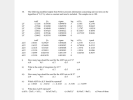 10. The following modified output from PcGive presents infomation concerning unit root tests on the logarithm of Y (LY), where a constant and trend is included. The sample size is 100. t-adf 2.7256 0.93930 2.5568 0.94380 2.2990 0.94949 2.0632 0.95425 2.0181 0.95546 2.0442 0.95518 lag -AY LY LY LY LY LY LY 0.049070 5 0,0491504 0.049613 3 0.050322 20.72567 0.050230 017339 0.8626 0,050044 0 1.1881 0.2370 0,0665 0.0318 0.4694 2.1707 lag AY ALY 3.8343 0.29629 ALY 3.6152 0.36690 ALY ALY...
1. Given that angular momentum is given by L=(r)(p), the components of the angular momentum can...
1. Given that angular momentum is given by L=(r)(p), the components of the angular momentum can be found to be: Lx=ypz-zpy Ly=zpx-xpz Lz=xpy-ypx (a) What are the corresponding angular momentum operators Lx, Ly, and Lz? (b) write communation relations [Lx, Ly], [Ly, Lz], and [Lz, Lx]. What does these expressions say about the ability to measure components of angular momentum simultaneously? plz explain part B in depth dont do derivation of commutation relation explain the second part also do part...
 suppose man offers to trade him a unit of x for six units of
y. calculate new utilty maximizing production and consumption. show
results in graph
2:49 Expert Q&A + X= (2) Lx y=25(ly) Ulwy) = (xy) 100 unity of Labour (6) broly also What is stility marinzing production & consumption of x ty? Hint: use the relation between MRPT & MRS Expert Answer Kalam9746 4 hours later MRT shows substitution of Y to produce one additional unit of X....
suppose man offers to trade him a unit of x for six units of
y. calculate new utilty maximizing production and consumption. show
results in graph
2:49 Expert Q&A + X= (2) Lx y=25(ly) Ulwy) = (xy) 100 unity of Labour (6) broly also What is stility marinzing production & consumption of x ty? Hint: use the relation between MRPT & MRS Expert Answer Kalam9746 4 hours later MRT shows substitution of Y to produce one additional unit of X....
 Determine the beam's moment of inertia ly about the centroidal y axis. 15 mm 15 mm 50 mm X C 10 mm 50 mm 100 mm 100 mm a) ly 25.8 x 106 mm4 = b) ly 29.8 x 106 mm4 c) Iv = 21.8 x 100 mm4 d) 23.8 x 106 mm4
Determine the beam's moment of inertia ly about the centroidal y axis. 15 mm 15 mm 50 mm X C 10 mm 50 mm 100 mm 100...
Determine the beam's moment of inertia ly about the centroidal y axis. 15 mm 15 mm 50 mm X C 10 mm 50 mm 100 mm 100 mm a) ly 25.8 x 106 mm4 = b) ly 29.8 x 106 mm4 c) Iv = 21.8 x 100 mm4 d) 23.8 x 106 mm4
Determine the beam's moment of inertia ly about the centroidal y axis. 15 mm 15 mm 50 mm X C 10 mm 50 mm 100 mm 100...
 MA Calculate the commutator between Lx and Ly, i.e. [Lx,Ly].
 Numbers 3 thru 4 please
Assignment 12. Introduction to Nonhomogeneous
Equations
Read 4.4 Hand in the following problems:
If L is a linear operator, an equation of the form Ly = 0 is called
a homogeneous equation and an equation of the form Ly = f is called
a non homogeneous equation.
The solution of Ly = 0 is related to the solution of Ly = f. When
you solve each of the following equations, look for the
relationship between...
Numbers 3 thru 4 please
Assignment 12. Introduction to Nonhomogeneous
Equations
Read 4.4 Hand in the following problems:
If L is a linear operator, an equation of the form Ly = 0 is called
a homogeneous equation and an equation of the form Ly = f is called
a non homogeneous equation.
The solution of Ly = 0 is related to the solution of Ly = f. When
you solve each of the following equations, look for the
relationship between...
 10. The following modified output from PcGive presents infomation concerning unit root tests on the logarithm of Y (LY), where a constant and trend is included. The sample size is 100. t-adf 2.7256 0.93930 2.5568 0.94380 2.2990 0.94949 2.0632 0.95425 2.0181 0.95546 2.0442 0.95518 lag -AY LY LY LY LY LY LY 0.049070 5 0,0491504 0.049613 3 0.050322 20.72567 0.050230 017339 0.8626 0,050044 0 1.1881 0.2370 0,0665 0.0318 0.4694 2.1707 lag AY ALY 3.8343 0.29629 ALY 3.6152 0.36690 ALY ALY...
Most questions answered within 3 hours.
-
Where is the error in this code sequence?
String s1 = "Hello";
String s2 = "ello";...
asked 10 months ago -
Financial data for Joel de Paris, Inc., for last year
follow:
Joel de Paris, Inc.
Balance...
asked 10 months ago -
Consider this reaction:
Al2(SO4)3 (aq)+ BaCl3
(aq) Al2Cl6 (aq)- +
3BaSO4(s) . What is the...
asked 10 months ago -
Suppose that Savneet is considering increasing her
recent random sample from 20 car rentals to 40...
asked 10 months ago -
Trucks arrive at an unloading terminal at an average rate of 120
per hour.
Trucks arrive...
asked 10 months ago -
Why are methanol and ethanol completely soluble in water while
octanol is not very little soluble....
asked 10 months ago -
A facilities manager at a university reads in a research report
that the mean amount of...
asked 10 months ago -
When the CuSO4 is rehydrated by adding water to the anhydrous
compound, is this an endothermic...
asked 10 months ago -
A ray of sunlight is passing from diamond into crown glass; the
angle of incidence is...
asked 10 months ago -
A block of mass 0.249 kg is placed on top of a light, vertical
spring of...
asked 10 months ago -
how do the kidneys compensate in the presences of acidosis
a) trigger hyperventilate
b) reserve acid...
asked 10 months ago -
Question 501 pts
The rental rate of capital to the firm increases. Which of the
following...
asked 10 months ago