By submerging an object in a body of water, how can one determine the volume of...
By submerging an object in a body of water, how can one determine the volume of that object by measuring the volume of water that the object displaces? Provide functions needed. (Archimedes Principle)
Homework Answers

Add Answer to:
By submerging an object in a body of water, how can one
determine the volume of...
Question 7 1 pts the volume of the When an object is floating in water, it...
 Question 7 1 pts the volume of the When an object is floating in water, it displaces a volume of water object. greater than less than equal to Question 8 1 pts When an object floats on water, it displaces a mass of water larger than the mass of the object. True False Question 9 1 pts If the density of an object is larger than the density of water, it will not float in water. True False
Please help me with these questions Question 3 - to - 5 EST 1) State Archimede's...
 Please help me with these questions
Question 3 - to - 5
EST 1) State Archimede's principle. by mass ofme splacid fid 2) Use Archimedes' principle to prove the following: "When a body is floating on a liquid, it displaces a weight of liquid equal to its own weight." 3) How would you determine the density of an irregularly shaped rock? 4) Lead has a greater density than iron, and both are denser than water. Is the buoyant force on...
Please help me with these questions
Question 3 - to - 5
EST 1) State Archimede's principle. by mass ofme splacid fid 2) Use Archimedes' principle to prove the following: "When a body is floating on a liquid, it displaces a weight of liquid equal to its own weight." 3) How would you determine the density of an irregularly shaped rock? 4) Lead has a greater density than iron, and both are denser than water. Is the buoyant force on...
Help please Archimedes Principle states that an object will float if the weight of the water...
 Help please
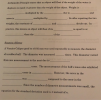
Archimedes Principle states that an object will float if the weight of the water it displaces is equal or greater than the weight of the object. Weight is multiplied by the due to and mass is multiplied by So after equating the two weights, the constants of and divide out. In practice, this means an object will float if itsis equal to or than the of the Sources of Error A Vernier Caliper good to :0.02 mm was...
Help please
Archimedes Principle states that an object will float if the weight of the water it displaces is equal or greater than the weight of the object. Weight is multiplied by the due to and mass is multiplied by So after equating the two weights, the constants of and divide out. In practice, this means an object will float if itsis equal to or than the of the Sources of Error A Vernier Caliper good to :0.02 mm was...
3. Archimedes' Principle states that the buoyant force on an object partially or fully submerged in...
 3. Archimedes' Principle states that the buoyant force on an object partially or fully submerged in a fluid is equal to the weight of the fluid that the object displaces. For an object of density po floating partly submerged in a fluid of density pf, the buoyant force is given by F P19 SA(y)dy, where g is the acceleration due to gravity and A(y) is the area of a typical cross-section of the object. The weight of the object is...
Can I please get help on how to solve problem #10 step-by-step? ring scale, 10. A...
 Can
I please get help on how to solve problem #10 step-by-step?
ring scale, 10. A boat of mass mboat carrying a load of iron ore of mass miron and density Piron is floating on a pool of water. a) Write an expression for the volume Viron of the iron ore using Miron and Piron b) Using the combined weight of the boat and ore and Archimedes' principle, find an expression for the volume of the boat submerged (Vola) in...
Can
I please get help on how to solve problem #10 step-by-step?
ring scale, 10. A boat of mass mboat carrying a load of iron ore of mass miron and density Piron is floating on a pool of water. a) Write an expression for the volume Viron of the iron ore using Miron and Piron b) Using the combined weight of the boat and ore and Archimedes' principle, find an expression for the volume of the boat submerged (Vola) in...
You are measuring the density of a solid object by displacement. The volume of water in...
 You are measuring the density of a solid object by displacement. The volume of water in the cylinder initially is 30.7 (plusminus 0.3 mL) and the volume after the solid metal sample sank was 34.5 (plusminus 0.3 mL). Find the volume of the metal sample and calculate the uncertainty in the volume reading. Remember to retain one extra sig fig for the next calculation.
The mass is 25 grams. Please label and put a box around the solution. Purpose: To calculate the apparent weight of a mass when immersed in water. Students will also have the opportunity to learn how t...
 The
mass is 25 grams. Please label and put a box around the
solution.
Purpose: To calculate the apparent weight of a mass when immersed in water. Students will also have the opportunity to learn how to use calipers to accurately measure lenghs. Background: Archimedes discovered that he could find the density of an object by comparing it's weight o its apparent weight when immersed in water (see example 10-8 in he textbook). When mmersed, the buoyancy due to the...
The
mass is 25 grams. Please label and put a box around the
solution.
Purpose: To calculate the apparent weight of a mass when immersed in water. Students will also have the opportunity to learn how to use calipers to accurately measure lenghs. Background: Archimedes discovered that he could find the density of an object by comparing it's weight o its apparent weight when immersed in water (see example 10-8 in he textbook). When mmersed, the buoyancy due to the...
Please fill the blanks Diseussi Table of Resalte 1.11650 54 Archimedes Principle states that an object...
 Please fill the blanks
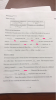
Diseussi Table of Resalte 1.11650 54 Archimedes Principle states that an object wil dloat if the weight of the water it displaces is equal or greater than the weight of the object. Weight is and multiplied by So after equating the two weights, the constants of_ divide out. In practice, this means an object will float if its一.ǐcitL;s equal to or tessthan the nity of thedar_ A Vernier Caliper good to ±0.02 mm was used repeatedly...
Please fill the blanks
Diseussi Table of Resalte 1.11650 54 Archimedes Principle states that an object wil dloat if the weight of the water it displaces is equal or greater than the weight of the object. Weight is and multiplied by So after equating the two weights, the constants of_ divide out. In practice, this means an object will float if its一.ǐcitL;s equal to or tessthan the nity of thedar_ A Vernier Caliper good to ±0.02 mm was used repeatedly...
A 4.00 cm x 4.00 cm x 4.00 cm cube of density 920 kg/m3 is floating at rest at the top of a beaker of cross sectional area 100 cm2 with 500 mL of water in it. 500 mL of oil of density 900 kg/m3 is add...
A 4.00 cm x 4.00 cm x 4.00 cm cube of density 920 kg/m3 is floating at rest at the top of a beaker of cross sectional area 100 cm2 with 500 mL of water in it. 500 mL of oil of density 900 kg/m3 is added to the top of the beaker, and the cube is observed to float completely submerged, unevenly straddling the boundary between the oil and water. a. Draw a picture showing the beaker, layers of...
Archimedes' principle can be used to determine the specific gravity of a solid using a known...
 Archimedes' principle can be used to determine the specific gravity of a solid using a known liquid. The reverse can be done as well. Suppose that a solid object with mass mi has an apparent mass m2 when submerged in a particular liquid. The density of the object is p. Part A Determine the density of the liquid. Express your answer in terms of some or all of the variables mi, m2 and p. IVO AQ R O a ?...
 Question 7 1 pts the volume of the When an object is floating in water, it displaces a volume of water object. greater than less than equal to Question 8 1 pts When an object floats on water, it displaces a mass of water larger than the mass of the object. True False Question 9 1 pts If the density of an object is larger than the density of water, it will not float in water. True False
 Please help me with these questions
Question 3 - to - 5
EST 1) State Archimede's principle. by mass ofme splacid fid 2) Use Archimedes' principle to prove the following: "When a body is floating on a liquid, it displaces a weight of liquid equal to its own weight." 3) How would you determine the density of an irregularly shaped rock? 4) Lead has a greater density than iron, and both are denser than water. Is the buoyant force on...
Please help me with these questions
Question 3 - to - 5
EST 1) State Archimede's principle. by mass ofme splacid fid 2) Use Archimedes' principle to prove the following: "When a body is floating on a liquid, it displaces a weight of liquid equal to its own weight." 3) How would you determine the density of an irregularly shaped rock? 4) Lead has a greater density than iron, and both are denser than water. Is the buoyant force on...
 Help please
Archimedes Principle states that an object will float if the weight of the water it displaces is equal or greater than the weight of the object. Weight is multiplied by the due to and mass is multiplied by So after equating the two weights, the constants of and divide out. In practice, this means an object will float if itsis equal to or than the of the Sources of Error A Vernier Caliper good to :0.02 mm was...
Help please
Archimedes Principle states that an object will float if the weight of the water it displaces is equal or greater than the weight of the object. Weight is multiplied by the due to and mass is multiplied by So after equating the two weights, the constants of and divide out. In practice, this means an object will float if itsis equal to or than the of the Sources of Error A Vernier Caliper good to :0.02 mm was...
 3. Archimedes' Principle states that the buoyant force on an object partially or fully submerged in a fluid is equal to the weight of the fluid that the object displaces. For an object of density po floating partly submerged in a fluid of density pf, the buoyant force is given by F P19 SA(y)dy, where g is the acceleration due to gravity and A(y) is the area of a typical cross-section of the object. The weight of the object is...
 Can
I please get help on how to solve problem #10 step-by-step?
ring scale, 10. A boat of mass mboat carrying a load of iron ore of mass miron and density Piron is floating on a pool of water. a) Write an expression for the volume Viron of the iron ore using Miron and Piron b) Using the combined weight of the boat and ore and Archimedes' principle, find an expression for the volume of the boat submerged (Vola) in...
Can
I please get help on how to solve problem #10 step-by-step?
ring scale, 10. A boat of mass mboat carrying a load of iron ore of mass miron and density Piron is floating on a pool of water. a) Write an expression for the volume Viron of the iron ore using Miron and Piron b) Using the combined weight of the boat and ore and Archimedes' principle, find an expression for the volume of the boat submerged (Vola) in...
 You are measuring the density of a solid object by displacement. The volume of water in the cylinder initially is 30.7 (plusminus 0.3 mL) and the volume after the solid metal sample sank was 34.5 (plusminus 0.3 mL). Find the volume of the metal sample and calculate the uncertainty in the volume reading. Remember to retain one extra sig fig for the next calculation.
 The
mass is 25 grams. Please label and put a box around the
solution.
Purpose: To calculate the apparent weight of a mass when immersed in water. Students will also have the opportunity to learn how to use calipers to accurately measure lenghs. Background: Archimedes discovered that he could find the density of an object by comparing it's weight o its apparent weight when immersed in water (see example 10-8 in he textbook). When mmersed, the buoyancy due to the...
The
mass is 25 grams. Please label and put a box around the
solution.
Purpose: To calculate the apparent weight of a mass when immersed in water. Students will also have the opportunity to learn how to use calipers to accurately measure lenghs. Background: Archimedes discovered that he could find the density of an object by comparing it's weight o its apparent weight when immersed in water (see example 10-8 in he textbook). When mmersed, the buoyancy due to the...
 Please fill the blanks
Diseussi Table of Resalte 1.11650 54 Archimedes Principle states that an object wil dloat if the weight of the water it displaces is equal or greater than the weight of the object. Weight is and multiplied by So after equating the two weights, the constants of_ divide out. In practice, this means an object will float if its一.ǐcitL;s equal to or tessthan the nity of thedar_ A Vernier Caliper good to ±0.02 mm was used repeatedly...
Please fill the blanks
Diseussi Table of Resalte 1.11650 54 Archimedes Principle states that an object wil dloat if the weight of the water it displaces is equal or greater than the weight of the object. Weight is and multiplied by So after equating the two weights, the constants of_ divide out. In practice, this means an object will float if its一.ǐcitL;s equal to or tessthan the nity of thedar_ A Vernier Caliper good to ±0.02 mm was used repeatedly...
 Archimedes' principle can be used to determine the specific gravity of a solid using a known liquid. The reverse can be done as well. Suppose that a solid object with mass mi has an apparent mass m2 when submerged in a particular liquid. The density of the object is p. Part A Determine the density of the liquid. Express your answer in terms of some or all of the variables mi, m2 and p. IVO AQ R O a ?...
Most questions answered within 3 hours.
-
Where is the error in this code sequence?
String s1 = "Hello";
String s2 = "ello";...
asked 11 months ago -
Financial data for Joel de Paris, Inc., for last year
follow:
Joel de Paris, Inc.
Balance...
asked 11 months ago -
Consider this reaction:
Al2(SO4)3 (aq)+ BaCl3
(aq) Al2Cl6 (aq)- +
3BaSO4(s) . What is the...
asked 11 months ago -
Suppose that Savneet is considering increasing her
recent random sample from 20 car rentals to 40...
asked 11 months ago -
Trucks arrive at an unloading terminal at an average rate of 120
per hour.
Trucks arrive...
asked 11 months ago -
Why are methanol and ethanol completely soluble in water while
octanol is not very little soluble....
asked 11 months ago -
A facilities manager at a university reads in a research report
that the mean amount of...
asked 11 months ago -
When the CuSO4 is rehydrated by adding water to the anhydrous
compound, is this an endothermic...
asked 11 months ago -
A ray of sunlight is passing from diamond into crown glass; the
angle of incidence is...
asked 11 months ago -
A block of mass 0.249 kg is placed on top of a light, vertical
spring of...
asked 11 months ago -
how do the kidneys compensate in the presences of acidosis
a) trigger hyperventilate
b) reserve acid...
asked 11 months ago -
Question 501 pts
The rental rate of capital to the firm increases. Which of the
following...
asked 11 months ago