find the bandwidth of sinc(100t) cos(100t), in rad/sec?
find the bandwidth of sinc(100t) cos(100t), in rad/sec?
Homework Answers

(8) Suppose you need to sample the bandlimited signal x()-5 sinc(100t) every Tsec. (a) Find the...
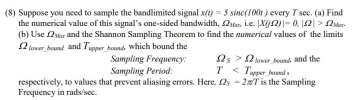 (8) Suppose you need to sample the bandlimited signal x()-5 sinc(100t) every Tsec. (a) Find the numerical value of this signal's one-sided bandwidth, 와far, ie. IX(jQ) |-이외 > 2Max. (b) Use 2Mar and the Shannon Sampling Theorem to find the numerical values of the limits Ω lower-bound and Tupper-bound, which bound the s > Ω lowerbound, and the Sampling Frequency: Sampling Period - < Tupper bound, T respectively, to values that prevent aliasing errors. Here.Qs-2㎡Ts the Sampling Frequency in rads/sec.
(1 point) Find A, B, C, and o if 30 cos(100t – 158°) - 50 sin(100t...
 (1 point) Find A, B, C, and o if 30 cos(100t – 158°) - 50 sin(100t + 135°) = A cos(100t) + B sin(100+) = C cos(100t+)
You are given Vs = A1.12.cos (100t +B) Vc = A2. Cos (100t + B2) Find...
 You are given Vs = A1.12.cos (100t +B) Vc = A2. Cos (100t + B2) Find VR = Az . cos (100t + B3) with - 180° SB3 S 180° + DR w Solve without using a calculator. Given Variables: A1: 8 V B1: 5 degrees A2:8 V B2: -40 degrees Determine the following: A3 (V): B3 (degrees):
You are given vs = A1:72.cos (100t + B1) Vc = A2 · cos (100t +...
 You are given vs = A1:72.cos (100t + B1) Vc = A2 · cos (100t + B2) Find vr = Az · cos (100t + B3) with – 180° 5 B3 S 180° + VR . Solve without using a calculator. Given Variables: A1:2V B1:25 degrees A2:2V B2:-20 degrees Determine the following: A3 (V): B3 (degrees):
Exercises: u used to the instructor b the end of next lab. 20 102 Plot the f(t)-sinc(20r) cos(300...
 Exercises: u used to the instructor b the end of next lab. 20 102 Plot the f(t)-sinc(20r) cos(300t)sinc (10t) cos(100t) Use the fast Fourier transform to find the magnitude and phase spectrum of the signal and plot over an appropriate range. Use appropriate values for the time interval and the sampling interval. Note that in Matlab sinc(x)-, so we need to divide the argument by n to make it match the given function. Le, sinc(20t/pi) Hint: Use the parameters from...
4.15. Use phasor techniques in the following. (a) Find 2 cos(100t - 459) – 3 cos...
 4.15. Use phasor techniques in the following. (a) Find 2 cos(100t - 459) – 3 cos (100t + 60°) (b) Find 50 sin(100t) + (d/dt) cos (100t - 30). Hint: Do not take the derivative in the time domain; replace it by jo in the frequency domain. (c) Use phasor techniques to evaluate the derivative the formula in the time domain and transform of i(t) = 20 sin(500t) at t = 2 ms. Hint: Write into the frequency domain, using...
44. Consider the following passband sinc pulse signal: (t) = 2sind(2x 10⁷t) cos (4.8 × 10-t) (a) ...
 Introduction to Wireless Digital Communication
44. Consider the following passband sinc pulse signal: (t) = 2sind(2x 10⁷t) cos (4.8 × 10-t) (a) Determine and plot p()l, where Xpf) is the continuous-time Fourier trans (b) Find the complex baseband equivalent signal a() of p(t). Plot x(f)I, where zp 3.540) where sinc(a)) form of rp(t). Do not forget to label correctly. x(f) is the continuous-time Fourier transform of r(t). Do not forget to label correctly (c) Determine the absolute bandwidth of the...
Introduction to Wireless Digital Communication
44. Consider the following passband sinc pulse signal: (t) = 2sind(2x 10⁷t) cos (4.8 × 10-t) (a) Determine and plot p()l, where Xpf) is the continuous-time Fourier trans (b) Find the complex baseband equivalent signal a() of p(t). Plot x(f)I, where zp 3.540) where sinc(a)) form of rp(t). Do not forget to label correctly. x(f) is the continuous-time Fourier transform of r(t). Do not forget to label correctly (c) Determine the absolute bandwidth of the...
Find the Nyquist rates for these signals: (a) X(t) = sinc (20) (b)x(t) = 4 sinca...
 Find the Nyquist rates for these signals: (a) X(t) = sinc (20) (b)x(t) = 4 sinca (100t) (C) x(t) = 8 sin(50TTT) (d) x(t) = 4 sin(30TTt) + 3 cos(70nt) (e) X(t) = rect(300t) (f) X(t) = -10 sin(40nt) cos(300Tt) (g) X(t) = sinc(t/2)*710(t) (h) x(t) = sinc(t/2) 70.1() (i) X(t) = 8tri((t - 4)/12) (1) X(t) = 13e-201 cos(70TTt)u(t) (k) x(t) = u(t)-u(t-5)
Find the power delivered to a load of 30 kΩ by a 6000 cos(100t) V generator...
Find the power delivered to a load of 30 kΩ by a 6000 cos(100t) V generator when the line between the two acts as a 400 H inductor in series. What capacitance should be added in series to balance the line?
Q1: Given a signal (1 0.1 cos 5t) cos 100t A Use Fourier series to decomposition...
 Q1: Given a signal (1 0.1 cos 5t) cos 100t A Use Fourier series to decomposition the signal into a linear combination of sinusoidal Functions B- Find the amplitude, frequency, and phase of each component.
 (8) Suppose you need to sample the bandlimited signal x()-5 sinc(100t) every Tsec. (a) Find the numerical value of this signal's one-sided bandwidth, 와far, ie. IX(jQ) |-이외 > 2Max. (b) Use 2Mar and the Shannon Sampling Theorem to find the numerical values of the limits Ω lower-bound and Tupper-bound, which bound the s > Ω lowerbound, and the Sampling Frequency: Sampling Period - < Tupper bound, T respectively, to values that prevent aliasing errors. Here.Qs-2㎡Ts the Sampling Frequency in rads/sec.
 (1 point) Find A, B, C, and o if 30 cos(100t – 158°) - 50 sin(100t + 135°) = A cos(100t) + B sin(100+) = C cos(100t+)
 You are given Vs = A1.12.cos (100t +B) Vc = A2. Cos (100t + B2) Find VR = Az . cos (100t + B3) with - 180° SB3 S 180° + DR w Solve without using a calculator. Given Variables: A1: 8 V B1: 5 degrees A2:8 V B2: -40 degrees Determine the following: A3 (V): B3 (degrees):
 You are given vs = A1:72.cos (100t + B1) Vc = A2 · cos (100t + B2) Find vr = Az · cos (100t + B3) with – 180° 5 B3 S 180° + VR . Solve without using a calculator. Given Variables: A1:2V B1:25 degrees A2:2V B2:-20 degrees Determine the following: A3 (V): B3 (degrees):
 Exercises: u used to the instructor b the end of next lab. 20 102 Plot the f(t)-sinc(20r) cos(300t)sinc (10t) cos(100t) Use the fast Fourier transform to find the magnitude and phase spectrum of the signal and plot over an appropriate range. Use appropriate values for the time interval and the sampling interval. Note that in Matlab sinc(x)-, so we need to divide the argument by n to make it match the given function. Le, sinc(20t/pi) Hint: Use the parameters from...
 4.15. Use phasor techniques in the following. (a) Find 2 cos(100t - 459) – 3 cos (100t + 60°) (b) Find 50 sin(100t) + (d/dt) cos (100t - 30). Hint: Do not take the derivative in the time domain; replace it by jo in the frequency domain. (c) Use phasor techniques to evaluate the derivative the formula in the time domain and transform of i(t) = 20 sin(500t) at t = 2 ms. Hint: Write into the frequency domain, using...
 Introduction to Wireless Digital Communication
44. Consider the following passband sinc pulse signal: (t) = 2sind(2x 10⁷t) cos (4.8 × 10-t) (a) Determine and plot p()l, where Xpf) is the continuous-time Fourier trans (b) Find the complex baseband equivalent signal a() of p(t). Plot x(f)I, where zp 3.540) where sinc(a)) form of rp(t). Do not forget to label correctly. x(f) is the continuous-time Fourier transform of r(t). Do not forget to label correctly (c) Determine the absolute bandwidth of the...
Introduction to Wireless Digital Communication
44. Consider the following passband sinc pulse signal: (t) = 2sind(2x 10⁷t) cos (4.8 × 10-t) (a) Determine and plot p()l, where Xpf) is the continuous-time Fourier trans (b) Find the complex baseband equivalent signal a() of p(t). Plot x(f)I, where zp 3.540) where sinc(a)) form of rp(t). Do not forget to label correctly. x(f) is the continuous-time Fourier transform of r(t). Do not forget to label correctly (c) Determine the absolute bandwidth of the...
 Find the Nyquist rates for these signals: (a) X(t) = sinc (20) (b)x(t) = 4 sinca (100t) (C) x(t) = 8 sin(50TTT) (d) x(t) = 4 sin(30TTt) + 3 cos(70nt) (e) X(t) = rect(300t) (f) X(t) = -10 sin(40nt) cos(300Tt) (g) X(t) = sinc(t/2)*710(t) (h) x(t) = sinc(t/2) 70.1() (i) X(t) = 8tri((t - 4)/12) (1) X(t) = 13e-201 cos(70TTt)u(t) (k) x(t) = u(t)-u(t-5)
 Q1: Given a signal (1 0.1 cos 5t) cos 100t A Use Fourier series to decomposition the signal into a linear combination of sinusoidal Functions B- Find the amplitude, frequency, and phase of each component.
Most questions answered within 3 hours.
-
Where is the error in this code sequence?
String s1 = "Hello";
String s2 = "ello";...
asked 11 months ago -
Financial data for Joel de Paris, Inc., for last year
follow:
Joel de Paris, Inc.
Balance...
asked 11 months ago -
Consider this reaction:
Al2(SO4)3 (aq)+ BaCl3
(aq) Al2Cl6 (aq)- +
3BaSO4(s) . What is the...
asked 11 months ago -
Suppose that Savneet is considering increasing her
recent random sample from 20 car rentals to 40...
asked 11 months ago -
Trucks arrive at an unloading terminal at an average rate of 120
per hour.
Trucks arrive...
asked 11 months ago -
Why are methanol and ethanol completely soluble in water while
octanol is not very little soluble....
asked 11 months ago -
A facilities manager at a university reads in a research report
that the mean amount of...
asked 11 months ago -
When the CuSO4 is rehydrated by adding water to the anhydrous
compound, is this an endothermic...
asked 11 months ago -
A ray of sunlight is passing from diamond into crown glass; the
angle of incidence is...
asked 11 months ago -
A block of mass 0.249 kg is placed on top of a light, vertical
spring of...
asked 11 months ago -
how do the kidneys compensate in the presences of acidosis
a) trigger hyperventilate
b) reserve acid...
asked 11 months ago -
Question 501 pts
The rental rate of capital to the firm increases. Which of the
following...
asked 11 months ago