Explain why the cooling curve for a pure solvent reaches a plateau at its freezing point...
Explain why the cooling curve for a pure solvent reaches a plateau at its freezing point whereas the cooling curve for the solution does not reach a plateau but continues to decrease slowly as the solvent freezes out of the solution.
Homework Answers
Cooling of a pure solvent is approximately an isothermal process which means that the temperature doesn't change by much until the whole solvent has frozen.
But for a solution, it is not the case. Addition of solute to the solvent causes a depression of the freezing point. Higher the concentration, lower is the freezing point. When the solvent in a solution starts to freeze, the solvent also starts getting separated out of the solution. This will mean that in the remaining solution, the concentration of solute starts increasing. As we know that higher the concentration of solute, lower is the freezing point. Thus, this will cause a further depression in freezing point and you would need to lower the temperature further to cause additional freezing. Thus, the cooling curve continues to decrease slowly as the solvent freezes out of the solution.
Add Answer to:
Explain why the cooling curve for a pure solvent reaches a
plateau at its freezing point...
Freezing Point Curves pure solvent AF D el B TEMPERATURE solution + D E TIME Match...
 Freezing Point Curves pure solvent AF D el B TEMPERATURE solution + D E TIME Match the following: Freezing point depression The effect of supercooling Freezing point of solution Freezing point of pure solvent Region where liquid is cooling Submit Answer Tries 0/5
A pure solvent freezes at 6.35 degrees Celsius and a pure solute freezes at 832.0 degrees...
A pure solvent freezes at 6.35 degrees Celsius and a pure solute freezes at 832.0 degrees Celsius. The molar mass of the solvent is 96.4 g/mol and the molar mass of the solute is 78.5 g/mol. The freezing point depression constant for the solvent is 6.33 degrees/m. A solution is made of 1.012 g of the solute and 15.280 g of the solvent, determine its freezing point in degrees Celsius.
7. If a 3.0 M solution of glucose (C H202), a 2.0 M solution of Na...
 7. If a 3.0 M solution of glucose (C H202), a 2.0 M solution of Na SO, and a 1.0 M solution of (NH4)3PO4, is made, which solution will have the lowest vapor pressure, highest boiling point, and lowest freezing point? 10. Consider the structures for benzophenone and cyclohexanone shown as follows benzophenone cyclohexanone a) Are all the atoms in the same plane in the cyclohexanone? anone is b) Explain why benzophenone is a solid at room temperature and why...
1h. A certain pure solvent freezes at 39.8°C and has a freezing point depression constant Kf...
1h. A certain pure solvent freezes at 39.8°C and has a freezing point depression constant Kf = 0.777°C/m. What is the predicted freezing point (in °C) of a solution made from this solvent that is (1.90x10^0) m in a non-electrolyte solute? 1i. When (8.23x10^1) g of a non-electrolyte is dissolved in (5.2600x10^2) g of a solvent (with Kb = 0.416°C/m) the boiling point of the solution is 1.50°C higher than the boiling point of the pure solvent. What is the...
The freezing point of 53.48 g of a pure solvent is measured to be 41.91 ºC....
The freezing point of 53.48 g of a pure solvent is measured to be 41.91 ºC. When 2.94 g of an unknown solute (assume the van 't Hoff factor = 1.0000) is added to the solvent the freezing point is measured to be 39.86 ºC. Answer the following questions ( the freezing point depression constant of the pure solvent is 7.33 ºC·kg solvent/mol solute). -What is the molality of the solution?___ m -How many moles of solute are present? ___mol...
The freezing point of 53.37 g of a pure solvent is measured to be 49.20 ºC....
The freezing point of 53.37 g of a pure solvent is measured to be 49.20 ºC. When 2.74 g of an unknown solute (assume the van 't Hoff factor = 1.0000) is added to the solvent the freezing point is measured to be 47.05 ºC. Answer the following questions ( the freezing point depression constant of the pure solvent is 7.83 ºC·kg solvent/mol solute). What is the molality of the solution? m How many moles of solute are present? mol...
What is defined as the difference between the freezing point of a pure solvent and the...
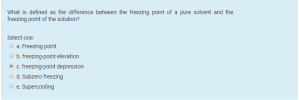 What is defined as the difference between the freezing point of a pure solvent and the freezing point of the solution? Select one: o a. Freezing point o b. freezing-point elevation c. freezing-point depression d. Subzero freezing O e. Supercooling
You obtained the following graphical data from two experimental runs to determine the freezing point depression...
 You obtained the following
graphical data from two experimental runs to determine the freezing
point depression constant for a pure solvent. The solution was made
up by adding 3.025 g of naphthalene, C10H8,
to 45.320 g of pure solvent.
1.What is the freezing point temperature of the pure solvent (in
oC)?
2.What is the solution freezing point temperature (in
oC)?
3.What is the freezing point depression, Tfp (in
oC)?
4.What is the molar mass of naphthalene (in g/mol)?
5.How many...
You obtained the following
graphical data from two experimental runs to determine the freezing
point depression constant for a pure solvent. The solution was made
up by adding 3.025 g of naphthalene, C10H8,
to 45.320 g of pure solvent.
1.What is the freezing point temperature of the pure solvent (in
oC)?
2.What is the solution freezing point temperature (in
oC)?
3.What is the freezing point depression, Tfp (in
oC)?
4.What is the molar mass of naphthalene (in g/mol)?
5.How many...
In one experiment, a student compares the freezing point (6.5 oC) of a pure solvent to...
In one experiment, a student compares the freezing point (6.5 oC) of a pure solvent to the freezing point (1.1oC) of the solvent with a solute. If the kf of the solvent is 5.12 oC/m, what is the molality of the solvent with solute solution?
a. (2) On Graph 1, extrapolate and give the freezing point of the pure solvent to...
 a. (2) On Graph 1, extrapolate and give the freezing point of the pure solvent to the nearest 0.1°C. Show the extrapolation on graph 1. b. (2) On Graph 2, extrapolate and give the freezing point of the solution to the nearest 0.1 °C. Show the extrapolation on graph 2. c. Determine the change in freezing point (AT) between pure solvent and solution? (3) d. (7) If the molal freezing point depression constant (KI) for the solvent is 1.86 kg°C/mol,...
 Freezing Point Curves pure solvent AF D el B TEMPERATURE solution + D E TIME Match the following: Freezing point depression The effect of supercooling Freezing point of solution Freezing point of pure solvent Region where liquid is cooling Submit Answer Tries 0/5
 7. If a 3.0 M solution of glucose (C H202), a 2.0 M solution of Na SO, and a 1.0 M solution of (NH4)3PO4, is made, which solution will have the lowest vapor pressure, highest boiling point, and lowest freezing point? 10. Consider the structures for benzophenone and cyclohexanone shown as follows benzophenone cyclohexanone a) Are all the atoms in the same plane in the cyclohexanone? anone is b) Explain why benzophenone is a solid at room temperature and why...
 What is defined as the difference between the freezing point of a pure solvent and the freezing point of the solution? Select one: o a. Freezing point o b. freezing-point elevation c. freezing-point depression d. Subzero freezing O e. Supercooling
 You obtained the following
graphical data from two experimental runs to determine the freezing
point depression constant for a pure solvent. The solution was made
up by adding 3.025 g of naphthalene, C10H8,
to 45.320 g of pure solvent.
1.What is the freezing point temperature of the pure solvent (in
oC)?
2.What is the solution freezing point temperature (in
oC)?
3.What is the freezing point depression, Tfp (in
oC)?
4.What is the molar mass of naphthalene (in g/mol)?
5.How many...
You obtained the following
graphical data from two experimental runs to determine the freezing
point depression constant for a pure solvent. The solution was made
up by adding 3.025 g of naphthalene, C10H8,
to 45.320 g of pure solvent.
1.What is the freezing point temperature of the pure solvent (in
oC)?
2.What is the solution freezing point temperature (in
oC)?
3.What is the freezing point depression, Tfp (in
oC)?
4.What is the molar mass of naphthalene (in g/mol)?
5.How many...
 a. (2) On Graph 1, extrapolate and give the freezing point of the pure solvent to the nearest 0.1°C. Show the extrapolation on graph 1. b. (2) On Graph 2, extrapolate and give the freezing point of the solution to the nearest 0.1 °C. Show the extrapolation on graph 2. c. Determine the change in freezing point (AT) between pure solvent and solution? (3) d. (7) If the molal freezing point depression constant (KI) for the solvent is 1.86 kg°C/mol,...
Most questions answered within 3 hours.
-
Where is the error in this code sequence?
String s1 = "Hello";
String s2 = "ello";...
asked 10 months ago -
Financial data for Joel de Paris, Inc., for last year
follow:
Joel de Paris, Inc.
Balance...
asked 10 months ago -
Consider this reaction:
Al2(SO4)3 (aq)+ BaCl3
(aq) Al2Cl6 (aq)- +
3BaSO4(s) . What is the...
asked 10 months ago -
Suppose that Savneet is considering increasing her
recent random sample from 20 car rentals to 40...
asked 10 months ago -
Trucks arrive at an unloading terminal at an average rate of 120
per hour.
Trucks arrive...
asked 10 months ago -
Why are methanol and ethanol completely soluble in water while
octanol is not very little soluble....
asked 10 months ago -
A facilities manager at a university reads in a research report
that the mean amount of...
asked 10 months ago -
When the CuSO4 is rehydrated by adding water to the anhydrous
compound, is this an endothermic...
asked 10 months ago -
A ray of sunlight is passing from diamond into crown glass; the
angle of incidence is...
asked 10 months ago -
A block of mass 0.249 kg is placed on top of a light, vertical
spring of...
asked 10 months ago -
how do the kidneys compensate in the presences of acidosis
a) trigger hyperventilate
b) reserve acid...
asked 10 months ago -
Question 501 pts
The rental rate of capital to the firm increases. Which of the
following...
asked 10 months ago