The next few questions challenge you to figure out the acceleration due to gravity ( g...
The next few questions challenge you to figure out the acceleration due to gravity ( g ) on various hypothetical alien planets. On MArs, you drop a stone from rest, 91.4 m above the ground, and the stone hits the ground 6.93 s later. What is the value of g on Mars?
Homework Answers
Here,
let the value of g is g
Using second equation of motion
as displacement = u * t + 0.50 * g * t^2
t is the time of falling
91.4 = 0.50 *g * 6.93^2
g = 3.81 m/s^2
the value of g at Mars is 3.81 m/s^2
Add Answer to:
The next few questions challenge you to figure out the
acceleration due to gravity ( g...
You are on a planet with an unknown acceleration due to gravity. You drop an object...
You are on a planet with an unknown acceleration due to gravity. You drop an object from rest and a height 1.1 metres, and measure the final speed 5.6 m/s as the object hits the ground. Using the Principle of Conservation of Energy, calculate the magnitude of the acceleration due to gravity. Use 2 sf in your answer.
On Mars, where the acceleration due to gravity is 3.8 m/s2, a 500 gram ball is...
On Mars, where the acceleration due to gravity is 3.8 m/s2, a 500 gram ball is thrown from a cliff that is 30 m above the ground at a speed of 22 m/s. The ball lands 45 m away from the base of the cliff. What is the speed of the ball just before it hits the ground?
A tennis ball on Mars, where the acceleration due to gravity is 0.379 of a g...
A tennis ball on Mars, where the acceleration due to gravity is 0.379 of a g and air resistance is negligible, is hit directly upward and returns to the same level 9.20 {\rm s} later. How high above its original point did the ball go? and How fast was it moving just after being hit?
You wake up one morning to find yourself in a strange room with opaque walls, and...
You wake up one morning to find yourself in a strange room with opaque walls, and no visible doors or windows. Clearly, you’ve been abducted in your sleep! You’re immediately aware that the local gravity feels different from what you’re accustomed to, so it’s clear you’re not at rest on the surface of the Earth. You decide to do some experiments to find out more about your strange situation. Fortunately, there seems to be some measuring equipment in the room...
SECTION2 You wake up one morning to find yourself in a strange room with opaque walls, and no vis...
 SECTION2 You wake up one morning to find yourself in a strange room with opaque walls, and no visible doors or windows. Clearly you've been abducted in your sleep! You're immediately aware that the local gravity feels different from what you're accustomed to, so it's clear you're not at rest on the surface of the Earth. You decide to do some experiments to find out more about your strange situation. Fortunately there seems to be some measuring equipment in the...
** Assume the acceleration gravity g=10 m/s2 in ALL questions. Problem 1 In the figure shown...
 ** Assume the acceleration gravity g=10 m/s2 in ALL questions. Problem 1 In the figure shown below, a block of mass m - 2.0 kg is released from rest at point A and slides down a frictionless track to point B. Then, the block continues its motion and leaves the AB track horizontally from point B to hit the ground at point C. (12 points) a) Calculate the speed of the block at point B. 25 m B 5 m...
The next TWO questions apply to the following: To demonstrate that the acceleration of gravity is...
 The next TWO questions apply to the following: To demonstrate that the acceleration of gravity is constant for all objects, Galileo climbs to the top of the Leaning Tower of Pisa and drops a 2.0 kg pebble from a height of 59 m, hoping that the effects of air resistance will be small 13. When the experiment is actually done, the pebble hits the ground with a speed of 29.0 m/s, having been slowed some by air resistance. In this...
SECTION2 You wake up one morning to find yourself in a strange room with opaque walls,...
 SECTION2 You wake up one morning to find yourself in a strange room with opaque walls, and no visible doors or windows. Clearly you've been abducted in your sleep! You're immediately aware that the local gravity feels different from what you're accustomed to, so it's clear you're not at rest on the surface of the Earth. You decide to do some experiments to find out more about your strange situation. Fortunately there seems to be some measuring equipment in the...
6. A tennis ball on Moon, where the acceleration due to gravity is 1/6 g (g-...
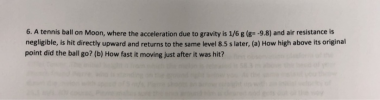 6. A tennis ball on Moon, where the acceleration due to gravity is 1/6 g (g- -9.8) and air resistance is negligible, is hit directly upward and returns to the same level 8.5 s later, (a) How high above its original point did the ball go? (b) How fast it moving just after it was hit?
2: For this problem the heights are low enough that the acceleration due to gravity can...
2: For this problem the heights are low enough that the acceleration due to gravity can be approximated as -g. (Note: even at low Earth orbit, such as the location of the International Space Station, the acceleration due to gravity is not much smaller then g. The apparent weightlessness is due to the space station and its occupants being in free-fall.) A rocket is launched vertically from a launchpad on the surface of the Earth. The net acceleration (provided by...
 SECTION2 You wake up one morning to find yourself in a strange room with opaque walls, and no visible doors or windows. Clearly you've been abducted in your sleep! You're immediately aware that the local gravity feels different from what you're accustomed to, so it's clear you're not at rest on the surface of the Earth. You decide to do some experiments to find out more about your strange situation. Fortunately there seems to be some measuring equipment in the...
 ** Assume the acceleration gravity g=10 m/s2 in ALL questions. Problem 1 In the figure shown below, a block of mass m - 2.0 kg is released from rest at point A and slides down a frictionless track to point B. Then, the block continues its motion and leaves the AB track horizontally from point B to hit the ground at point C. (12 points) a) Calculate the speed of the block at point B. 25 m B 5 m...
 The next TWO questions apply to the following: To demonstrate that the acceleration of gravity is constant for all objects, Galileo climbs to the top of the Leaning Tower of Pisa and drops a 2.0 kg pebble from a height of 59 m, hoping that the effects of air resistance will be small 13. When the experiment is actually done, the pebble hits the ground with a speed of 29.0 m/s, having been slowed some by air resistance. In this...
 SECTION2 You wake up one morning to find yourself in a strange room with opaque walls, and no visible doors or windows. Clearly you've been abducted in your sleep! You're immediately aware that the local gravity feels different from what you're accustomed to, so it's clear you're not at rest on the surface of the Earth. You decide to do some experiments to find out more about your strange situation. Fortunately there seems to be some measuring equipment in the...
 6. A tennis ball on Moon, where the acceleration due to gravity is 1/6 g (g- -9.8) and air resistance is negligible, is hit directly upward and returns to the same level 8.5 s later, (a) How high above its original point did the ball go? (b) How fast it moving just after it was hit?
Most questions answered within 3 hours.
-
Where is the error in this code sequence?
String s1 = "Hello";
String s2 = "ello";...
asked 10 months ago -
Financial data for Joel de Paris, Inc., for last year
follow:
Joel de Paris, Inc.
Balance...
asked 10 months ago -
Consider this reaction:
Al2(SO4)3 (aq)+ BaCl3
(aq) Al2Cl6 (aq)- +
3BaSO4(s) . What is the...
asked 10 months ago -
Suppose that Savneet is considering increasing her
recent random sample from 20 car rentals to 40...
asked 10 months ago -
Trucks arrive at an unloading terminal at an average rate of 120
per hour.
Trucks arrive...
asked 10 months ago -
Why are methanol and ethanol completely soluble in water while
octanol is not very little soluble....
asked 10 months ago -
A facilities manager at a university reads in a research report
that the mean amount of...
asked 10 months ago -
When the CuSO4 is rehydrated by adding water to the anhydrous
compound, is this an endothermic...
asked 10 months ago -
A ray of sunlight is passing from diamond into crown glass; the
angle of incidence is...
asked 10 months ago -
A block of mass 0.249 kg is placed on top of a light, vertical
spring of...
asked 10 months ago -
how do the kidneys compensate in the presences of acidosis
a) trigger hyperventilate
b) reserve acid...
asked 10 months ago -
Question 501 pts
The rental rate of capital to the firm increases. Which of the
following...
asked 10 months ago