Using a diagram,illustrate and describe the four basic sourcing strategies that businesses use to procure goods...
Homework Answers
Global Sourcing: Procurement must define global sourcing as a strategic alternative to benefit from the advantages of internationalization. International purchasing has to be developed into global sourcing by using a strategic focus. This means: realizing competitive advantage. In fact, globalization refers to two aspects.
(1) Operating in international marketplaces: Here, globalization means systematically extending procurement policy towards sources in foreign markets at least worldwide.
(2) Strategic orientation: Here, globalization means an overall orientation of purchasing activities in order to secure the profit base of a firm.
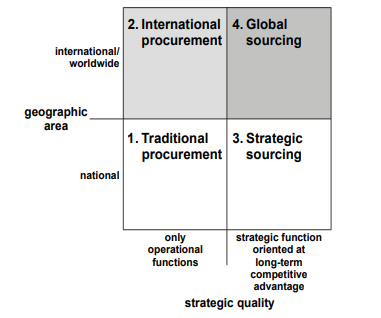
The figure combines these two dimensions and creates four sectors of purchasing activities: Besides traditional procurement and a just operative-oriented ‘going international’ there is the field of strategic supply management and the field of global sourcing which integrates high degrees in both aspects of globalization.
One of the most important instruments in the strategic planning process is portfolio technique. Portfolios help to formulate an adequate strategy. For defining the right global sourcing strategy, purchasing has to analyse.
(a) the goods and services to be sourced:
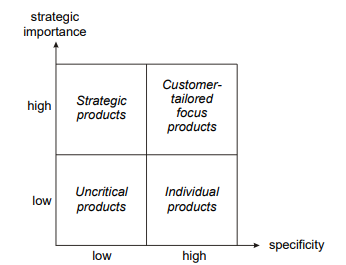
Therefore, the object portfolio distinguishes four types of goods depending on their specificity and their strategic importance. Strategic importance refers to the contribution of the good or service sourced to the competitive advantage of the company on its sales markets. Specificity refers to the degree of individuality of the object - highly specific goods are produced for one customer only. As a result, there is a range of goods from uncritical products with low specificity and low strategic importance to customer-tailored focus products with both high importance and specificity. In between, there are strategic and individual products as shown in the object portfolio below.
(b) the markets where to be sourced.
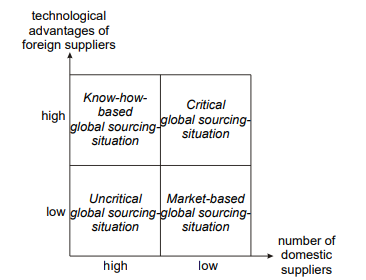
While the object portfolio is primarily internal oriented, the market portfolio has a closer look on the external market situation. The buying market situation is described best by looking on suppliers and their capabilities. As a result, the market portfolio has two dimensions: The number of domestic suppliers and the technological advantages of foreign suppliers. Often, companies are forced to source internationally due to the fact that some high-tech products are just not available from domestic suppliers, e.g. microelectronics/semiconductors. As a result, we distinguish between the know-how based global sourcing-situation, where buyers make use of the technological advantage of foreign suppliers, and the market-based global sourcing-situation, where buyers just look for international supplying alternatives. The worst situation from a buyer’s point of view is called ‘critical global sourcing-situation’. In this case, the number of domestic suppliers is low and the technological advantage of foreign suppliers is high.
The four product types and the four market situations can be brought together in the so-called ‘global sourcing strategy type portfolio’. This portfolio identifies three major types of global sourcing strategies:
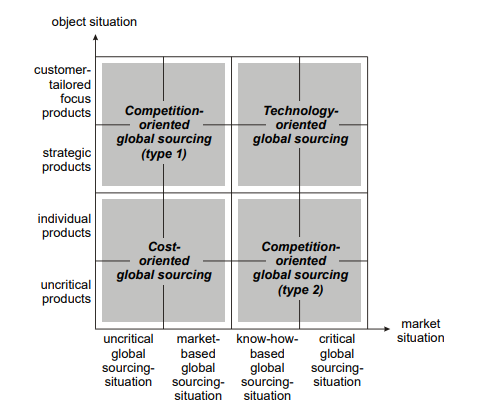
Technology-oriented global sourcing is a strategy which is closely connected with high-tech sourcing outside domestic markets.
Cost-oriented global sourcing is the strategy pattern that helps to increase competition. As its name says, the major goal is not to get one step ahead in technology but to save cost. It is useful for standardised products where suppliers are easily available in domestic and international markets.
Competition-oriented global sourcing differs from cost-oriented global sourcing not in the goal to reinforce competition - but it does not have a single cost reduction focus. Instead, it tries to gain new product ideas and developments in uncritical market situations by addressing foreign suppliers (type 1) or it looks for a wider range of supply markets and suppliers for less critical products (type 2).
These three strategy patterns for global sourcing show the direction in which global sourcing goes regularly. Supply management has to observe the dimensions of the pre-portfolios mentioned above carefully before they can formulate an adequate global sourcing strategy. Sometimes, the reason for going internationally in purchasing differs from the three strategies mentioned above. The following case study shows an example of a mainly sales-driven global sourcing which led in the end to cost-oriented global sourcing.
Global sourcing alone is not a total supply strategy - but it is an important part of it. The following ‘sourcing toolbox’ gives an overview about the sub-strategies, which form together an integrated sourcing strategy.
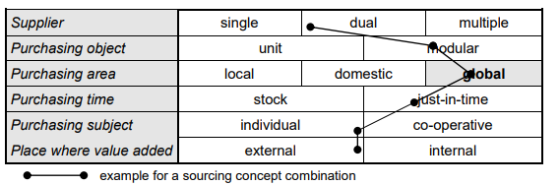
We see global sourcing as an alternative to local and domestic sourcing in the area sub-strategy. On the other hand, supply management has to decide (a) the number of suppliers (one, two, or more than two leads to single, dual, or multiple sourcing), (b) the kind of object to buy (simple parts or complex modules leads to unit or modular sourcing), (c) the time when to deliver (long-term delivery on stock sourcing or just in-time), (d) the number of buyers to buy with (only one or as a purchasing consortium leads to individual or co-operative sourcing), and (e) the place where to add value by suppliers (on their own supplier plant or in the plant of the buyer leads to external or internal sourcing).
Add Answer to:
Using a diagram,illustrate and describe the four basic sourcing
strategies that businesses use to procure goods...
Using the four basic strategies to enter and compete in the international market (1) global standardization...
Using the four basic strategies to enter and compete in the international market (1) global standardization strategy, (2) localization strategy, (3) transnational strategy, and (4) international strategy. Which strategy does Sony Corporation use in the international market, to leverage the market and to stay relevant?
What are the three basic strategies that businesses can employ to ward off competition. Give an...
What are the three basic strategies that businesses can employ to ward off competition. Give an example of a company that utilizes each and describe why their strategy is effective.
Question 1 Explain four functions of the control process. Question 2 Using a diagram illustrate the...
 Question 1 Explain four functions of the control process. Question 2 Using a diagram illustrate the control process. Question 3 Describe the characteristics of an effective control system. (10) Question 4 What are the main areas on which we focus control? Provide an example of a control method for each. Question 5 List and briefly describe the four levels of ethical questions in a business.
Explain the reasons for expatriate failures. List and explain the four basic global business strategies. In...
Explain the reasons for expatriate failures. List and explain the four basic global business strategies. In a few sentences, explain the Fisher International Fisher effect (IFE). Explain the steps in determining if a company is ready for exporting a product or service
Task Description Critically discuss three key corporate strategies that businesses use for international expansion. In the...
Task Description Critically discuss three key corporate strategies that businesses use for international expansion. In the context of internationalization of business engagements, alliances, and joint ventures are widely used. Discuss with examples of the recent challenges businesses are facing in managing their international operations. Please note: Each student is required to write a critical and analytical argumentative essay on strategic business management and planning issues using contemporary concepts, theories, and models. The students will have to use their cognitive knowledge...
Describe briefly the following four international strategies: Home Replication Strategy, Multi-domestic Strategy, Global Strategy, Trans-National Strategy....
Describe briefly the following four international strategies: Home Replication Strategy, Multi-domestic Strategy, Global Strategy, Trans-National Strategy. (Use examples if it helps.) Typed please
In Chapter 13, your e-book lists four distinct Global Market Entry Strategies. How you enter the...
In Chapter 13, your e-book lists four distinct Global Market Entry Strategies. How you enter the market initially as an international or global marketer is an important early consideration and choosing the right method for that specific market and one that also fits your circumstances is critical. Choose any one of the four entry methods, describe it, and explain why and when you might choose to use that strategy to enter a new market. Provide examples that illustrate your thoughts.
List four businesses in a global organization, of your choice, and discuss if the process of...
List four businesses in a global organization, of your choice, and discuss if the process of globalization impacted its strategy.(200 words) Setting up business internationally has been increasing. What are the advantages and disadvantage with businesses operating abroad.(200 words) Used an upcoming international business, of your choice, and discuss if the how using strategies in to impacted its financial earning and create a robust cash flows. What could be the reasons for this business to expand internationally.(300 words)
Identify and explain the four strategies that operations managers of international and multinational firms use to...
Identify and explain the four strategies that operations managers of international and multinational firms use to approach global opportunities.
Describe the structural features and mechanism of assembly of Escherichia coli P (Pap) pili. Use a diagram to illustrate...
Describe the structural features and mechanism of assembly of Escherichia coli P (Pap) pili. Use a diagram to illustrate you answer. When are these pili used during infection, and how is receptor specificity determined in this system? [ESSAY TYPE QUESTION]
 Question 1 Explain four functions of the control process. Question 2 Using a diagram illustrate the control process. Question 3 Describe the characteristics of an effective control system. (10) Question 4 What are the main areas on which we focus control? Provide an example of a control method for each. Question 5 List and briefly describe the four levels of ethical questions in a business.
Most questions answered within 3 hours.
-
Where is the error in this code sequence?
String s1 = "Hello";
String s2 = "ello";...
asked 10 months ago -
Financial data for Joel de Paris, Inc., for last year
follow:
Joel de Paris, Inc.
Balance...
asked 10 months ago -
Consider this reaction:
Al2(SO4)3 (aq)+ BaCl3
(aq) Al2Cl6 (aq)- +
3BaSO4(s) . What is the...
asked 10 months ago -
Suppose that Savneet is considering increasing her
recent random sample from 20 car rentals to 40...
asked 10 months ago -
Trucks arrive at an unloading terminal at an average rate of 120
per hour.
Trucks arrive...
asked 10 months ago -
Why are methanol and ethanol completely soluble in water while
octanol is not very little soluble....
asked 10 months ago -
A facilities manager at a university reads in a research report
that the mean amount of...
asked 10 months ago -
When the CuSO4 is rehydrated by adding water to the anhydrous
compound, is this an endothermic...
asked 10 months ago -
A ray of sunlight is passing from diamond into crown glass; the
angle of incidence is...
asked 10 months ago -
A block of mass 0.249 kg is placed on top of a light, vertical
spring of...
asked 10 months ago -
how do the kidneys compensate in the presences of acidosis
a) trigger hyperventilate
b) reserve acid...
asked 10 months ago -
Question 501 pts
The rental rate of capital to the firm increases. Which of the
following...
asked 10 months ago