Fluorine and NO2 substituents on a benzene ring (para to each other), reacted with KCN in...
Fluorine and NO2 substituents on a benzene ring (para to each other), reacted with KCN in DMF solution, what is the product and why? Thank you! (please include mechanism and pictures if possible)
Homework Answers

Add Answer to:
Fluorine and NO2 substituents on a benzene ring (para to each
other), reacted with KCN in...
437 Predict whether the following substituents on the benzene ring are likely to be ha para...
 437 Predict whether the following substituents on the benzene ring are likely to be ha para directing or meta directing and whether they are like to be ring activating or ring deactivating deact vabang a) - NH(CH 4.38 For each of the monosabstituted benenes shown below, (1) Indicate whether the substituent is ortho, para directing or meta directing (2) Draw the structure of the main monosubstitution product for each of the reactions indicated orth. OCH3 + HCl -OCHE (fecutulys ortho...
2. D type and strength of each substituents as activating(A) or outcome as ortho-para (O/P) or...
 2. D type and strength of each substituents as activating(A) or outcome as ortho-para (O/P) or meta(M) directors. (6 pts) you expect an electrophile to be attached to the ring You must identify the deactivating(D) and also the expected regiochemical 3. Use aromatic, non aromatic or antiaromatic concepts to explain the reactions or molecules shown (6 pts) Provide a curved arrow mechanism to show the formation of a aromatic carbocation intermediate Show the final product H-I The pK,values for the...
2. Not only does an aromatic ring itself affect the reactivity of an acid derivative (an ester, o...
 2. Not only does an aromatic ring itself affect the reactivity of an acid derivative (an ester, on last year's quiz), substituents on the aromatic ring can further modify the reactivity. First, we will consider a phenyl amide with a para-acetyl substituent: CH, (a) What is the n-effect (resonance) of the para-acetyl substituent? How will that affect the reactivity of the other (amide) carbonyl in the molecule below (increase or decrease, compared to the same amide but with no p-...
Which one of the following substituents is activating and othe-para directing in electrophilic aromatic substitution reactions?...
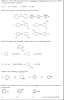 Which one of the following substituents is activating and othe-para directing in electrophilic aromatic substitution reactions? 1) -C1 2) -N* (CH) 3) -COH 4) Ph What is the product of the following series of reactions? ΗΝΟ, H.SO Brs FeBry ZHg) HCI ON NO, 1) CH -CH, Br ON 2) CHE CH, Er Br NO; Identify the diene and dienophile which would give the following product. NO, 1) + H.C-CHNO 3) + HỌC CHNO3 2) + CH CH-CHNO; 4) + нс...
Liy myas iw nolt yd fuods Name: anibia blsu base loro o done Part I: single substituents Lab report for lab the we...
 Liy myas iw nolt yd fuods Name: anibia blsu base loro o done Part I: single substituents Lab report for lab the week of October 22 1. What is the name of the compound with the formula CsHsBr? What is the special name of the compound with the formula CeHsCH3?- 2. 3. What is the special name for benzene with an amino group attached to the ring? 4. What is the special name for the benzene derivative with an alcohol...
The benzene molecule, C6H6, contains 6 carbon atoms in a ring. Each carbon atom contributes one...
The benzene molecule, C6H6, contains 6 carbon atoms in a ring. Each carbon atom contributes one electron that is free to move round the ring. By treating the electrons as particles moving on a ring of radius r the delocalised electron energies can be estimated by E = h2n 2 / (8π2mer 2 ) (1) where n = 0, ±1, ±2, ±3, … . (a) Use equation (1) to calculate the n=1 to n=2 electronic transition energy in benzene. Take...
1. please check what is wrong. Thank you! Determine the product formed when each compound is treated with...
 1. please check what is wrong. Thank you!
Determine the product formed when each compound is treated with Br2 and FeBr3. Drag the atom labels to their appropriate positions. CN Atom labels H H Br Br2 A. FeBr Br H OH OH Br Br. Br2 FeBr3 H H Br Br H Br2 FeBr H1 H Reset T Rank the compounds in each group in order of decreasing reactivity in electrophilic aromatic substitution. CI Decreasing reactivity Rank the compounds in each...
1. please check what is wrong. Thank you!
Determine the product formed when each compound is treated with Br2 and FeBr3. Drag the atom labels to their appropriate positions. CN Atom labels H H Br Br2 A. FeBr Br H OH OH Br Br. Br2 FeBr3 H H Br Br H Br2 FeBr H1 H Reset T Rank the compounds in each group in order of decreasing reactivity in electrophilic aromatic substitution. CI Decreasing reactivity Rank the compounds in each...
Reaction 1: Nitration HNO3 NO2 H2SO4, H20 NO2 toluene NO2 ortho meta para Procedure for Reaction...
 Reaction 1: Nitration HNO3 NO2 H2SO4, H20 NO2 toluene NO2 ortho meta para Procedure for Reaction 1: 1) To a stirred solution of 3 mL (44.7 mmoles) 67 % HNO3 in 3.75 mL of water, H2SO4 (9 mL) was slowly added at 10-15 °C. 2) This nitrating solution was added dropwise with vigorous stirring to 4 mL (37.5 mmoles) of toluene while cooling in ice-water in order to maintain the reaction temperature between 15 and 25 °C. 3) Stirring was...
Question1: Introduction Three aromatic compounds that have ortho-para directing and activating substituents will be brominated. The...
 Question1:
Introduction Three aromatic compounds that have ortho-para directing and activating substituents will be brominated. The extent of activation will be judged by the number of bromine atoms that add to the benzene ring in each case. For each of the compounds shown below you will work out if a mono- di- or tri- brominated derivative formed following treatment with acetic acid and bromine in hydrobromic acid. This will be determined by measuring the melting point and interpreting the H...
Question1:
Introduction Three aromatic compounds that have ortho-para directing and activating substituents will be brominated. The extent of activation will be judged by the number of bromine atoms that add to the benzene ring in each case. For each of the compounds shown below you will work out if a mono- di- or tri- brominated derivative formed following treatment with acetic acid and bromine in hydrobromic acid. This will be determined by measuring the melting point and interpreting the H...
Please provide some type of explanation for each question and thank you for your help in...
 Please provide some type of explanation for each question and
thank you for your help in advance.
3. Which of the following does not undergo oxidation in the presence of H-CrO4? CH3 CH2CH3 CH(CH3)2 C(CH3)3 3 d. 4 4. Which of the following compounds is aromatic? a. ethane b. cyclobutadiene C. benzene d. syclooctatetraene 5. Which of the following compounds is antiaromatic? a. ethane b. cyclobutadiene C. benzene d. cyclooctatetraene 6. What are the relative positions of the substituents in...
Please provide some type of explanation for each question and
thank you for your help in advance.
3. Which of the following does not undergo oxidation in the presence of H-CrO4? CH3 CH2CH3 CH(CH3)2 C(CH3)3 3 d. 4 4. Which of the following compounds is aromatic? a. ethane b. cyclobutadiene C. benzene d. syclooctatetraene 5. Which of the following compounds is antiaromatic? a. ethane b. cyclobutadiene C. benzene d. cyclooctatetraene 6. What are the relative positions of the substituents in...
 437 Predict whether the following substituents on the benzene ring are likely to be ha para directing or meta directing and whether they are like to be ring activating or ring deactivating deact vabang a) - NH(CH 4.38 For each of the monosabstituted benenes shown below, (1) Indicate whether the substituent is ortho, para directing or meta directing (2) Draw the structure of the main monosubstitution product for each of the reactions indicated orth. OCH3 + HCl -OCHE (fecutulys ortho...
 2. D type and strength of each substituents as activating(A) or outcome as ortho-para (O/P) or meta(M) directors. (6 pts) you expect an electrophile to be attached to the ring You must identify the deactivating(D) and also the expected regiochemical 3. Use aromatic, non aromatic or antiaromatic concepts to explain the reactions or molecules shown (6 pts) Provide a curved arrow mechanism to show the formation of a aromatic carbocation intermediate Show the final product H-I The pK,values for the...
 2. Not only does an aromatic ring itself affect the reactivity of an acid derivative (an ester, on last year's quiz), substituents on the aromatic ring can further modify the reactivity. First, we will consider a phenyl amide with a para-acetyl substituent: CH, (a) What is the n-effect (resonance) of the para-acetyl substituent? How will that affect the reactivity of the other (amide) carbonyl in the molecule below (increase or decrease, compared to the same amide but with no p-...
 Which one of the following substituents is activating and othe-para directing in electrophilic aromatic substitution reactions? 1) -C1 2) -N* (CH) 3) -COH 4) Ph What is the product of the following series of reactions? ΗΝΟ, H.SO Brs FeBry ZHg) HCI ON NO, 1) CH -CH, Br ON 2) CHE CH, Er Br NO; Identify the diene and dienophile which would give the following product. NO, 1) + H.C-CHNO 3) + HỌC CHNO3 2) + CH CH-CHNO; 4) + нс...
 Liy myas iw nolt yd fuods Name: anibia blsu base loro o done Part I: single substituents Lab report for lab the week of October 22 1. What is the name of the compound with the formula CsHsBr? What is the special name of the compound with the formula CeHsCH3?- 2. 3. What is the special name for benzene with an amino group attached to the ring? 4. What is the special name for the benzene derivative with an alcohol...
 1. please check what is wrong. Thank you!
Determine the product formed when each compound is treated with Br2 and FeBr3. Drag the atom labels to their appropriate positions. CN Atom labels H H Br Br2 A. FeBr Br H OH OH Br Br. Br2 FeBr3 H H Br Br H Br2 FeBr H1 H Reset T Rank the compounds in each group in order of decreasing reactivity in electrophilic aromatic substitution. CI Decreasing reactivity Rank the compounds in each...
1. please check what is wrong. Thank you!
Determine the product formed when each compound is treated with Br2 and FeBr3. Drag the atom labels to their appropriate positions. CN Atom labels H H Br Br2 A. FeBr Br H OH OH Br Br. Br2 FeBr3 H H Br Br H Br2 FeBr H1 H Reset T Rank the compounds in each group in order of decreasing reactivity in electrophilic aromatic substitution. CI Decreasing reactivity Rank the compounds in each...
 Reaction 1: Nitration HNO3 NO2 H2SO4, H20 NO2 toluene NO2 ortho meta para Procedure for Reaction 1: 1) To a stirred solution of 3 mL (44.7 mmoles) 67 % HNO3 in 3.75 mL of water, H2SO4 (9 mL) was slowly added at 10-15 °C. 2) This nitrating solution was added dropwise with vigorous stirring to 4 mL (37.5 mmoles) of toluene while cooling in ice-water in order to maintain the reaction temperature between 15 and 25 °C. 3) Stirring was...
 Question1:
Introduction Three aromatic compounds that have ortho-para directing and activating substituents will be brominated. The extent of activation will be judged by the number of bromine atoms that add to the benzene ring in each case. For each of the compounds shown below you will work out if a mono- di- or tri- brominated derivative formed following treatment with acetic acid and bromine in hydrobromic acid. This will be determined by measuring the melting point and interpreting the H...
Question1:
Introduction Three aromatic compounds that have ortho-para directing and activating substituents will be brominated. The extent of activation will be judged by the number of bromine atoms that add to the benzene ring in each case. For each of the compounds shown below you will work out if a mono- di- or tri- brominated derivative formed following treatment with acetic acid and bromine in hydrobromic acid. This will be determined by measuring the melting point and interpreting the H...
 Please provide some type of explanation for each question and
thank you for your help in advance.
3. Which of the following does not undergo oxidation in the presence of H-CrO4? CH3 CH2CH3 CH(CH3)2 C(CH3)3 3 d. 4 4. Which of the following compounds is aromatic? a. ethane b. cyclobutadiene C. benzene d. syclooctatetraene 5. Which of the following compounds is antiaromatic? a. ethane b. cyclobutadiene C. benzene d. cyclooctatetraene 6. What are the relative positions of the substituents in...
Please provide some type of explanation for each question and
thank you for your help in advance.
3. Which of the following does not undergo oxidation in the presence of H-CrO4? CH3 CH2CH3 CH(CH3)2 C(CH3)3 3 d. 4 4. Which of the following compounds is aromatic? a. ethane b. cyclobutadiene C. benzene d. syclooctatetraene 5. Which of the following compounds is antiaromatic? a. ethane b. cyclobutadiene C. benzene d. cyclooctatetraene 6. What are the relative positions of the substituents in...
Most questions answered within 3 hours.
-
Where is the error in this code sequence?
String s1 = "Hello";
String s2 = "ello";...
asked 10 months ago -
Financial data for Joel de Paris, Inc., for last year
follow:
Joel de Paris, Inc.
Balance...
asked 10 months ago -
Consider this reaction:
Al2(SO4)3 (aq)+ BaCl3
(aq) Al2Cl6 (aq)- +
3BaSO4(s) . What is the...
asked 10 months ago -
Suppose that Savneet is considering increasing her
recent random sample from 20 car rentals to 40...
asked 10 months ago -
Trucks arrive at an unloading terminal at an average rate of 120
per hour.
Trucks arrive...
asked 10 months ago -
Why are methanol and ethanol completely soluble in water while
octanol is not very little soluble....
asked 10 months ago -
A facilities manager at a university reads in a research report
that the mean amount of...
asked 10 months ago -
When the CuSO4 is rehydrated by adding water to the anhydrous
compound, is this an endothermic...
asked 10 months ago -
A ray of sunlight is passing from diamond into crown glass; the
angle of incidence is...
asked 10 months ago -
A block of mass 0.249 kg is placed on top of a light, vertical
spring of...
asked 10 months ago -
how do the kidneys compensate in the presences of acidosis
a) trigger hyperventilate
b) reserve acid...
asked 10 months ago -
Question 501 pts
The rental rate of capital to the firm increases. Which of the
following...
asked 10 months ago