Algorithm 1: built-in sort The first algorithm you must implement is in builtin_sort, which must use...
Algorithm 1: built-in sort
The first algorithm you must implement is in builtin_sort, which must use the std::sort or qsort functions built into C++ to sort a vector of words. The function should sort the vector in-place, so it takes the vector as a non-const reference and returns void. This function may only need to be one line long.
Both std::sort and qsort have time complexity O(n n). In addition, since these are widely-used library functions, developers have put a lot of work into making them fast in terms of constant factors. Therefore we should expect this algorithm to have better constant factors than algorithms 3 and 4.
implement it here:
void builtin_sort(string_vector& unsorted) {
// TODO: implement this function, then delete this comment
}
Homework Answers
We are working in C++ so better use std:sort for sorting
void builtin_sort( string_vector &unsorted)
{
std::sort(unsorted.begin(), unsorted.end());
}
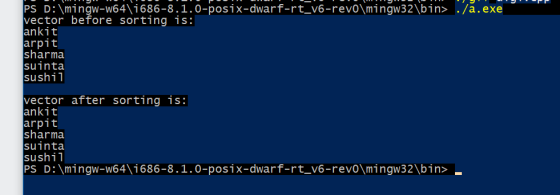
here is the example which shows how it works you can run it on your environment
#include<bits/stdc++.h>
using namespace std;
typedef std::vector<string> string_vector; // this is type
define n
void builtin_sort(string_vector & unsorted)
{
std::sort(unsorted.begin(),unsorted.end()); // this is
the function sort which will sort
}
int main()
{
string_vector unsorted;
unsorted.push_back("ankit");
unsorted.push_back("sharma");
unsorted.push_back("sushil");
unsorted.push_back("suinta");
unsorted.push_back("arpit");
builtin_sort(unsorted);
string_vector:: iterator it;
cout<<"vector before sorting is:";
for(it=unsorted.begin();it!=unsorted.end();it++)
//unsorted data will be printed here
cout<<"\n"<<*it;
cout<<"\n\nvector after sorting is:";
for(it=unsorted.begin();it!=unsorted.end();it++)
//sorted data will be printed here
cout<<"\n"<<*it;
}
output is:
Add Answer to:
Algorithm 1: built-in sort
The first algorithm you must implement is in builtin_sort, which
must use...
In below C++ sort.cpp 1- Implement the insertion_sort function. 2- Implement the compareSensorPtr function and the...
In below C++ sort.cpp 1- Implement the insertion_sort function. 2- Implement the compareSensorPtr function and the code in main to create and sort the array of pointers. The places to make modifications are indicated by TODO: comments. You should not have to make modifications anywhere else. 3- what's big O and runtime for 100000 items. #include <iostream> #include <algorithm> #include <numeric> #include <vector> #include <string> #include <cstdlib> #include <cassert> using namespace std; // Set this to false to skip the...
BACKGROUND Movie Review sites collect reviews and will often provide some sort of average review to...
BACKGROUND Movie Review sites collect reviews and will often provide some sort of average review to sort movies by their quality. In this assignment, you will collect a list of movies and then a list of reviews for each movie. You will then take a simple average (total of reviews divided by number of reviews) for each movie and output a sorted list of movies with their average review. Here you are provided the shell of a program and asked...
Implement a tic-tac-toe game. At the bottom of these specifications you will see a template you...
Implement a tic-tac-toe game. At the bottom of these specifications you will see a template you must copy and paste to cloud9. Do not change the provided complete functions, or the function stub headers / return values. Currently, if the variables provided in main are commented out, the program will compile. Complete the specifications for each function. As you develop the program, implement one function at a time, and test that function. The provided comments provide hints as to what...
You will be implementing a Breadth-First Search (BFS) and a Depth-First Search (DFS) algorithm on a...
 You will be implementing a Breadth-First Search (BFS) and a
Depth-First Search (DFS) algorithm on a graph stored as an
adjacency list. The AdjacencyList class inherits from the Graph
class shown below. class Graph { private: vector _distances; vector
_previous; public: Graph() { } virtual int vertices() const = 0;
virtual int edges() const = 0; virtual int distance(int) const = 0;
virtual void bfs(int) const = 0; virtual void dfs(int) const = 0;
virtual void display() const = 0;...
You will be implementing a Breadth-First Search (BFS) and a
Depth-First Search (DFS) algorithm on a graph stored as an
adjacency list. The AdjacencyList class inherits from the Graph
class shown below. class Graph { private: vector _distances; vector
_previous; public: Graph() { } virtual int vertices() const = 0;
virtual int edges() const = 0; virtual int distance(int) const = 0;
virtual void bfs(int) const = 0; virtual void dfs(int) const = 0;
virtual void display() const = 0;...
You are going to implement Treesort algorithm in C++ to sort string data. Here are the...
 You are going to implement Treesort algorithm in C++ to sort string data. Here are the steps to complete the homework 1) Use the following class definition for binary search tree nodes. Its constructor is incomplete you should first complete the constructor. class TreeNode t public: string data; / this is the string stored in the node TreeNode left: TreeNode right; TreeNode (string element, TreeNode 1t, TreeNode rt //your code here 2) Write a function that will insert a string...
Solve ques no. 2 a, b, c, d . Algorithm 1 Sort a list al,..., an...
 Solve ques no. 2 a, b, c, d .
Algorithm 1 Sort a list al,..., an for i=1 to n-1 do for j=1 to n-i do if aj > aj+1 then interchange a; and a;+1 end if end for end for (b) Algorithm 1 describes a sorting algorithm called bubble sort for a list al,...,an of at least two numbers. Prove that the algorithm is complete, correct and terminates. (2) Complexity of Algorithms (Learning Target C2) (a) What is the...
Solve ques no. 2 a, b, c, d .
Algorithm 1 Sort a list al,..., an for i=1 to n-1 do for j=1 to n-i do if aj > aj+1 then interchange a; and a;+1 end if end for end for (b) Algorithm 1 describes a sorting algorithm called bubble sort for a list al,...,an of at least two numbers. Prove that the algorithm is complete, correct and terminates. (2) Complexity of Algorithms (Learning Target C2) (a) What is the...
1. Implement an algorithm to convert binary number into an integer. Binary number is represented as...
1. Implement an algorithm to convert binary number into an integer. Binary number is represented as a string. Ex. int n = to_int("01010"); int to_int(const std::string& b) { } 2. Implement an algorithm to convert a decimal number to binary. The return type is string which holds the binary number as string. std::string to_binary(int n) { } 3. Implement a function to check if the number is positive or negative. The function should return true if number is positive. bool...
Exercise 1: Sorting void mysort(vector & v); Write a function called mysort that rearranges elements of...
Exercise 1: Sorting void mysort(vector & v); Write a function called mysort that rearranges elements of a vector v so that they form an increasing sequence of values. Allow for different vector positions to contain the same value. Develop your own sorting algorithm; do not use a predefined sort routine from the standard library. Implement a simple sorting algorithm rather than an efficient algorithm. Write code that thoroughly tests your function. Express your tests using assertions. Exercise 2: Comparison For...
//CODE 16-02.cpp //Demonstrates a template function that implements //a generic version of the selection sort algorithm....
//CODE 16-02.cpp //Demonstrates a template function that implements //a generic version of the selection sort algorithm. #include <iostream> using std::cout; using std::endl; template<class T> void sort(T a[], int numberUsed); //Precondition: numberUsed <= declared size of the array a. //The array elements a[0] through a[numberUsed - 1] have values. //The assignment and < operator work for values of type T. //Postcondition: The values of a[0] through a[numberUsed - 1] have //been rearranged so that a[0] <= a[1] <=... <= a[numberUsed -...
c++ data structures please Pick any inefficient sorting algorithm you want, selection, bubble, insertion, etc., and...
c++ data structures please Pick any inefficient sorting algorithm you want, selection, bubble, insertion, etc., and implement it as a function. Using the system clock as a timer, determine when the efficiency of the algorithm breaks down. For example, does it become slow after 1000 elements, 10000 elements, 100000 elements? Write some code to figure this out. Then use the sort() algorithm that is part of the STL <algorithm> library. How does this function compare to the function you implemented?...
 You will be implementing a Breadth-First Search (BFS) and a
Depth-First Search (DFS) algorithm on a graph stored as an
adjacency list. The AdjacencyList class inherits from the Graph
class shown below. class Graph { private: vector _distances; vector
_previous; public: Graph() { } virtual int vertices() const = 0;
virtual int edges() const = 0; virtual int distance(int) const = 0;
virtual void bfs(int) const = 0; virtual void dfs(int) const = 0;
virtual void display() const = 0;...
You will be implementing a Breadth-First Search (BFS) and a
Depth-First Search (DFS) algorithm on a graph stored as an
adjacency list. The AdjacencyList class inherits from the Graph
class shown below. class Graph { private: vector _distances; vector
_previous; public: Graph() { } virtual int vertices() const = 0;
virtual int edges() const = 0; virtual int distance(int) const = 0;
virtual void bfs(int) const = 0; virtual void dfs(int) const = 0;
virtual void display() const = 0;...
 You are going to implement Treesort algorithm in C++ to sort string data. Here are the steps to complete the homework 1) Use the following class definition for binary search tree nodes. Its constructor is incomplete you should first complete the constructor. class TreeNode t public: string data; / this is the string stored in the node TreeNode left: TreeNode right; TreeNode (string element, TreeNode 1t, TreeNode rt //your code here 2) Write a function that will insert a string...
 Solve ques no. 2 a, b, c, d .
Algorithm 1 Sort a list al,..., an for i=1 to n-1 do for j=1 to n-i do if aj > aj+1 then interchange a; and a;+1 end if end for end for (b) Algorithm 1 describes a sorting algorithm called bubble sort for a list al,...,an of at least two numbers. Prove that the algorithm is complete, correct and terminates. (2) Complexity of Algorithms (Learning Target C2) (a) What is the...
Solve ques no. 2 a, b, c, d .
Algorithm 1 Sort a list al,..., an for i=1 to n-1 do for j=1 to n-i do if aj > aj+1 then interchange a; and a;+1 end if end for end for (b) Algorithm 1 describes a sorting algorithm called bubble sort for a list al,...,an of at least two numbers. Prove that the algorithm is complete, correct and terminates. (2) Complexity of Algorithms (Learning Target C2) (a) What is the...
Most questions answered within 3 hours.
-
Where is the error in this code sequence?
String s1 = "Hello";
String s2 = "ello";...
asked 11 months ago -
Financial data for Joel de Paris, Inc., for last year
follow:
Joel de Paris, Inc.
Balance...
asked 11 months ago -
Consider this reaction:
Al2(SO4)3 (aq)+ BaCl3
(aq) Al2Cl6 (aq)- +
3BaSO4(s) . What is the...
asked 11 months ago -
Suppose that Savneet is considering increasing her
recent random sample from 20 car rentals to 40...
asked 11 months ago -
Trucks arrive at an unloading terminal at an average rate of 120
per hour.
Trucks arrive...
asked 11 months ago -
Why are methanol and ethanol completely soluble in water while
octanol is not very little soluble....
asked 11 months ago -
A facilities manager at a university reads in a research report
that the mean amount of...
asked 11 months ago -
When the CuSO4 is rehydrated by adding water to the anhydrous
compound, is this an endothermic...
asked 11 months ago -
A ray of sunlight is passing from diamond into crown glass; the
angle of incidence is...
asked 11 months ago -
A block of mass 0.249 kg is placed on top of a light, vertical
spring of...
asked 11 months ago -
how do the kidneys compensate in the presences of acidosis
a) trigger hyperventilate
b) reserve acid...
asked 11 months ago -
Question 501 pts
The rental rate of capital to the firm increases. Which of the
following...
asked 11 months ago