If you ran the reaction for this experiment and began with 65.0 mmol of isopentyl alcohol,...
If you ran the reaction for this experiment and began with 65.0 mmol of isopentyl alcohol, how many grams of isopentyl acetate could you theoretically produce assuming only a 67.0% attainable yield?
Homework Answers

Add Answer to:
If you ran the reaction for this experiment and began with 65.0
mmol of isopentyl alcohol,...
If the yield from the reaction of acetic acid with isopentyl alcohol is 45%, how many...
If the yield from the reaction of acetic acid with isopentyl alcohol is 45%, how many grams of isopentyl acetate are formed from 3.58 g of acetic acid and 4.70 g of isopentyl alcohol? The reaction is: CH3CO2H+C5H12O→C7H14O2+H2O Express your answer using two significant figures.
In this experiment, we did a Fischer Esterification using excess acetic acid, isopentyl alcohol, and sulfuric...
In this experiment, we did a Fischer Esterification using excess acetic acid, isopentyl alcohol, and sulfuric acid to form isopentyl acetate. Then sodium bicarbonate and NaCl were used in the extraction step of the experiment. Is there another method we could have used to calculate percent yield other than using the amount of isopentyl acetate? What are the advantages and disadvantages? (Using GC is not the answer we are looking for.)
Assume you are doing an experiment on the esterification of isopentyl acetate using 1mL of isopentyl...
Assume you are doing an experiment on the esterification of isopentyl acetate using 1mL of isopentyl alcohol and 1.5mL of acetic acid. Assuming complete reaction, calculate the amount of acetic acid left in the post-reaction mixture at the end of reflux Calculate the amount of 5% aq sodium bicarbonate needed to neutralize the unreacted acetic acid
In today’s experiment, we will react isopentyl alcohol with acetic acid to produce isopentyl acetate. Isopentyl...
In today’s experiment, we will react isopentyl alcohol with acetic acid to produce isopentyl acetate. Isopentyl acetate smells like bananas: CH3 O CH3 O + H3COH H3C -H2O H3C O CH3 Isopentyl Acetate However, instead of using conventional heating, we will use microwave energy to promote the reaction and we will use an acidic resin, Dowex-50, in place of the mineral acid to catalyze the process. Questions 1. The three standards have different retention times on the Mini-GC. What physical...
This experiment involved the use of Fischer Esterification to create isopentyl acetate from reacting isopentyl alcohol...
This experiment involved the use of Fischer Esterification to create isopentyl acetate from reacting isopentyl alcohol with acetic acid and sufluric acid. 1. Provide a balanced equation to explain the evolution of gas during the sodium bicarbonate washing step. 2. The microscale synthesis of esters often uses a Dean-Stark trap. A Dean-Stark trap separates and collects water during a reaction. How would using a Dean-Stark trap during a Fisher-Esterification affect the synthesis? 3. Esters are often used in artificial flavorings....
Could anyone please assign the peaks for the 1HNMR of isopentyl acetate, and explain how you...
 Could anyone please assign the peaks for the 1HNMR of
isopentyl acetate, and explain how you can use this
1HNMR spectrum to characterize the product of a reaction
between acetic acid and isopentyl alcohol? Thank you so much for
the help!
F1 (IH) SI= 65 536 SF= 300.19 SP 6103.516 ppm]
Could anyone please assign the peaks for the 1HNMR of
isopentyl acetate, and explain how you can use this
1HNMR spectrum to characterize the product of a reaction
between acetic acid and isopentyl alcohol? Thank you so much for
the help!
F1 (IH) SI= 65 536 SF= 300.19 SP 6103.516 ppm]
Calculate the percent yield of your product assuming you started with 0.545 grams of Al metal...
Calculate the percent yield of your product assuming you started with 0.545 grams of Al metal and collect 5.25 grams of alum product? 1) Calculate the number of moles of Al used in your reaction. 2) Calculate the molar mass of alum, potassium aluminum sulfate dodecahydrate (do not forget to include the associated water in you molar mass calculation). 3) This experiment has been set up such that Al is the limiting reagent,(determines the maximum amount of product that could...
We made esters from carboxylic acids and alcohol. (for one of them, acetic acid + isopentyl...
We made esters from carboxylic acids and alcohol. (for one of them, acetic acid + isopentyl alcohol + couple drops of sulfuric acid). Could someone please explain those. Thank you 1. Consider if we had prepared high molecular weight esters, what problems would this pose regarding our method of analysis 2. We used sulfuric acid as a catalyst, but carboxylic acids are a reagent in this reaction. Would simply using excess carboxylic acid work as efficiently as sulfuric acid to...
Acetic Anhydride NaOH OCHa OCH3 он In the last experiment, we used 2.0 mmol of vanillin...
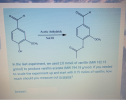 Acetic Anhydride NaOH OCHa OCH3 он In the last experiment, we used 2.0 mmol of vanillin (MW 152.15 g/mol) to produce vanillin acetate (MW 194.18 g/mol). If you needed to scale the experiment up and start with 0.75 moles of vanillin, how much should you measure out in grams? Answer
If the percent yield for the following reaction is 65.0%, how many grams of KClO3 are...
If the percent yield for the following reaction is 65.0%, how many grams of KClO3 are needed to produce 42.0 g of O2? 2 KClO3(s) → 2 KCl(s) + 3 O2(g)
 Could anyone please assign the peaks for the 1HNMR of
isopentyl acetate, and explain how you can use this
1HNMR spectrum to characterize the product of a reaction
between acetic acid and isopentyl alcohol? Thank you so much for
the help!
F1 (IH) SI= 65 536 SF= 300.19 SP 6103.516 ppm]
Could anyone please assign the peaks for the 1HNMR of
isopentyl acetate, and explain how you can use this
1HNMR spectrum to characterize the product of a reaction
between acetic acid and isopentyl alcohol? Thank you so much for
the help!
F1 (IH) SI= 65 536 SF= 300.19 SP 6103.516 ppm]
 Acetic Anhydride NaOH OCHa OCH3 он In the last experiment, we used 2.0 mmol of vanillin (MW 152.15 g/mol) to produce vanillin acetate (MW 194.18 g/mol). If you needed to scale the experiment up and start with 0.75 moles of vanillin, how much should you measure out in grams? Answer
Most questions answered within 3 hours.
-
Where is the error in this code sequence?
String s1 = "Hello";
String s2 = "ello";...
asked 10 months ago -
Financial data for Joel de Paris, Inc., for last year
follow:
Joel de Paris, Inc.
Balance...
asked 10 months ago -
Consider this reaction:
Al2(SO4)3 (aq)+ BaCl3
(aq) Al2Cl6 (aq)- +
3BaSO4(s) . What is the...
asked 10 months ago -
Suppose that Savneet is considering increasing her
recent random sample from 20 car rentals to 40...
asked 10 months ago -
Trucks arrive at an unloading terminal at an average rate of 120
per hour.
Trucks arrive...
asked 10 months ago -
Why are methanol and ethanol completely soluble in water while
octanol is not very little soluble....
asked 10 months ago -
A facilities manager at a university reads in a research report
that the mean amount of...
asked 10 months ago -
When the CuSO4 is rehydrated by adding water to the anhydrous
compound, is this an endothermic...
asked 10 months ago -
A ray of sunlight is passing from diamond into crown glass; the
angle of incidence is...
asked 10 months ago -
A block of mass 0.249 kg is placed on top of a light, vertical
spring of...
asked 10 months ago -
how do the kidneys compensate in the presences of acidosis
a) trigger hyperventilate
b) reserve acid...
asked 10 months ago -
Question 501 pts
The rental rate of capital to the firm increases. Which of the
following...
asked 10 months ago