What are the normal uses of condenser? What are the normal operating conditions, in terms of...
Homework Answers
- Condensers main application is to condense high T & P refrigerant vapor and removing heat.
- Condenser is used in refrigeration, air conditioning , distillation column & steam power plant etc.
- Condenser is used in every process where condensation is involved.
Operating conditions of condenser varies from process to process and as per different process fluids it deal with.
In case of refrigeration working temp can be vary from -30 to 35oC depending on working Pressure.
Load on the condenser is removed heat for converting vapour to condensate, it can be varying from 300 to 340 kW for 1.5 to 3 kg/s for water flow rate at 473K
- effect of fouling is different at condenser temperatures.
- reducing cooling fluid temp. can improve condenser performance.
Add Answer to:
What are the normal uses of condenser?
What are the normal operating conditions, in terms of...
Consider a condenser for a room air conditioner that uses R-22 as the refrigerant. This heat...
 Consider a condenser for a room air conditioner that uses R-22 as the refrigerant. This heat exchanger has total internal (refrigerant side) and external (air side) surface areas of 0.49 m2 and 10.33 m2 , respectively. Using a "lumped" analysis and neglecting refrigerant pressure drop, determine the heat transfer rate from the condenser and the exit air and refrigerant conditions for the following design conditions: a.) volumetric air flow of 0.50 m3 /s, b.) inlet air temperature of 30 C,...
please solve this question using excel sheet (refrigeration systems) Q1): It is required to design a condenser that will be suitable for a refrigeration system that uses refrigerant 22 as the wo...
 please solve this question using excel sheet (refrigeration
systems)
Q1): It is required to design a condenser that will be suitable for a refrigeration system that uses refrigerant 22 as the working fluid. The refrigeration system provides a refrigerating capacity of 50 kW for air conditioning purposes. At design conditions, the condensing temperature is 40°C while the evaporating temperature is 0°C. Cooling water enters the condenser at 25°C and leaves at 30°C. Design the condenser (calculate the required heat transfer...
please solve this question using excel sheet (refrigeration
systems)
Q1): It is required to design a condenser that will be suitable for a refrigeration system that uses refrigerant 22 as the working fluid. The refrigeration system provides a refrigerating capacity of 50 kW for air conditioning purposes. At design conditions, the condensing temperature is 40°C while the evaporating temperature is 0°C. Cooling water enters the condenser at 25°C and leaves at 30°C. Design the condenser (calculate the required heat transfer...
please provide excel sheet for the calculation too Q1): It is required to design a condenser that wl be suitable for a refrigeration system that uses refrigerant 22 as the working fluid. The refr...
 please provide excel sheet for the calculation too
Q1): It is required to design a condenser that wl be suitable for a refrigeration system that uses refrigerant 22 as the working fluid. The refrigeration system provides a refrigerating capacity of 50 kW for air conditioning purposes. At design conditions, the condensing temperature is 40°C while the evaporating temperature is 0°C. Cooling water enters the condenser at 25°C and leaves at 30°C. Design the condenser (calculate the required heat transfer area...
please provide excel sheet for the calculation too
Q1): It is required to design a condenser that wl be suitable for a refrigeration system that uses refrigerant 22 as the working fluid. The refrigeration system provides a refrigerating capacity of 50 kW for air conditioning purposes. At design conditions, the condensing temperature is 40°C while the evaporating temperature is 0°C. Cooling water enters the condenser at 25°C and leaves at 30°C. Design the condenser (calculate the required heat transfer area...
condenser operating conditions 40-2 MAINTENANCE OF WORKSTATION AND TOOLS: Replacr all pancls with proper fastener...
 condenser operating conditions 40-2
MAINTENANCE OF WORKSTATION AND TOOLS: Replacr all pancls with proper fasteners. Return alA ls te SUMMARY STATEMENT: Describe how the unit ssiction pressure and air temperature dtterences responded additional sheet of paper if more space is necessary for yoser answer 374 Lab 4o-1 places 6. List four things that can happen to reduce the QUESTIONS 1. How does a fixed-bore expansion device respond to a reduction in load, such as when the filter is restricted? airflow...
condenser operating conditions 40-2
MAINTENANCE OF WORKSTATION AND TOOLS: Replacr all pancls with proper fasteners. Return alA ls te SUMMARY STATEMENT: Describe how the unit ssiction pressure and air temperature dtterences responded additional sheet of paper if more space is necessary for yoser answer 374 Lab 4o-1 places 6. List four things that can happen to reduce the QUESTIONS 1. How does a fixed-bore expansion device respond to a reduction in load, such as when the filter is restricted? airflow...
Assume anything to solve the problem A single-effect thermal vapor-compression system is designed at the following operating conditions .Boiling temperature, of 75 °C Compression ratio, of 2.5...
 Assume anything to solve the problem
A single-effect thermal vapor-compression system is designed at the following operating conditions .Boiling temperature, of 75 °C Compression ratio, of 2.5 Motive steam pressure, of 750 kPa. .Brine reject concentration, of 70 000 ppm .Intake seawater salinity of 42 000 ppm .Intake seawater temperature, of 25 °C .System capacity, of 1 kg/s .Feed seawater temperature, of 70 °C Condenser efficiency, of 0.9. Consider the losses associated with the demister equal to 340 Pa/m Find:...
Assume anything to solve the problem
A single-effect thermal vapor-compression system is designed at the following operating conditions .Boiling temperature, of 75 °C Compression ratio, of 2.5 Motive steam pressure, of 750 kPa. .Brine reject concentration, of 70 000 ppm .Intake seawater salinity of 42 000 ppm .Intake seawater temperature, of 25 °C .System capacity, of 1 kg/s .Feed seawater temperature, of 70 °C Condenser efficiency, of 0.9. Consider the losses associated with the demister equal to 340 Pa/m Find:...
Discuss the mechanisms your body uses to maintain normal water and temperature balance. This answer should...
Discuss the mechanisms your body uses to maintain normal water and temperature balance. This answer should include the role of the blood, glands, hormones, organs, etc. Explain how temperature and humidity affect this.
Please help with HW 37 Qoutl condenser Condenser A standard 4-component vapor-compression cycle using R-134a is...
 Please help with HW 37
Qoutl condenser Condenser A standard 4-component vapor-compression cycle using R-134a is shown in the figure to the right. The cycle is used as a refrigeration cycle to cool a refrigerator at 5 °C with a cooling capacity of 200 W, with a heat transfer to a kitchen at 20 °C. Assume that the pressure drops in the evaporator and condenser are negligible, and that the compressor and expansion valve are adiabatic. Take the boundary temperature...
Please help with HW 37
Qoutl condenser Condenser A standard 4-component vapor-compression cycle using R-134a is shown in the figure to the right. The cycle is used as a refrigeration cycle to cool a refrigerator at 5 °C with a cooling capacity of 200 W, with a heat transfer to a kitchen at 20 °C. Assume that the pressure drops in the evaporator and condenser are negligible, and that the compressor and expansion valve are adiabatic. Take the boundary temperature...
A small power system was operating from 9AM to 10AM at the following approximated loadings conditions...
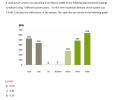 A small power system was operating from 9AM to 10AM at the following approximated loadings conditions using 7 different power plants. For this time maximum demand of the system was 1.9GW. Calculate the utility factor of the system. The capacities are shown in the following graph. 638 529 487 438 283 O 0 0 Coal Gas Oil Nuclear Hydro Wind Solar a) 0.80 b) 0.60 c) 0.40 d) 0.20
2. The exhaust steam from a power station turbine is condensed in a condenser operating at...
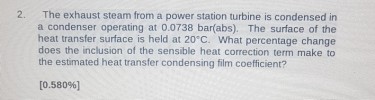 2. The exhaust steam from a power station turbine is condensed in a condenser operating at 0.0738 bar(abs). The surface of the heat transfer surface is held at 20°C. What percentage change does the inclusion of the sensible heat correction term make to the estimated heat transfer condensing film coefficient? [0.580%]
An ideal vapor-compression refrigeration cycle that uses refrigerant R-134a as its working fluid maintains a condenser...
 An ideal vapor-compression refrigeration cycle that uses refrigerant R-134a as its working fluid maintains a condenser at 800 kPa and the evaporator at -12C. (a) Determine this system's COP and the amount of power required to service a 150kW cooling load. (b) Determine the P,T, h, S and exergy of R-134a at all four states of the entire cycle. Assume the ambient temperature to be 25C.
 Consider a condenser for a room air conditioner that uses R-22 as the refrigerant. This heat exchanger has total internal (refrigerant side) and external (air side) surface areas of 0.49 m2 and 10.33 m2 , respectively. Using a "lumped" analysis and neglecting refrigerant pressure drop, determine the heat transfer rate from the condenser and the exit air and refrigerant conditions for the following design conditions: a.) volumetric air flow of 0.50 m3 /s, b.) inlet air temperature of 30 C,...
 please solve this question using excel sheet (refrigeration
systems)
Q1): It is required to design a condenser that will be suitable for a refrigeration system that uses refrigerant 22 as the working fluid. The refrigeration system provides a refrigerating capacity of 50 kW for air conditioning purposes. At design conditions, the condensing temperature is 40°C while the evaporating temperature is 0°C. Cooling water enters the condenser at 25°C and leaves at 30°C. Design the condenser (calculate the required heat transfer...
please solve this question using excel sheet (refrigeration
systems)
Q1): It is required to design a condenser that will be suitable for a refrigeration system that uses refrigerant 22 as the working fluid. The refrigeration system provides a refrigerating capacity of 50 kW for air conditioning purposes. At design conditions, the condensing temperature is 40°C while the evaporating temperature is 0°C. Cooling water enters the condenser at 25°C and leaves at 30°C. Design the condenser (calculate the required heat transfer...
 please provide excel sheet for the calculation too
Q1): It is required to design a condenser that wl be suitable for a refrigeration system that uses refrigerant 22 as the working fluid. The refrigeration system provides a refrigerating capacity of 50 kW for air conditioning purposes. At design conditions, the condensing temperature is 40°C while the evaporating temperature is 0°C. Cooling water enters the condenser at 25°C and leaves at 30°C. Design the condenser (calculate the required heat transfer area...
please provide excel sheet for the calculation too
Q1): It is required to design a condenser that wl be suitable for a refrigeration system that uses refrigerant 22 as the working fluid. The refrigeration system provides a refrigerating capacity of 50 kW for air conditioning purposes. At design conditions, the condensing temperature is 40°C while the evaporating temperature is 0°C. Cooling water enters the condenser at 25°C and leaves at 30°C. Design the condenser (calculate the required heat transfer area...
 condenser operating conditions 40-2
MAINTENANCE OF WORKSTATION AND TOOLS: Replacr all pancls with proper fasteners. Return alA ls te SUMMARY STATEMENT: Describe how the unit ssiction pressure and air temperature dtterences responded additional sheet of paper if more space is necessary for yoser answer 374 Lab 4o-1 places 6. List four things that can happen to reduce the QUESTIONS 1. How does a fixed-bore expansion device respond to a reduction in load, such as when the filter is restricted? airflow...
condenser operating conditions 40-2
MAINTENANCE OF WORKSTATION AND TOOLS: Replacr all pancls with proper fasteners. Return alA ls te SUMMARY STATEMENT: Describe how the unit ssiction pressure and air temperature dtterences responded additional sheet of paper if more space is necessary for yoser answer 374 Lab 4o-1 places 6. List four things that can happen to reduce the QUESTIONS 1. How does a fixed-bore expansion device respond to a reduction in load, such as when the filter is restricted? airflow...
 Assume anything to solve the problem
A single-effect thermal vapor-compression system is designed at the following operating conditions .Boiling temperature, of 75 °C Compression ratio, of 2.5 Motive steam pressure, of 750 kPa. .Brine reject concentration, of 70 000 ppm .Intake seawater salinity of 42 000 ppm .Intake seawater temperature, of 25 °C .System capacity, of 1 kg/s .Feed seawater temperature, of 70 °C Condenser efficiency, of 0.9. Consider the losses associated with the demister equal to 340 Pa/m Find:...
Assume anything to solve the problem
A single-effect thermal vapor-compression system is designed at the following operating conditions .Boiling temperature, of 75 °C Compression ratio, of 2.5 Motive steam pressure, of 750 kPa. .Brine reject concentration, of 70 000 ppm .Intake seawater salinity of 42 000 ppm .Intake seawater temperature, of 25 °C .System capacity, of 1 kg/s .Feed seawater temperature, of 70 °C Condenser efficiency, of 0.9. Consider the losses associated with the demister equal to 340 Pa/m Find:...
 Please help with HW 37
Qoutl condenser Condenser A standard 4-component vapor-compression cycle using R-134a is shown in the figure to the right. The cycle is used as a refrigeration cycle to cool a refrigerator at 5 °C with a cooling capacity of 200 W, with a heat transfer to a kitchen at 20 °C. Assume that the pressure drops in the evaporator and condenser are negligible, and that the compressor and expansion valve are adiabatic. Take the boundary temperature...
Please help with HW 37
Qoutl condenser Condenser A standard 4-component vapor-compression cycle using R-134a is shown in the figure to the right. The cycle is used as a refrigeration cycle to cool a refrigerator at 5 °C with a cooling capacity of 200 W, with a heat transfer to a kitchen at 20 °C. Assume that the pressure drops in the evaporator and condenser are negligible, and that the compressor and expansion valve are adiabatic. Take the boundary temperature...
 A small power system was operating from 9AM to 10AM at the following approximated loadings conditions using 7 different power plants. For this time maximum demand of the system was 1.9GW. Calculate the utility factor of the system. The capacities are shown in the following graph. 638 529 487 438 283 O 0 0 Coal Gas Oil Nuclear Hydro Wind Solar a) 0.80 b) 0.60 c) 0.40 d) 0.20
 2. The exhaust steam from a power station turbine is condensed in a condenser operating at 0.0738 bar(abs). The surface of the heat transfer surface is held at 20°C. What percentage change does the inclusion of the sensible heat correction term make to the estimated heat transfer condensing film coefficient? [0.580%]
 An ideal vapor-compression refrigeration cycle that uses refrigerant R-134a as its working fluid maintains a condenser at 800 kPa and the evaporator at -12C. (a) Determine this system's COP and the amount of power required to service a 150kW cooling load. (b) Determine the P,T, h, S and exergy of R-134a at all four states of the entire cycle. Assume the ambient temperature to be 25C.
Most questions answered within 3 hours.
-
Where is the error in this code sequence?
String s1 = "Hello";
String s2 = "ello";...
asked 11 months ago -
Financial data for Joel de Paris, Inc., for last year
follow:
Joel de Paris, Inc.
Balance...
asked 11 months ago -
Consider this reaction:
Al2(SO4)3 (aq)+ BaCl3
(aq) Al2Cl6 (aq)- +
3BaSO4(s) . What is the...
asked 11 months ago -
Suppose that Savneet is considering increasing her
recent random sample from 20 car rentals to 40...
asked 11 months ago -
Trucks arrive at an unloading terminal at an average rate of 120
per hour.
Trucks arrive...
asked 11 months ago -
Why are methanol and ethanol completely soluble in water while
octanol is not very little soluble....
asked 11 months ago -
A facilities manager at a university reads in a research report
that the mean amount of...
asked 11 months ago -
When the CuSO4 is rehydrated by adding water to the anhydrous
compound, is this an endothermic...
asked 11 months ago -
A ray of sunlight is passing from diamond into crown glass; the
angle of incidence is...
asked 11 months ago -
A block of mass 0.249 kg is placed on top of a light, vertical
spring of...
asked 11 months ago -
how do the kidneys compensate in the presences of acidosis
a) trigger hyperventilate
b) reserve acid...
asked 11 months ago -
Question 501 pts
The rental rate of capital to the firm increases. Which of the
following...
asked 11 months ago