38.)If the last worker employed ($10/hour) produces 50 additional units of output per hour and the...
38.)If the last worker employed ($10/hour) produces 50 additional units of output per hour and the last unit of capital employed ($500/hour) produces 2,500 units of output per hour, how can the firm minimize the cost of its current output?
a.)hire more labor and less capital
b.)hire more capital and less labor
c.)hire more labor and capital
d.)hire less labor and capital
e.)maintain current employment levels of labor and capital
39.)The least-cost hiring rule states that costs are minimized
when
a.)each input has an equivalent MP.
b.)a firm employs workers to the point where MRP = MRC.
c.)MP per dollar is equal for all inputs.
d.)VMP is maximized.
e.)MR = MC.
Homework Answers
38) e
MPl/w= 50/10= 5
MPk/r= 2500/500= 5
Since both ratios are equal cost is minimized
39) c
At cost minimization MP per dollar is equal for all inputs
Add Answer to:
38.)If the last worker employed ($10/hour) produces 50
additional units of output per hour and the...
A firm produces its output using only capital and labor.Labor costs $100 per worker per day...
A firm produces its output using only capital and labor.Labor costs $100 per worker per day and capital costs $200 per unit per day. If the marginal product of the last worker employed is 500 and the marginal product of the last unit of capital is 1,000, is the firm employing the cost-minimizing combination of inputs? Explain.
Assume labor and machines are used in the production of an output. The marginal product of the last worker h...
Assume labor and machines are used in the production of an output. The marginal product of the last worker hired was 175 units a day and the marginal product of the last machine employed was 850 units a day. The wage to hire a worker for a day is $100 while the cost to employ the machine for a day was $400. Assuming perfect competition what would you recommend the firm do to become more efficient?
58) If the last hour of labour, hired for $18, produces 8 units of output selling...
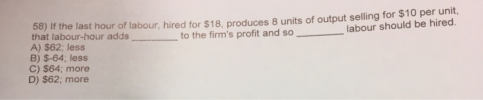 58) If the last hour of labour, hired for $18, produces 8 units of output selling for $10 per unit, that labour-hour adds A) $62; less B) $-64, less C) $64; more D) $62; more to the firm's profit and so SOlabour should be hired
VMP MRP Labor WageTP MP ATP 3 $6 200 AL MCL ATCL AL MP*P MP*MR $...
 VMP MRP Labor WageTP MP ATP 3 $6 200 AL MCL ATCL AL MP*P MP*MR $ $ 4 $7 260 60 $10 180 180 $ $ 5 $8 295 35 $105 12 105 $ $ $ 6 $9 315 20 14 60 60 $ $ 7 $10 326 $33 11 16 33 $ $ $ 8 $11 332 6 18 18 18 $ $ $ 9 $12 333 1 20 3 3 The table above shows the relationship between additional...
#3 3. The isoquant map for a firm that produces output with labor and capital is shown on the next page. The price...
 #3
3. The isoquant map for a firm that produces output with labor and capital is shown on the next page. The price of labor is $20 per unit and the price of capital is $60 per unit. a) Draw the isocost lines for expenditures of TC =$300 and TC -$360. b) How many units of labor and how many units of capital should the firm hire to minimize the cost of producing Q. units of output? EXPLAIN. c) What...
#3
3. The isoquant map for a firm that produces output with labor and capital is shown on the next page. The price of labor is $20 per unit and the price of capital is $60 per unit. a) Draw the isocost lines for expenditures of TC =$300 and TC -$360. b) How many units of labor and how many units of capital should the firm hire to minimize the cost of producing Q. units of output? EXPLAIN. c) What...
A seed merchant can hire additional labor at $7.50 per hour. Hiring five more hours of...
A seed merchant can hire additional labor at $7.50 per hour. Hiring five more hours of labor will increase output by ten units. If the final product sells for $3.50, should extra labor be hired? Explain.
A seed merchant can hire additional labor at $7.50 per hour. Hiring five more hours of...
A seed merchant can hire additional labor at $7.50 per hour. Hiring five more hours of labor will increase output by ten units. If the final product sells for $3.50, should extra labor be hired? Explain.
A firm employs labor and capital by paying $40 per unit of labor employed and $200...
A firm employs labor and capital by paying $40 per unit of labor employed and $200 per hour to rent a unit of capital. The production function is given by: Q = 60L – 2L2 + 180K – 3K2, where Q is total output. b. Determine the firm’s optimal combination of capital (K) and labor (L)? Hint: state the combination in the format L = Using your answer in b, if the firm is committed to spending $6,600 on capital...
A firm is unlikely to hire a worker if: A. the additional output a firms gets...
A firm is unlikely to hire a worker if: A. the additional output a firms gets by hiring the worker is greater than his or her wage. B. there are diminishing marginal returns to labor. C. the minimum wage set by law is less than the equilibrium wage in the market. D. the additional revenue generated by hiring the worker is less than his or her wage. In a competitive labor market, the equilibrium wage rate is determined by: A....
Question: A firm currently employs 40 production workers and 5 supervisors. The marginal product of the...
Question: A firm currently employs 40 production workers and 5 supervisors. The marginal product of the last production worker employed is 60 units of output per hour and production workers are paid $8 per hour. The marginal product of the last supervisor employed is 120 units of output per hour and supervisors are paid $20 per hour. Every employee works 40 hours per week. a) What is the firm's total labor cost per week? b) Assume that the firm's isoquants...
 58) If the last hour of labour, hired for $18, produces 8 units of output selling for $10 per unit, that labour-hour adds A) $62; less B) $-64, less C) $64; more D) $62; more to the firm's profit and so SOlabour should be hired
 VMP MRP Labor WageTP MP ATP 3 $6 200 AL MCL ATCL AL MP*P MP*MR $ $ 4 $7 260 60 $10 180 180 $ $ 5 $8 295 35 $105 12 105 $ $ $ 6 $9 315 20 14 60 60 $ $ 7 $10 326 $33 11 16 33 $ $ $ 8 $11 332 6 18 18 18 $ $ $ 9 $12 333 1 20 3 3 The table above shows the relationship between additional...
 #3
3. The isoquant map for a firm that produces output with labor and capital is shown on the next page. The price of labor is $20 per unit and the price of capital is $60 per unit. a) Draw the isocost lines for expenditures of TC =$300 and TC -$360. b) How many units of labor and how many units of capital should the firm hire to minimize the cost of producing Q. units of output? EXPLAIN. c) What...
#3
3. The isoquant map for a firm that produces output with labor and capital is shown on the next page. The price of labor is $20 per unit and the price of capital is $60 per unit. a) Draw the isocost lines for expenditures of TC =$300 and TC -$360. b) How many units of labor and how many units of capital should the firm hire to minimize the cost of producing Q. units of output? EXPLAIN. c) What...
Most questions answered within 3 hours.
-
Where is the error in this code sequence?
String s1 = "Hello";
String s2 = "ello";...
asked 11 months ago -
Financial data for Joel de Paris, Inc., for last year
follow:
Joel de Paris, Inc.
Balance...
asked 11 months ago -
Consider this reaction:
Al2(SO4)3 (aq)+ BaCl3
(aq) Al2Cl6 (aq)- +
3BaSO4(s) . What is the...
asked 11 months ago -
Suppose that Savneet is considering increasing her
recent random sample from 20 car rentals to 40...
asked 11 months ago -
Trucks arrive at an unloading terminal at an average rate of 120
per hour.
Trucks arrive...
asked 11 months ago -
Why are methanol and ethanol completely soluble in water while
octanol is not very little soluble....
asked 11 months ago -
A facilities manager at a university reads in a research report
that the mean amount of...
asked 11 months ago -
When the CuSO4 is rehydrated by adding water to the anhydrous
compound, is this an endothermic...
asked 11 months ago -
A ray of sunlight is passing from diamond into crown glass; the
angle of incidence is...
asked 11 months ago -
A block of mass 0.249 kg is placed on top of a light, vertical
spring of...
asked 11 months ago -
how do the kidneys compensate in the presences of acidosis
a) trigger hyperventilate
b) reserve acid...
asked 11 months ago -
Question 501 pts
The rental rate of capital to the firm increases. Which of the
following...
asked 11 months ago