6. What are Eurodollars? Is the Eurodollar market a large and active market?
6. What are Eurodollars? Is the Eurodollar market a large and active market?
Homework Answers
The term Eurodollar alludes to U.S.
dollar-designated stores at outside banks or at the abroad parts of
American banks. Since they are held outside the United States,
Eurodollars are not dependent upon guideline by the Federal Reserve
Board, including hold prerequisites. Dollar-named stores do not
expose to U.S. banking guidelines were initially held solely in
Europe, subsequently the name Eurodollar. They are likewise broadly
held in branches situated in the Bahamas as well as the Cayman
Islands.
The way that the Eurodollar market is generally free of guideline
means such stores can pay a higher premium. Their seaward area
makes them subject to political and financial hazard in the nation
of their habitation; be that as it may, most branches where the
stores are housed are in entirely stable areas.
The Eurodollar market is one of the world's essential universal
capital markets. They require an unfaltering stock of contributors
placing their cash into outside banks. These Eurodollar banks may
have issues with their liquidity if the stock of stores drops.
Add Answer to:
6. What are Eurodollars? Is the Eurodollar market a large and
active market?
Why might American businesses want to hold Eurodollars? OA. Eurodollar deposits are insured by the FDIC B. Minimum...
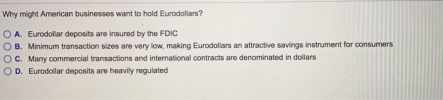 Why might American businesses want to hold Eurodollars? OA. Eurodollar deposits are insured by the FDIC B. Minimum transaction sizes are very low, making Eurodollars an attractive savings instrument for consum O C. Many commercial transactions and international contracts are denominated in dollars O D. Eurodollar deposits are heavily regulated ers
Why might American businesses want to hold Eurodollars? OA. Eurodollar deposits are insured by the FDIC B. Minimum transaction sizes are very low, making Eurodollars an attractive savings instrument...
Why might American businesses want to hold Eurodollars? OA. Eurodollar deposits are insured by the FDIC B. Minimum transaction sizes are very low, making Eurodollars an attractive savings instrument for consum O C. Many commercial transactions and international contracts are denominated in dollars O D. Eurodollar deposits are heavily regulated ers
Why might American businesses want to hold Eurodollars? OA. Eurodollar deposits are insured by the FDIC B. Minimum transaction sizes are very low, making Eurodollars an attractive savings instrument...
For commercial banks what is meant by managed liability? What role do liquid assets play on...
For commercial banks what is meant by managed liability? What role do liquid assets play on the balance sheet of commercial banks? What role do money market instruments play in the asset and liability management of large global banks? In other words, how do banks manage unexpected changes in loans or core deposits? What roles do large CD’s and Eurodollars play? Liquid assets? What has happened to the Eurodollar market during the recent turmoil?
Which of the following is not a money market instrument? O a. A eurodollar account. O...
 Which of the following is not a money market instrument? O a. A eurodollar account. O b. A negotiable certificate of deposit. O c. Commercial paper. O d. A Treasury bond. A coupon bond that pays interest of $60 annually has a par value of $1,000, matures in 5 years, and is selling today at $883.31. What is the yield to maturity for this bond? O a. 6%. b. 7%. C. 8%. d. 9%.
12. You wish to acquire a eurodollar interest rate option for LC $6 million in March...
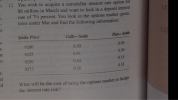 12. You wish to acquire a eurodollar interest rate option for LC $6 million in March and want to lock in a deposit interest rate of 7½ percent. You look in the options market quota. tions under Mar and find the following information: LC Strike Price 9200 9225 9250 9275 Calls-Settle 0.50 0.41 0.54 0.26 Puts -Sette 0.05 0.30 0.15 0.18 at 1- et of What will be the cost of using the options market to he the interest rate...
Firm C has the ability to issue fixed-rate bonds in the Eurodollar market at a rate of 9%. Howeve...
Firm C has the ability to issue fixed-rate bonds in the Eurodollar market at a rate of 9%. However, it has a strong preference for paying floating rate interest on their debt, which it could do directly at a rate of LIBOR + 0.25%. In contrast, Firm D has a harder time borrowing due their limp credit rating. It wishes to borrow longterm at a fixed rate, which it can do directly in the fixed-rate bond market at 11%. Alternatively,...
An investor uses 3-month Eurodollar futures contracts to lock in the rate of interest paid on a $...
An investor uses 3-month Eurodollar futures contracts to lock in the rate of interest paid on a $25 million floating rate note for the next nine months. Assume that Eurodollar futures contracts which mature in 3 months, 6 months and 9 months are traded. What should the investor do? Should the investor buy or sell contracts? How many contracts should the investor trade? Which maturities should the investor choose?
Which of the following financial assets is least likely to have an active secondary market? 5...
 Which of the following financial assets is least likely to have an active secondary market? 5 Multiple Choice 01:45.41 Bonds of a major, multinational corporation Common stock of a large public to Debt issued by the US Treasury Bank loans made to smaller firms
A corporate treasurer would like to use 3-month Eurodollar futures contracts to lock in the rate...
A corporate treasurer would like to use 3-month Eurodollar futures contracts to lock in the rate of interest paid by the corporation on a one-year $100 million floating rate note which will be issued in 3 months. Assume that Eurodollar futures contracts which mature in 3 months, 6 months, 9 months, and 12 months are traded. How many contracts should the treasurer trade? Which maturities should the treasurer choose?
Implied yield volatility for at-the-money Dec 20 Eurodollar options currently equals 40%. These options expire in...
 Implied yield volatility for at-the-money Dec 20 Eurodollar options currently equals 40%. These options expire in 300 days (12/14/20) and the current December futures price suggests that the market expects 3-month LIBOR to equal 1.40% on that date. Based on current implied volatility, (approximately) what is the likelihood that 3-month LIBOR will be above 1.90% on 12/14/20?
A 3-month Eurodollar futures contract starts with a price of 97.72 and by the time it...
A 3-month Eurodollar futures contract starts with a price of 97.72 and by the time it is sold it is priced at 98.56. If three contracts are shorted, what is the overall gain or loss?
 Why might American businesses want to hold Eurodollars? OA. Eurodollar deposits are insured by the FDIC B. Minimum transaction sizes are very low, making Eurodollars an attractive savings instrument for consum O C. Many commercial transactions and international contracts are denominated in dollars O D. Eurodollar deposits are heavily regulated ers
Why might American businesses want to hold Eurodollars? OA. Eurodollar deposits are insured by the FDIC B. Minimum transaction sizes are very low, making Eurodollars an attractive savings instrument...
Why might American businesses want to hold Eurodollars? OA. Eurodollar deposits are insured by the FDIC B. Minimum transaction sizes are very low, making Eurodollars an attractive savings instrument for consum O C. Many commercial transactions and international contracts are denominated in dollars O D. Eurodollar deposits are heavily regulated ers
Why might American businesses want to hold Eurodollars? OA. Eurodollar deposits are insured by the FDIC B. Minimum transaction sizes are very low, making Eurodollars an attractive savings instrument...
 Which of the following is not a money market instrument? O a. A eurodollar account. O b. A negotiable certificate of deposit. O c. Commercial paper. O d. A Treasury bond. A coupon bond that pays interest of $60 annually has a par value of $1,000, matures in 5 years, and is selling today at $883.31. What is the yield to maturity for this bond? O a. 6%. b. 7%. C. 8%. d. 9%.
 12. You wish to acquire a eurodollar interest rate option for LC $6 million in March and want to lock in a deposit interest rate of 7½ percent. You look in the options market quota. tions under Mar and find the following information: LC Strike Price 9200 9225 9250 9275 Calls-Settle 0.50 0.41 0.54 0.26 Puts -Sette 0.05 0.30 0.15 0.18 at 1- et of What will be the cost of using the options market to he the interest rate...
 Which of the following financial assets is least likely to have an active secondary market? 5 Multiple Choice 01:45.41 Bonds of a major, multinational corporation Common stock of a large public to Debt issued by the US Treasury Bank loans made to smaller firms
 Implied yield volatility for at-the-money Dec 20 Eurodollar options currently equals 40%. These options expire in 300 days (12/14/20) and the current December futures price suggests that the market expects 3-month LIBOR to equal 1.40% on that date. Based on current implied volatility, (approximately) what is the likelihood that 3-month LIBOR will be above 1.90% on 12/14/20?
Most questions answered within 3 hours.
-
Where is the error in this code sequence?
String s1 = "Hello";
String s2 = "ello";...
asked 11 months ago -
Financial data for Joel de Paris, Inc., for last year
follow:
Joel de Paris, Inc.
Balance...
asked 11 months ago -
Consider this reaction:
Al2(SO4)3 (aq)+ BaCl3
(aq) Al2Cl6 (aq)- +
3BaSO4(s) . What is the...
asked 11 months ago -
Suppose that Savneet is considering increasing her
recent random sample from 20 car rentals to 40...
asked 11 months ago -
Trucks arrive at an unloading terminal at an average rate of 120
per hour.
Trucks arrive...
asked 11 months ago -
Why are methanol and ethanol completely soluble in water while
octanol is not very little soluble....
asked 11 months ago -
A facilities manager at a university reads in a research report
that the mean amount of...
asked 11 months ago -
When the CuSO4 is rehydrated by adding water to the anhydrous
compound, is this an endothermic...
asked 11 months ago -
A ray of sunlight is passing from diamond into crown glass; the
angle of incidence is...
asked 11 months ago -
A block of mass 0.249 kg is placed on top of a light, vertical
spring of...
asked 11 months ago -
how do the kidneys compensate in the presences of acidosis
a) trigger hyperventilate
b) reserve acid...
asked 11 months ago -
Question 501 pts
The rental rate of capital to the firm increases. Which of the
following...
asked 11 months ago