explain the difference between mutating a value and rebinding a variable and give an example of...
explain the difference between mutating a value and rebinding a variable and give an example of code that might trip up someone who doesn't get the difference, and explain why it might trip them up.
Homework Answers
Answer:
Mutating a value and Rebinding a variable are two important concepts and if not used correctly can create logical errors.
In Python, a variable is called a name.
Let's first understand binding & rebinding:
x = 1
(Here value 1 is bound to name x)
y = 2
(Here value 2 is bound to name y)
z = x
(Here the value of x is bound to name z, means 1 is bound to z)
Note: Python didn’t create or copy the object 1, it only assigned a new name for that value/object. So both x and z are bound to the object 1.
Let's see State:
x ---> 1 <--- z
y ---> 2
what if, we do x = y
This will not create any new value/object this will only rebind
name x with the value of y.
New State,
1 <--- z
y ---> 2 <--- x
So, this was binding and rebinding.
Now, Let's understand Mutating
Let,
a = [1, 2]
This will bind object [1, 2] with name 1
Now,
b = a
This will similar to the previous case will bind object [1, 2] with
name b
So State,
a ---> [1, 2] <--- b
Now both names are pointing to the same value, what if we append new data
a.append(3)
We not creating any new value and only changing the existing
value.
This will change value/object and both names a and b are pointing
to the same object to so they will show newly updated results
State:
a ---> [1, 2, 3] <--- b
if we print b, it will show [1, 2, 3]
And who doesn't understand the difference will think that b is still [1, 2], And will use accordingly and create errors.
If we wanted to a to be [1, 2, 3] and b to be [1, 2] then instead of appending or mutating we could have rebound a with a new object, like
a = [1, 2, 3]
Then States would have
[1, 2] <--- b
a ---> [1, 2, 3]
Code: (Text file also included in End)
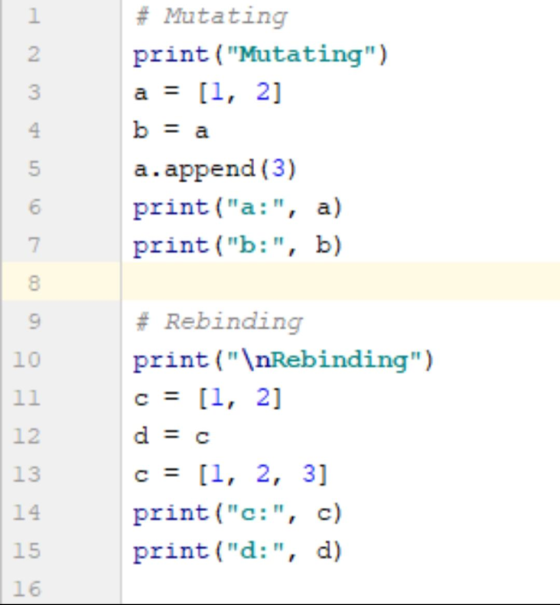
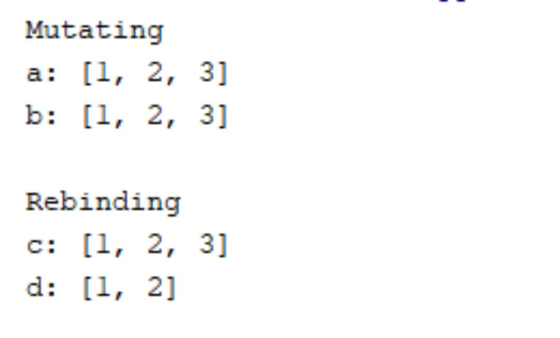
Code:
# Mutating
print("Mutating")
a = [1, 2]
b = a
a.append(3)
print("a:", a)
print("b:", b)
# Rebinding
print("\nRebinding")
c = [1, 2]
d = c
c = [1, 2, 3]
print("c:", c)
print("d:", d)
PLEASE UPVOTE.THANKYOU...!!
Add Answer to:
explain the difference between mutating a value and rebinding a
variable and give an example of...
Explain the difference between fixed and variable costs. Give an example of a cost that varies...
Explain the difference between fixed and variable costs. Give an example of a cost that varies with the number of miles you drive your car each week and an example of a cost that is fixed regardless of how many miles you drive your car each week.
5. Explain the difference between a Nash equilibrium and a dominant strategies equilibrium. Give an example...
 5. Explain the difference between a Nash equilibrium and a dominant strategies equilibrium. Give an example to show how the prisoners' dilemma helps to explain behaviour. 6. Why might a firm set prices based on a markup above average cost rather than equalising marginal costs and marginal benefits? 7. Using a diagram, explain how an external cost of production (i.e. a negative production externality) can be internalised with a tax. |8. Explain the conditions of price discrimination. Give two examples...
Explain the difference between proof by contradiction and proof by contraposition. Give an example of a...
Explain the difference between proof by contradiction and proof by contraposition. Give an example of a theorem that would lend itself to proof by contradiction. Explain why that proof technique would be a good choice in this case.
Discuss the difference between an "instance member variable" and a "static member variable" Give an example...
Discuss the difference between an "instance member variable" and a "static member variable" Give an example to support your answer.
Explain the difference between the terms factors and treatments. Give an example.
Explain the difference between the terms factors and treatments. Give an example.
Explain the difference between variable cost, fixed cost and mixed cost. What causes changes in these...
 Explain the difference between variable cost, fixed cost and mixed cost. What causes changes in these costs? What makes them increase or decrease? Give three examples of each and explain how each example meets the criteria of fixed, variable and mixed.
Explain the difference between enantiomers and diastereomers. Give one example of each.
Explain the difference between enantiomers and diastereomers. Give one example of each.
What is the difference between Private, Public, Community, and Hybrid Clouds. Give a practical example of...
What is the difference between Private, Public, Community, and Hybrid Clouds. Give a practical example of each. Be able to explain trunking and how it relates to VLAN communication Know how VLANs work, and why we use them in modern computer networks
What is the difference between simple linear and multiple regressions? Give an example of a situation...
What is the difference between simple linear and multiple regressions? Give an example of a situation where linear regression might be useful Give an example of a situation where multiple regression might be useful.
Explain the difference between fixed and variable costs and give two examples of each. Can a...
Explain the difference between fixed and variable costs and give two examples of each. Can a company budget for variable costs? Explain.
 5. Explain the difference between a Nash equilibrium and a dominant strategies equilibrium. Give an example to show how the prisoners' dilemma helps to explain behaviour. 6. Why might a firm set prices based on a markup above average cost rather than equalising marginal costs and marginal benefits? 7. Using a diagram, explain how an external cost of production (i.e. a negative production externality) can be internalised with a tax. |8. Explain the conditions of price discrimination. Give two examples...
 Explain the difference between variable cost, fixed cost and mixed cost. What causes changes in these costs? What makes them increase or decrease? Give three examples of each and explain how each example meets the criteria of fixed, variable and mixed.
Most questions answered within 3 hours.
-
Where is the error in this code sequence?
String s1 = "Hello";
String s2 = "ello";...
asked 11 months ago -
Financial data for Joel de Paris, Inc., for last year
follow:
Joel de Paris, Inc.
Balance...
asked 11 months ago -
Consider this reaction:
Al2(SO4)3 (aq)+ BaCl3
(aq) Al2Cl6 (aq)- +
3BaSO4(s) . What is the...
asked 11 months ago -
Suppose that Savneet is considering increasing her
recent random sample from 20 car rentals to 40...
asked 11 months ago -
Trucks arrive at an unloading terminal at an average rate of 120
per hour.
Trucks arrive...
asked 11 months ago -
Why are methanol and ethanol completely soluble in water while
octanol is not very little soluble....
asked 11 months ago -
A facilities manager at a university reads in a research report
that the mean amount of...
asked 11 months ago -
When the CuSO4 is rehydrated by adding water to the anhydrous
compound, is this an endothermic...
asked 11 months ago -
A ray of sunlight is passing from diamond into crown glass; the
angle of incidence is...
asked 11 months ago -
A block of mass 0.249 kg is placed on top of a light, vertical
spring of...
asked 11 months ago -
how do the kidneys compensate in the presences of acidosis
a) trigger hyperventilate
b) reserve acid...
asked 11 months ago -
Question 501 pts
The rental rate of capital to the firm increases. Which of the
following...
asked 11 months ago