Paraphase this Introduction to Multimeters: Multimeters have the purpose and ability to measure a plethora of...
Paraphase this
Introduction to Multimeters:
Multimeters have the purpose and ability to measure a plethora of electrical quantities. In this lab specifically DC Voltage, AC RMS (Root-Mean-Squared) voltage, DC current, and resistance will be measured using a multimeter. When taking RMS readings, a great deal of care must be taken because of the fact that different multimeters perform at different levels and produce differently temporal averages. The way a good deal of multimeters measure the RMS voltage is measure the peak to peak voltage and then make an educated guess on what the RMS actually is. If for example the signal inputted is sinusoidal at one frequency, the RMS voltage can be calculated by said measurement. It is also interesting to note that the RMS measurements of current can be treated in the same way. It is clear to see that only when input signals reflect these assumptions that this type of multimeter can indeed be used. In the case of other multimeters, they measure what is known as “True RMS” voltage. This is measured by detecting how much heat a resistor dissipates over time in which a voltage is applied. These meters specifically are used to measure any signal’s RMS voltage including multi-frequency signals. In addition to this method, the RMS value can be found by sampling a particular signal and applying an equation that defines the RMS voltage for a discreet signal:
Making a voltage measurement with a multimeter:
In order to measure the voltage across a certain electrical component (resistor, etc) it must be connected in parallel with the multimeter. In order for an accurate reading to take place, the impedance that is inputted must be several magnitudes larger than that of the resistor where the measurement is made.
Making current measurements with a multimeter:
For current measurements, the multimeter must be placed in series instead of parallel with the circuit.
Homework Answers
The given paragraph explains the usage of a multimeter. A Multimeter is a device that can measure much quantity such as AC and DC voltage, Currents, frequency, continuity, etc.
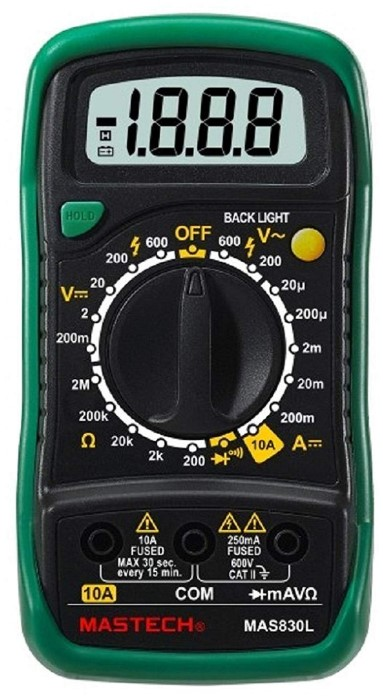
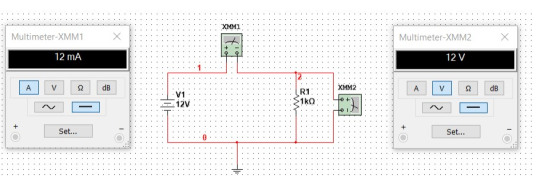
When an AC voltage is measured by a multimeter the value shown by multimeter is RMS value. Voltage measurement must be done in parallel with the component whose voltage is to be measured.
When the current measurement is done by the Multimeter, it should be connected in series to the component whose current is to be measured.
Voltage and current measurement is shown in the circuit diagram below
Please Thumbs Up
Add Answer to:
Paraphase this
Introduction to Multimeters:
Multimeters have the purpose and ability to measure a plethora
of...
3) (+3) Do the following in Multisim and verify the results with calculations (see equations 1.7-...
 Use NI Multisim
3) (+3) Do the following in Multisim and verify the results with calculations (see equations 1.7-1.9). Use the function generator to create the 120 Vrms signal as you would see in the classroom wall outlet. Connect it to a resistor (the value of the resistor is your choice, but must have two decimal places) and measure the RMS voltage across the resistor and current through the resistor with separate Multimeters. Calculate the RMS voltage and current and...
Use NI Multisim
3) (+3) Do the following in Multisim and verify the results with calculations (see equations 1.7-1.9). Use the function generator to create the 120 Vrms signal as you would see in the classroom wall outlet. Connect it to a resistor (the value of the resistor is your choice, but must have two decimal places) and measure the RMS voltage across the resistor and current through the resistor with separate Multimeters. Calculate the RMS voltage and current and...
One of the most important classes of time dependent signals are periodic signals. Periodic signals satisfy tho following signal equations, x(t) X(t) x(t+nt) for n 2,3. The periodic signals to b...
 One of the most important classes of time dependent signals are periodic signals. Periodic signals satisfy tho following signal equations, x(t) X(t) x(t+nt) for n 2,3. The periodic signals to be observed in this laboratory assignment are shown below. In all the examples A represents the amplitude of the signal and may be given as the measurement from 0 to the peak value A, Apk or can be given as the measurement between A and -A which defines a peak-to-peak...
Q1. You are given a 12 V DC power supply. You are expected to develop a voltage divider to achieve a voltage of no...
 Q1. You are given a 12 V DC power supply. You are expected to develop a voltage divider to achieve a voltage of nominal 5V value using a pair of resistors from the E 12 range, with the restrition that you are not expected to draw a current of more than 1 mA from the 12 V DC supply i. Develop a simple circuit showing the possible values for each resistor pair, and the range of the DC output possible...
Exercise #4 Voltage Divider A. Introduction In a previous exercise, you learned about the current-voltage relationship...
 Exercise #4 Voltage Divider A. Introduction In a previous exercise, you learned about the current-voltage relationship in a single resistor. Now, you will about how voltage is divided across two resistors in series. In this exercise you will: Examine the operation of the electric circuit known as the voltape divicder At the conclusion of this exercise you should be able to Compute the valtage across a resistor in a voltage divider circuit Design a voltage divider circuit to produce a...
I am working on my Physics lab report where it was all about Direct Current Measurement...
I am working on my Physics lab report where it was all about Direct Current Measurement and Ohm’s Law. We had 5 different resistors and had to construct different circuits using a power supply, volt-ohm-milliammeter (VOM) and a digital multimeter to get measurements of resistance, voltage, and current. Nominal values of resistance and tolerance Resistor Nominal Resistance (Ohms) Tolerance (Ohms) R1 680 +/- 68 R2 1000 +/- 50 R3 1500 +/- 75 R4 4700 +/- 470 R5 10,000 +/- 500...
Pease answer questions 4 and 5! Thank you so much! 4. Connect the 2nd resistor in...
 Pease answer questions 4 and 5! Thank you so much!
4. Connect the 2nd resistor in parallel with the 1st
resistor and connect that combination to the battery.
Measure
the following:
The
current passing through the R1, I1 = ___0.0058____ A
The
current passing through the R2, I2 = ___0.0031____ A
The
current supplied by the battery, I = ___0.0092____ A
Calculate I1 + I2 = ____________ A
Is the following statement true? I = I1 +...
Pease answer questions 4 and 5! Thank you so much!
4. Connect the 2nd resistor in parallel with the 1st
resistor and connect that combination to the battery.
Measure
the following:
The
current passing through the R1, I1 = ___0.0058____ A
The
current passing through the R2, I2 = ___0.0031____ A
The
current supplied by the battery, I = ___0.0092____ A
Calculate I1 + I2 = ____________ A
Is the following statement true? I = I1 +...
ENGT 3050
 EXERCISE NO. 3POWER IN DC CIRCUITSObjectives: The objectives of this exercise are to show how resistor power dissipation is related to voltage, current and resistance in a DC circuit.Procedure: ⦁ Connect the circuit shown in Figure 1 using two 1 kΩ resistors in series. The portable multimeter can be used for the voltmeter. The DMM, used as an ammeter, must be connected in series between the power supply and the resistors.Beginning at 0.0 volts, increase the voltage across the resistors in...
Fall 2019 ECEN 206 Lab 4 Thevenin Equivalent Circuits Due First week of November Introduction: This...
 Fall 2019 ECEN 206 Lab 4 Thevenin Equivalent Circuits Due First week of November Introduction: This lab focuses on the Thevenin equivalent circuit and maximum power transfer theorems Complex circuits are often replaced with their Thevenin equivalent to simplify analysis. For example, in the analysis of large industrial power systems the Thevenin equivalent is used in short circuit studies. Maximum power transfer is also an important concept which allows the designer to determine an optimal design when power is a...
02 +Vo D3 Rgare 18 Circuit for Problem 1 Analysis 1. Copy the circuit of Figure 1.8 and sketch the ow of pesitive curment throughout the entire circuit for o>0. Repeat for n ce 2....
 02 +Vo D3 Rgare 18 Circuit for Problem 1 Analysis 1. Copy the circuit of Figure 1.8 and sketch the ow of pesitive curment throughout the entire circuit for o>0. Repeat for n ce 2. Plot two periods of nlt) and s) for each of the thee input wave shown in Figune 17 on page 37 fom output t (a) Feak value, and b) Eflective DC value, also known as RMS value NotTE These and are therefore optional 4. Determine...
Course and Section cto EXPERIMENT ac series-Parallel Sinusoidal Circuits OBJECTIVES 1. Measure th...
 Course and Section cto EXPERIMENT ac series-Parallel Sinusoidal Circuits OBJECTIVES 1. Measure the currents of series-parallel R-L and R-C networks using sensing resistors 2. Demonstrate the Pythagorean relationship between the currents of the networks. 3. Measure the phase angles associated with the currents of the networks. 4. Calculate the input impedance of a parallel network using measured values EQUIPMENT REQUIRED Instruments Resistors 1-10-Q, 470-Ω, l-kM (14.W) Inductors 1-10-mH Capacitors 1-0.02-pF I-DMM 1--Oscilloscope 1-Audio oscillator or function generator 1--Frequency counter (if...
 Use NI Multisim
3) (+3) Do the following in Multisim and verify the results with calculations (see equations 1.7-1.9). Use the function generator to create the 120 Vrms signal as you would see in the classroom wall outlet. Connect it to a resistor (the value of the resistor is your choice, but must have two decimal places) and measure the RMS voltage across the resistor and current through the resistor with separate Multimeters. Calculate the RMS voltage and current and...
Use NI Multisim
3) (+3) Do the following in Multisim and verify the results with calculations (see equations 1.7-1.9). Use the function generator to create the 120 Vrms signal as you would see in the classroom wall outlet. Connect it to a resistor (the value of the resistor is your choice, but must have two decimal places) and measure the RMS voltage across the resistor and current through the resistor with separate Multimeters. Calculate the RMS voltage and current and...
 One of the most important classes of time dependent signals are periodic signals. Periodic signals satisfy tho following signal equations, x(t) X(t) x(t+nt) for n 2,3. The periodic signals to be observed in this laboratory assignment are shown below. In all the examples A represents the amplitude of the signal and may be given as the measurement from 0 to the peak value A, Apk or can be given as the measurement between A and -A which defines a peak-to-peak...
 Q1. You are given a 12 V DC power supply. You are expected to develop a voltage divider to achieve a voltage of nominal 5V value using a pair of resistors from the E 12 range, with the restrition that you are not expected to draw a current of more than 1 mA from the 12 V DC supply i. Develop a simple circuit showing the possible values for each resistor pair, and the range of the DC output possible...
 Exercise #4 Voltage Divider A. Introduction In a previous exercise, you learned about the current-voltage relationship in a single resistor. Now, you will about how voltage is divided across two resistors in series. In this exercise you will: Examine the operation of the electric circuit known as the voltape divicder At the conclusion of this exercise you should be able to Compute the valtage across a resistor in a voltage divider circuit Design a voltage divider circuit to produce a...
 Pease answer questions 4 and 5! Thank you so much!
4. Connect the 2nd resistor in parallel with the 1st
resistor and connect that combination to the battery.
Measure
the following:
The
current passing through the R1, I1 = ___0.0058____ A
The
current passing through the R2, I2 = ___0.0031____ A
The
current supplied by the battery, I = ___0.0092____ A
Calculate I1 + I2 = ____________ A
Is the following statement true? I = I1 +...
Pease answer questions 4 and 5! Thank you so much!
4. Connect the 2nd resistor in parallel with the 1st
resistor and connect that combination to the battery.
Measure
the following:
The
current passing through the R1, I1 = ___0.0058____ A
The
current passing through the R2, I2 = ___0.0031____ A
The
current supplied by the battery, I = ___0.0092____ A
Calculate I1 + I2 = ____________ A
Is the following statement true? I = I1 +...
 Fall 2019 ECEN 206 Lab 4 Thevenin Equivalent Circuits Due First week of November Introduction: This lab focuses on the Thevenin equivalent circuit and maximum power transfer theorems Complex circuits are often replaced with their Thevenin equivalent to simplify analysis. For example, in the analysis of large industrial power systems the Thevenin equivalent is used in short circuit studies. Maximum power transfer is also an important concept which allows the designer to determine an optimal design when power is a...
 02 +Vo D3 Rgare 18 Circuit for Problem 1 Analysis 1. Copy the circuit of Figure 1.8 and sketch the ow of pesitive curment throughout the entire circuit for o>0. Repeat for n ce 2. Plot two periods of nlt) and s) for each of the thee input wave shown in Figune 17 on page 37 fom output t (a) Feak value, and b) Eflective DC value, also known as RMS value NotTE These and are therefore optional 4. Determine...
 Course and Section cto EXPERIMENT ac series-Parallel Sinusoidal Circuits OBJECTIVES 1. Measure the currents of series-parallel R-L and R-C networks using sensing resistors 2. Demonstrate the Pythagorean relationship between the currents of the networks. 3. Measure the phase angles associated with the currents of the networks. 4. Calculate the input impedance of a parallel network using measured values EQUIPMENT REQUIRED Instruments Resistors 1-10-Q, 470-Ω, l-kM (14.W) Inductors 1-10-mH Capacitors 1-0.02-pF I-DMM 1--Oscilloscope 1-Audio oscillator or function generator 1--Frequency counter (if...
Most questions answered within 3 hours.
-
Where is the error in this code sequence?
String s1 = "Hello";
String s2 = "ello";...
asked 10 months ago -
Financial data for Joel de Paris, Inc., for last year
follow:
Joel de Paris, Inc.
Balance...
asked 10 months ago -
Consider this reaction:
Al2(SO4)3 (aq)+ BaCl3
(aq) Al2Cl6 (aq)- +
3BaSO4(s) . What is the...
asked 10 months ago -
Suppose that Savneet is considering increasing her
recent random sample from 20 car rentals to 40...
asked 10 months ago -
Trucks arrive at an unloading terminal at an average rate of 120
per hour.
Trucks arrive...
asked 10 months ago -
Why are methanol and ethanol completely soluble in water while
octanol is not very little soluble....
asked 10 months ago -
A facilities manager at a university reads in a research report
that the mean amount of...
asked 10 months ago -
When the CuSO4 is rehydrated by adding water to the anhydrous
compound, is this an endothermic...
asked 10 months ago -
A ray of sunlight is passing from diamond into crown glass; the
angle of incidence is...
asked 10 months ago -
A block of mass 0.249 kg is placed on top of a light, vertical
spring of...
asked 10 months ago -
how do the kidneys compensate in the presences of acidosis
a) trigger hyperventilate
b) reserve acid...
asked 10 months ago -
Question 501 pts
The rental rate of capital to the firm increases. Which of the
following...
asked 10 months ago