A 0.040-kg ice cube at -10°C is placed in an insulated box that contains a fixed...
A 0.040-kg ice cube at -10°C is placed in an insulated box that contains a fixed quantity of steam at 100°C. When thermal equilibrium of this closed system is established, its temperature is found to be 23 °C. Determine the original mass of the steam at 100 °C.
Homework Answers

Add Answer to:
A 0.040-kg ice cube at -10°C is placed in an insulated box that
contains a fixed...
(15 points) An ice cube of mass 0.0340 kg and temperature -10.00 °C is placed in...
 (15 points) An ice cube of mass 0.0340 kg and temperature -10.00 °C is placed in the steam room at a gym. The steam room, which is quite large, is filled with 2.000 kg of steam at a temperature of 110.0 °C (a) (5 points) How much ice is present, and at what temperature, when the ice and steam reach thermal equilibrium? Your answer should be two numbers (b) (5 points) How much water is present, and at what temperature,...
A 0.6630-kg ice cube at -12.40°C is placed inside a chamber of steam at 365.0°C. Later,...
A 0.6630-kg ice cube at -12.40°C is placed inside a chamber of steam at 365.0°C. Later, you notice that the ice cube has completely melted into a puddle of water. If the chamber initially contained 6.550 moles of steam (water) molecules before the ice is added, calculate the final temperature of the puddle once it settled to equilibrium. (Assume the chamber walls are sufficiently flexible to allow the system to remain isobaric and consider thermal losses/gains from the chamber walls...
A 0.6630-kg ice cube at -12.40°C is placed inside a chamber of steam at 365.0°C. Later,...
A 0.6630-kg ice cube at -12.40°C is placed inside a chamber of steam at 365.0°C. Later, you notice that the ice cube has completely melted into a puddle of water. If the chamber initially contained 5.950 moles of steam (water) molecules before the ice is added, calculate the final temperature of the puddle once it settled to equilibrium. (Assume the chamber walls are sufficiently flexible to allow the system to remain isobaric and consider thermal losses/gains from the chamber walls...
A 0.6630-kg ice cube at-12.40℃ is placed inside a chamber of steam at 365 0°C Later,...
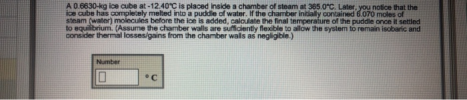 A 0.6630-kg ice cube at-12.40℃ is placed inside a chamber of steam at 365 0°C Later, you notice that the ice cube has completely melted into a puddle of water. If the chamber initially contained 6.070 moles of steam (water) molecules before the ice is added, caloulate the final temperature of the puddle once it settled to equilibrium. (Assume the chamber walls are sufficiently flexible to allow the system to remain isobaric and consider thermal losses/gains from the chamber walls...
You drop an ice cube into an insulated container full of water and wait for the...
You drop an ice cube into an insulated container full of water and wait for the ice cube to completely melt. The ice cube initially has a mass of 80.0 g and a temperature of 0°C. The water (before the ice cube is added) has a mass of 660 g and an initial temperature of 20.0°C. What is the final temperature (in °C) of the mixture? (Assume no energy is lost to the walls of the container, or to the...
A 0.0575 kg ice cube at −30.0°C is placed in 0.617 kg of 35.0°C water in...
A 0.0575 kg ice cube at −30.0°C is placed in 0.617 kg of 35.0°C water in a very well insulated container, like the kind we used in class. The heat of fusion of water is 3.33 x 10⁵ J/kg, the specific heat of ice is 2090 J/(kg · K), and the specific heat of water is 4190 J/(kg · K). The system comes to equilibrium after all of the ice has melted. What is the final temperature of the system?
A 0.0725 kg ice cube at −30.0°C is placed in 0.497 kg of 35.0°C water in...
A 0.0725 kg ice cube at −30.0°C is placed in 0.497 kg of 35.0°C water in a very well insulated container, like the kind we used in class. The heat of fusion of water is 3.33 x 10⁵ J/kg, the specific heat of ice is 2090 J/(kg · K), and the specific heat of water is 4190 J/(kg · K). The system comes to equilibrium after all of the ice has melted. What is the final temperature of the system?
A well-insulated bucket of negligible heat capacity contains 169 g of ice at 0°C. (a) If...
A well-insulated bucket of negligible heat capacity contains 169 g of ice at 0°C. (a) If 21 g of steam at 100°C is injected into the bucket, what is the final equilibrium temperature of the system? (b) What mass of ice remains?
A 0.6850-kg ice cube at-12.40°C is placed inside a chamber of steam at 365.0℃. Later, you...
 A 0.6850-kg ice cube at-12.40°C is placed inside a chamber of steam at 365.0℃. Later, you notice that the ice cube has completely melted into a puddle of water. If the chamber initially contained 6.670 moles of steam (water) molecules before the ice is added, calculate the final temperature of the puddle once it settled to eqilibrium. (Assume the chamber walls aresufficiently flexible to allow the system to remain isobaric and consider thermal losses/gains from the chamber walls as negligible.)...
A 39 g ice cube at -69°C is placed in a lake whose temperature is 65°C....
 A 39 g ice cube at -69°C is placed in a lake whose temperature is 65°C. Calculate the change in entropy of the cube-lake system as the ice cube comes to thermal equilibrium with the lake. The specific heat of ice is 2220 J/kg-K. (Hint: Will the ice cube affect the temperature of the lake?) Numbe UnitšT J/k the tolerance is +/-2% Click if you would like to Show Work for this question: Open Show Work
 (15 points) An ice cube of mass 0.0340 kg and temperature -10.00 °C is placed in the steam room at a gym. The steam room, which is quite large, is filled with 2.000 kg of steam at a temperature of 110.0 °C (a) (5 points) How much ice is present, and at what temperature, when the ice and steam reach thermal equilibrium? Your answer should be two numbers (b) (5 points) How much water is present, and at what temperature,...
 A 0.6630-kg ice cube at-12.40℃ is placed inside a chamber of steam at 365 0°C Later, you notice that the ice cube has completely melted into a puddle of water. If the chamber initially contained 6.070 moles of steam (water) molecules before the ice is added, caloulate the final temperature of the puddle once it settled to equilibrium. (Assume the chamber walls are sufficiently flexible to allow the system to remain isobaric and consider thermal losses/gains from the chamber walls...
 A 0.6850-kg ice cube at-12.40°C is placed inside a chamber of steam at 365.0℃. Later, you notice that the ice cube has completely melted into a puddle of water. If the chamber initially contained 6.670 moles of steam (water) molecules before the ice is added, calculate the final temperature of the puddle once it settled to eqilibrium. (Assume the chamber walls aresufficiently flexible to allow the system to remain isobaric and consider thermal losses/gains from the chamber walls as negligible.)...
 A 39 g ice cube at -69°C is placed in a lake whose temperature is 65°C. Calculate the change in entropy of the cube-lake system as the ice cube comes to thermal equilibrium with the lake. The specific heat of ice is 2220 J/kg-K. (Hint: Will the ice cube affect the temperature of the lake?) Numbe UnitšT J/k the tolerance is +/-2% Click if you would like to Show Work for this question: Open Show Work
Most questions answered within 3 hours.
-
Where is the error in this code sequence?
String s1 = "Hello";
String s2 = "ello";...
asked 10 months ago -
Financial data for Joel de Paris, Inc., for last year
follow:
Joel de Paris, Inc.
Balance...
asked 10 months ago -
Consider this reaction:
Al2(SO4)3 (aq)+ BaCl3
(aq) Al2Cl6 (aq)- +
3BaSO4(s) . What is the...
asked 10 months ago -
Suppose that Savneet is considering increasing her
recent random sample from 20 car rentals to 40...
asked 10 months ago -
Trucks arrive at an unloading terminal at an average rate of 120
per hour.
Trucks arrive...
asked 10 months ago -
Why are methanol and ethanol completely soluble in water while
octanol is not very little soluble....
asked 10 months ago -
A facilities manager at a university reads in a research report
that the mean amount of...
asked 10 months ago -
When the CuSO4 is rehydrated by adding water to the anhydrous
compound, is this an endothermic...
asked 10 months ago -
A ray of sunlight is passing from diamond into crown glass; the
angle of incidence is...
asked 10 months ago -
A block of mass 0.249 kg is placed on top of a light, vertical
spring of...
asked 10 months ago -
how do the kidneys compensate in the presences of acidosis
a) trigger hyperventilate
b) reserve acid...
asked 10 months ago -
Question 501 pts
The rental rate of capital to the firm increases. Which of the
following...
asked 10 months ago