Please draw the complete "arrow-pushing" mechanism for: A. The reaction of bromobenzene and magnesium (in the...
Please draw the complete "arrow-pushing" mechanism for:
A. The reaction of bromobenzene and magnesium (in the presence of ether) to form a Grignard reagent
B. The reaction of the Grignard reagent (from part A.) with Benzophenone (and HCl) to form Triphenylmethanol
Homework Answers


Add Answer to:
Please draw the complete "arrow-pushing" mechanism for:
A. The reaction of bromobenzene and magnesium (in the...
Draw an arrow pushing mechanism and find the theoretical yield for the Grignard reaction below using...
 Draw an arrow pushing mechanism and find the theoretical yield
for the Grignard reaction below using the following amounts of
reagent with the given molecular weights:
565 microliters of 2-bromopropane (molecular weight =
123g/mol)
304 microliters of 4-methoxybenzaldehyde (molecular weight =
136.15g/mol)
molecular weight of product = 180.27g/mol
The
limiting reagent is _____________.
In this experiment, you will prepare the Grignard reagent isopropyl-magnesium bromide from 2-bromopropane. You will allow this Grignard reagent to react with 4-methoxy-benzaldehyde to form a secondary...
Draw an arrow pushing mechanism and find the theoretical yield
for the Grignard reaction below using the following amounts of
reagent with the given molecular weights:
565 microliters of 2-bromopropane (molecular weight =
123g/mol)
304 microliters of 4-methoxybenzaldehyde (molecular weight =
136.15g/mol)
molecular weight of product = 180.27g/mol
The
limiting reagent is _____________.
In this experiment, you will prepare the Grignard reagent isopropyl-magnesium bromide from 2-bromopropane. You will allow this Grignard reagent to react with 4-methoxy-benzaldehyde to form a secondary...
Can you please provide a reaction mechanism for the following reaction and explain what is happening...
 Can you please provide a reaction mechanism for the following
reaction and explain what is happening at each step
A multistep synthesis demonstrating Grignard and Friedel Crafts reactions Part I and II Br MgBr Mg l21 diethyl ether bromobenzene MgBr 1, mix and heat OH 2, H30 benzophenone triphenylmethanol Part IV OCH3 H2so4 OCH3 anisole methoxytetraphenylmethane triphenylmethanol hane from a multistep reaction
Can you please provide a reaction mechanism for the following
reaction and explain what is happening at each step
A multistep synthesis demonstrating Grignard and Friedel Crafts reactions Part I and II Br MgBr Mg l21 diethyl ether bromobenzene MgBr 1, mix and heat OH 2, H30 benzophenone triphenylmethanol Part IV OCH3 H2so4 OCH3 anisole methoxytetraphenylmethane triphenylmethanol hane from a multistep reaction
Grignard Reaction 1. Draw your complete reaction, including the formation of the Grignard reagent and the...
 Grignard Reaction 1. Draw your complete reaction, including the formation of the Grignard reagent and the reaction with your carbonyl compound. Below each reagent, write its molecular weight and density (if a liquid). Also write how much of each material you will use in ml (if liquid), grams, and moles. Also include the molecular weight and melting point of your final product. 2. How many moles of Grignard reagent are you synthesizing? What mass of water could fully react with...
3. Draw the product and give the complete arrow pushing reaction mechanism for the ether cleavage...
 3. Draw the product and give the complete arrow pushing reaction mechanism for the ether cleavage of compound A with HBr. HBr
Draw the mechanism for this reaction. 1) Mg, Et20 2) bromobenzene triphenylmethanol benzophenone 3) H2O
 Draw the mechanism for this reaction. 1) Mg, Et20 2) bromobenzene triphenylmethanol benzophenone 3) H2O
MW: Molecular Weight, mmol: Millimoles mL MW mmol equivalents reagent bromobenzene magnesium benzophenone diethyl ether theoretical...
 MW: Molecular Weight, mmol: Millimoles
mL MW mmol equivalents reagent bromobenzene magnesium benzophenone diethyl ether theoretical product triphenylmethanol 24.30 b.65 74.123 O. 70(p
MW: Molecular Weight, mmol: Millimoles
mL MW mmol equivalents reagent bromobenzene magnesium benzophenone diethyl ether theoretical product triphenylmethanol 24.30 b.65 74.123 O. 70(p
Mechanism - Draw a logical arrow-pushing mechanism for the following reaction: Draw a logical arrow-pushing mechanism...
 Mechanism - Draw a logical arrow-pushing mechanism for the
following reaction:
Draw a logical arrow-pushing mechanism for the following reaction: Mechanism must account for the location of the labeled *carbon
Mechanism - Draw a logical arrow-pushing mechanism for the
following reaction:
Draw a logical arrow-pushing mechanism for the following reaction: Mechanism must account for the location of the labeled *carbon
(2) After the addition of benzophenone to the mixture of bromobenzene and magnesium in diethyl ether,...
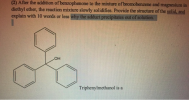 (2) After the addition of benzophenone to the mixture of bromobenzene and magnesium in diethyl ether, the reaction mixture slowly solidifies. Provide the structure of the solid, and explain with 10 words or less why the adduct precipitates out of solution. OH Triphenylmethanol is a
Outline separation scheme (in flow chart) beginning with bromobenzene, magnesium, diethyl ether, and bezophenone and en...
Outline separation scheme (in flow chart) beginning with bromobenzene, magnesium, diethyl ether, and bezophenone and ending with triphenyl methanol. (For grignard reaction to synthesize triphenylmethanol.
Grignard Reaction with a Ketone: Triphenylmethanol Introduction: The purpose of this lab is to prepare phenylmagnesium...
Grignard Reaction with a Ketone: Triphenylmethanol Introduction: The purpose of this lab is to prepare phenylmagnesium bromide, a Grignard reagent, and react it with benzophenone to give triphenylmethanol. Grignard reagents are very reactive and must be synthesized in an environment free of water or any other source of potential proton donor. Once made, the Grignard reagent will do a nucleophilic attack on the carbonyl carbon of the ketone, benzophenone. The result is an alkoxide that is then protonated to give...
 Draw an arrow pushing mechanism and find the theoretical yield
for the Grignard reaction below using the following amounts of
reagent with the given molecular weights:
565 microliters of 2-bromopropane (molecular weight =
123g/mol)
304 microliters of 4-methoxybenzaldehyde (molecular weight =
136.15g/mol)
molecular weight of product = 180.27g/mol
The
limiting reagent is _____________.
In this experiment, you will prepare the Grignard reagent isopropyl-magnesium bromide from 2-bromopropane. You will allow this Grignard reagent to react with 4-methoxy-benzaldehyde to form a secondary...
Draw an arrow pushing mechanism and find the theoretical yield
for the Grignard reaction below using the following amounts of
reagent with the given molecular weights:
565 microliters of 2-bromopropane (molecular weight =
123g/mol)
304 microliters of 4-methoxybenzaldehyde (molecular weight =
136.15g/mol)
molecular weight of product = 180.27g/mol
The
limiting reagent is _____________.
In this experiment, you will prepare the Grignard reagent isopropyl-magnesium bromide from 2-bromopropane. You will allow this Grignard reagent to react with 4-methoxy-benzaldehyde to form a secondary...
 Can you please provide a reaction mechanism for the following
reaction and explain what is happening at each step
A multistep synthesis demonstrating Grignard and Friedel Crafts reactions Part I and II Br MgBr Mg l21 diethyl ether bromobenzene MgBr 1, mix and heat OH 2, H30 benzophenone triphenylmethanol Part IV OCH3 H2so4 OCH3 anisole methoxytetraphenylmethane triphenylmethanol hane from a multistep reaction
Can you please provide a reaction mechanism for the following
reaction and explain what is happening at each step
A multistep synthesis demonstrating Grignard and Friedel Crafts reactions Part I and II Br MgBr Mg l21 diethyl ether bromobenzene MgBr 1, mix and heat OH 2, H30 benzophenone triphenylmethanol Part IV OCH3 H2so4 OCH3 anisole methoxytetraphenylmethane triphenylmethanol hane from a multistep reaction
 Grignard Reaction 1. Draw your complete reaction, including the formation of the Grignard reagent and the reaction with your carbonyl compound. Below each reagent, write its molecular weight and density (if a liquid). Also write how much of each material you will use in ml (if liquid), grams, and moles. Also include the molecular weight and melting point of your final product. 2. How many moles of Grignard reagent are you synthesizing? What mass of water could fully react with...
 3. Draw the product and give the complete arrow pushing reaction mechanism for the ether cleavage of compound A with HBr. HBr
 Draw the mechanism for this reaction. 1) Mg, Et20 2) bromobenzene triphenylmethanol benzophenone 3) H2O
 MW: Molecular Weight, mmol: Millimoles
mL MW mmol equivalents reagent bromobenzene magnesium benzophenone diethyl ether theoretical product triphenylmethanol 24.30 b.65 74.123 O. 70(p
MW: Molecular Weight, mmol: Millimoles
mL MW mmol equivalents reagent bromobenzene magnesium benzophenone diethyl ether theoretical product triphenylmethanol 24.30 b.65 74.123 O. 70(p
 Mechanism - Draw a logical arrow-pushing mechanism for the
following reaction:
Draw a logical arrow-pushing mechanism for the following reaction: Mechanism must account for the location of the labeled *carbon
Mechanism - Draw a logical arrow-pushing mechanism for the
following reaction:
Draw a logical arrow-pushing mechanism for the following reaction: Mechanism must account for the location of the labeled *carbon
 (2) After the addition of benzophenone to the mixture of bromobenzene and magnesium in diethyl ether, the reaction mixture slowly solidifies. Provide the structure of the solid, and explain with 10 words or less why the adduct precipitates out of solution. OH Triphenylmethanol is a
Most questions answered within 3 hours.
-
Where is the error in this code sequence?
String s1 = "Hello";
String s2 = "ello";...
asked 10 months ago -
Financial data for Joel de Paris, Inc., for last year
follow:
Joel de Paris, Inc.
Balance...
asked 10 months ago -
Consider this reaction:
Al2(SO4)3 (aq)+ BaCl3
(aq) Al2Cl6 (aq)- +
3BaSO4(s) . What is the...
asked 10 months ago -
Suppose that Savneet is considering increasing her
recent random sample from 20 car rentals to 40...
asked 10 months ago -
Trucks arrive at an unloading terminal at an average rate of 120
per hour.
Trucks arrive...
asked 10 months ago -
Why are methanol and ethanol completely soluble in water while
octanol is not very little soluble....
asked 10 months ago -
A facilities manager at a university reads in a research report
that the mean amount of...
asked 10 months ago -
When the CuSO4 is rehydrated by adding water to the anhydrous
compound, is this an endothermic...
asked 10 months ago -
A ray of sunlight is passing from diamond into crown glass; the
angle of incidence is...
asked 10 months ago -
A block of mass 0.249 kg is placed on top of a light, vertical
spring of...
asked 10 months ago -
how do the kidneys compensate in the presences of acidosis
a) trigger hyperventilate
b) reserve acid...
asked 10 months ago -
Question 501 pts
The rental rate of capital to the firm increases. Which of the
following...
asked 10 months ago