Explain each step of extracting cafeine, acetylsalicylic acid and paracetamol from an analgesic mixture in a...
Explain each step of extracting cafeine, acetylsalicylic acid and paracetamol from an analgesic mixture in a chemistry lab
Homework Answers

 Please Do provide your
valuable Ratings and be free to ask any query :)
Please Do provide your
valuable Ratings and be free to ask any query :)Add Answer to:
Explain each step of extracting cafeine, acetylsalicylic acid
and paracetamol from an analgesic mixture in a...
Show structure and cleavage of each step. In a lab, we seperated Excedrir (paracetamol, acetylsalicylic acid,...
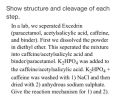 Show structure and cleavage of each step. In a lab, we seperated Excedrir (paracetamol, acetylsalicylic acid, caffeine and binder). First we dissolved the powder in diethyl ether. This seperated the mixture into caffeine/acetylsalicylc acid and binder/paracetamol. K2HPO4 was added to the caffeine/acetylsalicylic acid. K2HPO41+ caffeine was washed with 1) NaCl and then dried with 2) anhydrous sodium sulphate. Give the reaction mechanism for 1) and 2)
In a lab, we seperated Excedrin (paracetamol, acetylsalicylic acid, caffeine, and binder). First we dissolved the...
In a lab, we seperated Excedrin (paracetamol, acetylsalicylic acid, caffeine, and binder). First we dissolved the powder in diethyl ether. This seperated the mixture into caffeine/acetylsalicylc acid and binder/paracetamol. K2HPO4 was added to the caffeine/acetylsalicylic acid. Give the reaction mechanism for K2HPO4 + caffeine and K2HPO4 + acetylsalicylic acid. HCl was then added to K2HPO4 + acetylsalicylic acid. Give this reaction mechanism.
QUESTIONS 1. In the chromatogram of the analgesic tablet, the peaks for acetylsalicylic acid and caffeine...
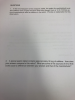 QUESTIONS 1. In the chromatogram of the analgesic tablet, the peaks for acetylsalicylic acid and caffeine have roughly the same area even though there is 10 to 15 times as much acetylsalicylic acid as caffeine in the tablet. Provide an explanation for this observation. 2. A typical aspirin tablet contains approximately 30 mg of caffeine. How does your answer compare to this value? What are some of the sources of error that could cause a difference between your answer and...
19. The over the counter analgesic aspirin is prepared from salicylic acid by a one step...
 19. The over the counter analgesic aspirin is prepared from salicylic acid by a one step process as shown below. Would pure aspirin give a positive FeCl3 test? Justify your answer. OH OH -OH Salicylic acid Acetic anhydride Aspirin (acetylsalicylic acid) acetic acid 20. Caproic acid (molecular formula C.H20) is only slightly soluble in water but is readily soluble (with stirring or shaking) in both 0.6 M NaHCO, and 2.5 M NaOH. Conversely, formic acid is readily soluble in both...
In the acid/base extraction lab, a carboxylic acid was separated from fluorene by extracting the carboxylic...
 In the acid/base extraction lab, a carboxylic acid was separated
from fluorene by extracting the carboxylic acid into the aqueous
layer using NaOH solution (a review of this experiment before lab
will be helpful). Phenols (aromatic alcohols) can also be separated
using this method. In a mixture of a phenol and a non-reacting
organic compound, the phenol may be selectively removed from an
organic solvent by extracting with a dilute NaOH solution. After
separating the organic and aqueous layers, the...
In the acid/base extraction lab, a carboxylic acid was separated
from fluorene by extracting the carboxylic acid into the aqueous
layer using NaOH solution (a review of this experiment before lab
will be helpful). Phenols (aromatic alcohols) can also be separated
using this method. In a mixture of a phenol and a non-reacting
organic compound, the phenol may be selectively removed from an
organic solvent by extracting with a dilute NaOH solution. After
separating the organic and aqueous layers, the...
Explain the differences in the stretches of the C=O in salicylic acid and in acetylsalicylic acid....
Explain the differences in the stretches of the C=O in salicylic acid and in acetylsalicylic acid. I found stretches of about 1650 for salicylic acid and 1680 for acetylsalicylic acid. Is it correct for the carboxylic acid C=O stretch to be greater for acetylsalicylic acid? If so, what would cause this? Conjugation/Resonance possibly?
II. Digestion of Acetylsalicylic acid(standard and tablet) with NaOH . Digestion of Acetylsalicylic Acid Standard to Pr...
II. Digestion of Acetylsalicylic acid(standard and tablet) with NaOH . Digestion of Acetylsalicylic Acid Standard to Prepare Stock Solution: Obtain ca. 0.1 g dried acetylsalicylic acid (MM = 180.16 g/mol), accurately weighed, and quantitatively transfer to a 125-ml Erlenmeyer flask. Add 5 ml 1.0 M NaOH and heat mixture to boiling on a hot plate. This will hydrolyze the acetylsalicylic acid to sodium salicylate. If necessary, rinse down the walls of the Erlenmeyer with DI water to ensure complete hydrolysis...
In this lab you are synthesizing acetylsalicylic acid (ASA) from salicylic acid using acetic anhydride, with...
In this lab you are synthesizing acetylsalicylic acid (ASA) from salicylic acid using acetic anhydride, with phosphoric acid as a catalyst. If the amount of salicylic acid at the start of the reaction was 1.05 g, what is the theoretical yield of ASA in g? Assume acetic anhydride is in excess. HINT: The structures of all the compounds you need are in the lab manual.
In this lab you are synthesizing acetylsalicylic acid (ASA) from salicylic acid using acetic anhydride, with...
In this lab you are synthesizing acetylsalicylic acid (ASA) from salicylic acid using acetic anhydride, with phosphoric acid as a catalyst. If the amount of salicylic acid at the start of the reaction was 1.05 g, what is the theoretical yield of ASA in g? Assume acetic anhydride is in excess.
14.0 g of acetylsalicylic acid were obtained from 23.9 g of salicylic acid. Determine the percentage...
14.0 g of acetylsalicylic acid were obtained from 23.9 g of salicylic acid. Determine the percentage yield of acetylsalicylic acid. What I did: 23.9 g ÷ 138 g = 0.1732 mol Known Information: Reactant mass: 23.9 g Product mass: 14.0 g Reactant moles: 0.1732 moles *Please help: How would I solve for the Theoretical maximum moles of acetylsalicylic acid? acetylsalicylic acid C₉H₈O₄ (12•9) + (1•8) + (4•16) = 180 g/mol Would it be 14.0 g ÷ 180 g? Please explain.
 Show structure and cleavage of each step. In a lab, we seperated Excedrir (paracetamol, acetylsalicylic acid, caffeine and binder). First we dissolved the powder in diethyl ether. This seperated the mixture into caffeine/acetylsalicylc acid and binder/paracetamol. K2HPO4 was added to the caffeine/acetylsalicylic acid. K2HPO41+ caffeine was washed with 1) NaCl and then dried with 2) anhydrous sodium sulphate. Give the reaction mechanism for 1) and 2)
 QUESTIONS 1. In the chromatogram of the analgesic tablet, the peaks for acetylsalicylic acid and caffeine have roughly the same area even though there is 10 to 15 times as much acetylsalicylic acid as caffeine in the tablet. Provide an explanation for this observation. 2. A typical aspirin tablet contains approximately 30 mg of caffeine. How does your answer compare to this value? What are some of the sources of error that could cause a difference between your answer and...
 19. The over the counter analgesic aspirin is prepared from salicylic acid by a one step process as shown below. Would pure aspirin give a positive FeCl3 test? Justify your answer. OH OH -OH Salicylic acid Acetic anhydride Aspirin (acetylsalicylic acid) acetic acid 20. Caproic acid (molecular formula C.H20) is only slightly soluble in water but is readily soluble (with stirring or shaking) in both 0.6 M NaHCO, and 2.5 M NaOH. Conversely, formic acid is readily soluble in both...
 In the acid/base extraction lab, a carboxylic acid was separated
from fluorene by extracting the carboxylic acid into the aqueous
layer using NaOH solution (a review of this experiment before lab
will be helpful). Phenols (aromatic alcohols) can also be separated
using this method. In a mixture of a phenol and a non-reacting
organic compound, the phenol may be selectively removed from an
organic solvent by extracting with a dilute NaOH solution. After
separating the organic and aqueous layers, the...
In the acid/base extraction lab, a carboxylic acid was separated
from fluorene by extracting the carboxylic acid into the aqueous
layer using NaOH solution (a review of this experiment before lab
will be helpful). Phenols (aromatic alcohols) can also be separated
using this method. In a mixture of a phenol and a non-reacting
organic compound, the phenol may be selectively removed from an
organic solvent by extracting with a dilute NaOH solution. After
separating the organic and aqueous layers, the...
Most questions answered within 3 hours.
-
Where is the error in this code sequence?
String s1 = "Hello";
String s2 = "ello";...
asked 10 months ago -
Financial data for Joel de Paris, Inc., for last year
follow:
Joel de Paris, Inc.
Balance...
asked 10 months ago -
Consider this reaction:
Al2(SO4)3 (aq)+ BaCl3
(aq) Al2Cl6 (aq)- +
3BaSO4(s) . What is the...
asked 10 months ago -
Suppose that Savneet is considering increasing her
recent random sample from 20 car rentals to 40...
asked 10 months ago -
Trucks arrive at an unloading terminal at an average rate of 120
per hour.
Trucks arrive...
asked 10 months ago -
Why are methanol and ethanol completely soluble in water while
octanol is not very little soluble....
asked 10 months ago -
A facilities manager at a university reads in a research report
that the mean amount of...
asked 10 months ago -
When the CuSO4 is rehydrated by adding water to the anhydrous
compound, is this an endothermic...
asked 10 months ago -
A ray of sunlight is passing from diamond into crown glass; the
angle of incidence is...
asked 10 months ago -
A block of mass 0.249 kg is placed on top of a light, vertical
spring of...
asked 10 months ago -
how do the kidneys compensate in the presences of acidosis
a) trigger hyperventilate
b) reserve acid...
asked 10 months ago -
Question 501 pts
The rental rate of capital to the firm increases. Which of the
following...
asked 10 months ago