Draw the Line Angle drawing for the following compounds. Your drawings must designate the charged atom...
Draw the Line Angle drawing for the following compounds. Your drawings must designate the charged atom if applicable.
A. Cis-1-sec-butyl-3-propylcyclopropane
B. [CH2CHCHCH(CH3)CN]-
C. [CH3CHCONHCH3]+
Thank you in advance!
Homework Answers

Add Answer to:
Draw the Line Angle drawing for the following compounds. Your
drawings must designate the charged atom...
Provide the structures structures (line-angle drawings) when drawing the structures! and molar masses for the following...
 Provide the structures structures (line-angle drawings) when drawing the structures! and molar masses for the following compounds. You must use line Compound Line Structure Molar MassIMF Present (g/ mol) Methanol Ethanol Propanol Butanol Hexanol Hexane 2,2,4- trimethylpentane isooctane 2-propanone acetone Page 7 of 7
can someone draw so i can check my answers (1 pt) For the following compound, draw...
 can someone draw so i can check my answers
(1 pt) For the following compound, draw the structure that has the (S) configuration around each chiral atom. You may make the drawing line-angle, 3-D, or a mixture of both, but your structure must show all bonds and angles correctly. You need only show bonds to H where they are needed to show a configuration он L / N-C-C-CH2SH CH3 CO2H (1 pt) For the following two compounds, draw the internal...
can someone draw so i can check my answers
(1 pt) For the following compound, draw the structure that has the (S) configuration around each chiral atom. You may make the drawing line-angle, 3-D, or a mixture of both, but your structure must show all bonds and angles correctly. You need only show bonds to H where they are needed to show a configuration он L / N-C-C-CH2SH CH3 CO2H (1 pt) For the following two compounds, draw the internal...
Line angle drawings are organic chemists’ shorthand for depicting chains of atoms. The ends of the...
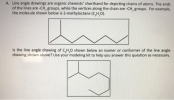 Line angle drawings are organic chemists’ shorthand for
depicting chains of atoms. The ends of the lines are -CH3 groups,
while the vertices along the chain are -CH2 groups. For example,
the molecule shown below is 2-methyloctane (C9H2O). Is the line
angle drawing of C9H2O shown below an isomer or conformer of the
line angle drawing shown above? Use your modeling kit to help you
answer this question as necessary.
Line angle drawings are organic chemists' shorthand for depicting chains...
Line angle drawings are organic chemists’ shorthand for
depicting chains of atoms. The ends of the lines are -CH3 groups,
while the vertices along the chain are -CH2 groups. For example,
the molecule shown below is 2-methyloctane (C9H2O). Is the line
angle drawing of C9H2O shown below an isomer or conformer of the
line angle drawing shown above? Use your modeling kit to help you
answer this question as necessary.
Line angle drawings are organic chemists' shorthand for depicting chains...
Draw the line angle drawing and the 3-dimensional (using wedges and dashes) of the following: Butane...
Draw the line angle drawing and the 3-dimensional (using wedges and dashes) of the following: Butane (C4H10) 1-Butene (C4H8) cis-2-butene (C4H8)
Consider each of the compounds. 1) Draw a large, stable line-angle structure with the correct bond...
Consider each of the compounds. 1) Draw a large, stable line-angle structure with the correct bond angles. 2) Draw all appropriate resonance structures and indicate the major contributor. 3) Indicate all lone pair electrons on the atom. 4) Indicate the hybridization under each atom other than H a) CH2=CHCH(.)CH3 b) CH2=CHCH2CH(+)OH c) CH3CO(-)CH2
Consider each of the compounds. 1) Draw a large, stable line-angle structure with the correct bond...
Consider each of the compounds. 1) Draw a large, stable line-angle structure with the correct bond angles. Do not show the hydrogen atoms. 2) Indicate any formal charge on top of the atom. 3) Indicate all lone pair electrons on the atom. 4) Indicate the hybridization under each atom other than H and Na. a) CH2=CHCH(.)CH3 b) CH2=CHCH2CH(+)OH c) CH3CO(-)CH2
1) Draw line-angle structures for these compounds. a. cis-2-pentene b. 1-butanol c. butanone 2) Identify the...
1) Draw line-angle structures for these compounds. a. cis-2-pentene b. 1-butanol c. butanone 2) Identify the strongest IMF for each of the above compounds. a. ____________________ b. __________________ c. ________________________ 3) Draw at least 2 molecules of these compounds showing the IMFs that form between them. a. Cis-2-pentene (draw 2 or more molecules) b. 1-butanol (draw 2 or more molecules) 4) Which of the three compounds in question 1 is the most soluble in water? Give a brief explanation and...
Draw the Bond-Line structures for the following compounds. a) 1-Bromo-6-(2,2,3-trimethylbutyl) undecane b) (CH3)2CHCHC(CH3)2 c) 2,5-dicyclobutyl-4-ethylheptane d)...
Draw the Bond-Line structures for the following compounds. a) 1-Bromo-6-(2,2,3-trimethylbutyl) undecane b) (CH3)2CHCHC(CH3)2 c) 2,5-dicyclobutyl-4-ethylheptane d) 1-tert-butyl-3-fluorocyclohexane
1) a. Draw a line drawing of 1,2-dibromoethane, and draw it with 3-D geometry, keeping the...
1) a. Draw a line drawing of 1,2-dibromoethane, and draw it with 3-D geometry, keeping the carbon and bromine atoms in the plane of the paper. b. Draw a line drawing of cis-2,3-dibromo-2-butene. c. Draw a line drawing of trans-2,3-dibromo-2-butene.
Draw the condensed and line-angle structural formulas for each of the following compounds: a. butyraldehyde b....
 Draw the condensed and line-angle structural formulas for each of the following compounds: a. butyraldehyde b. 3, 4-dichloropentanal c. 4-bromobutanone d. acetone
 Provide the structures structures (line-angle drawings) when drawing the structures! and molar masses for the following compounds. You must use line Compound Line Structure Molar MassIMF Present (g/ mol) Methanol Ethanol Propanol Butanol Hexanol Hexane 2,2,4- trimethylpentane isooctane 2-propanone acetone Page 7 of 7
 can someone draw so i can check my answers
(1 pt) For the following compound, draw the structure that has the (S) configuration around each chiral atom. You may make the drawing line-angle, 3-D, or a mixture of both, but your structure must show all bonds and angles correctly. You need only show bonds to H where they are needed to show a configuration он L / N-C-C-CH2SH CH3 CO2H (1 pt) For the following two compounds, draw the internal...
can someone draw so i can check my answers
(1 pt) For the following compound, draw the structure that has the (S) configuration around each chiral atom. You may make the drawing line-angle, 3-D, or a mixture of both, but your structure must show all bonds and angles correctly. You need only show bonds to H where they are needed to show a configuration он L / N-C-C-CH2SH CH3 CO2H (1 pt) For the following two compounds, draw the internal...
 Line angle drawings are organic chemists’ shorthand for
depicting chains of atoms. The ends of the lines are -CH3 groups,
while the vertices along the chain are -CH2 groups. For example,
the molecule shown below is 2-methyloctane (C9H2O). Is the line
angle drawing of C9H2O shown below an isomer or conformer of the
line angle drawing shown above? Use your modeling kit to help you
answer this question as necessary.
Line angle drawings are organic chemists' shorthand for depicting chains...
Line angle drawings are organic chemists’ shorthand for
depicting chains of atoms. The ends of the lines are -CH3 groups,
while the vertices along the chain are -CH2 groups. For example,
the molecule shown below is 2-methyloctane (C9H2O). Is the line
angle drawing of C9H2O shown below an isomer or conformer of the
line angle drawing shown above? Use your modeling kit to help you
answer this question as necessary.
Line angle drawings are organic chemists' shorthand for depicting chains...
 Draw the condensed and line-angle structural formulas for each of the following compounds: a. butyraldehyde b. 3, 4-dichloropentanal c. 4-bromobutanone d. acetone
Most questions answered within 3 hours.
-
Where is the error in this code sequence?
String s1 = "Hello";
String s2 = "ello";...
asked 10 months ago -
Financial data for Joel de Paris, Inc., for last year
follow:
Joel de Paris, Inc.
Balance...
asked 10 months ago -
Consider this reaction:
Al2(SO4)3 (aq)+ BaCl3
(aq) Al2Cl6 (aq)- +
3BaSO4(s) . What is the...
asked 10 months ago -
Suppose that Savneet is considering increasing her
recent random sample from 20 car rentals to 40...
asked 10 months ago -
Trucks arrive at an unloading terminal at an average rate of 120
per hour.
Trucks arrive...
asked 10 months ago -
Why are methanol and ethanol completely soluble in water while
octanol is not very little soluble....
asked 10 months ago -
A facilities manager at a university reads in a research report
that the mean amount of...
asked 10 months ago -
When the CuSO4 is rehydrated by adding water to the anhydrous
compound, is this an endothermic...
asked 10 months ago -
A ray of sunlight is passing from diamond into crown glass; the
angle of incidence is...
asked 10 months ago -
A block of mass 0.249 kg is placed on top of a light, vertical
spring of...
asked 10 months ago -
how do the kidneys compensate in the presences of acidosis
a) trigger hyperventilate
b) reserve acid...
asked 10 months ago -
Question 501 pts
The rental rate of capital to the firm increases. Which of the
following...
asked 10 months ago